Broedbaek Kasper, Køster-Rasmussen Rasmus, Siersma Volkert, Persson Frederik, Poulsen Henrik E, de Fine Olivarius Niels
Department of Clinical Biochemistry, Rigshospitalet, Copenhagen, Denmark; Denmark Laboratory of Clinical Pharmacology Q7642, Rigshospitalet, Copenhagen, Denmark; Department of Clinical Pharmacology, Bispebjerg Hospital, Copenhagen, Denmark.
The Research Unit for General Practice and Section of General Practice, Department of Public Health, University of Copenhagen, Copenhagen, Denmark.
Redox Biol. 2017 Oct;13:363-369. doi: 10.1016/j.redox.2017.06.005. Epub 2017 Jun 15.
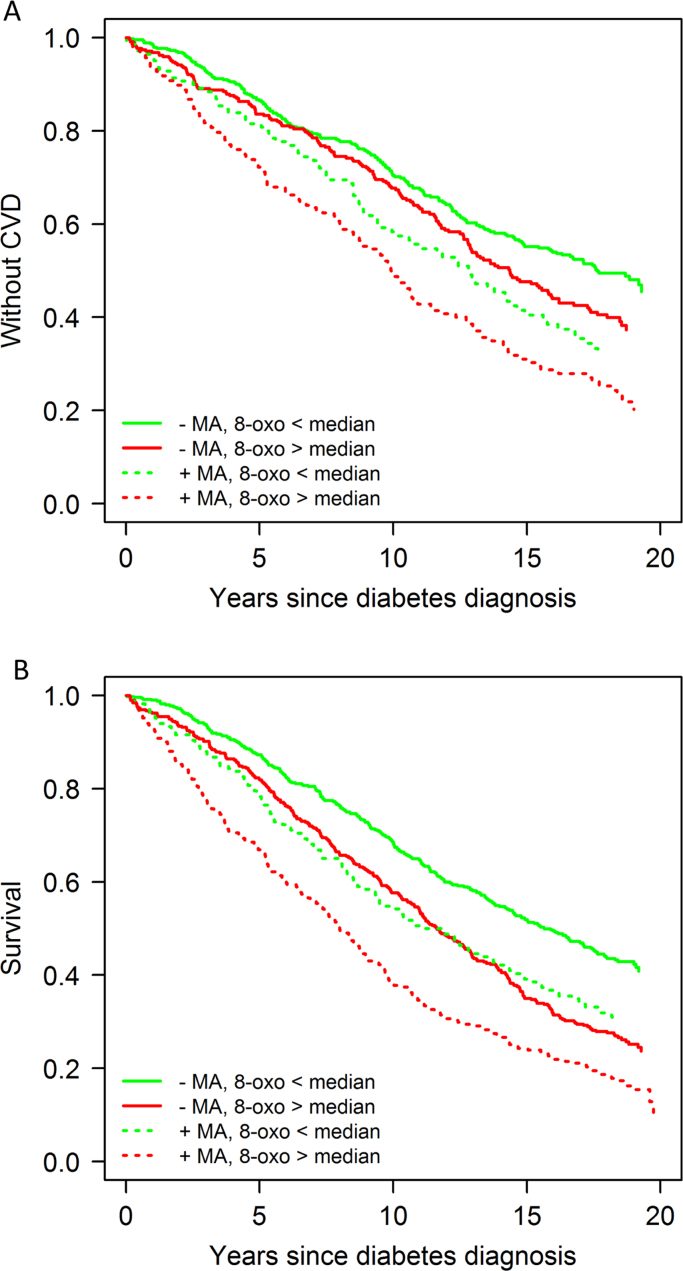
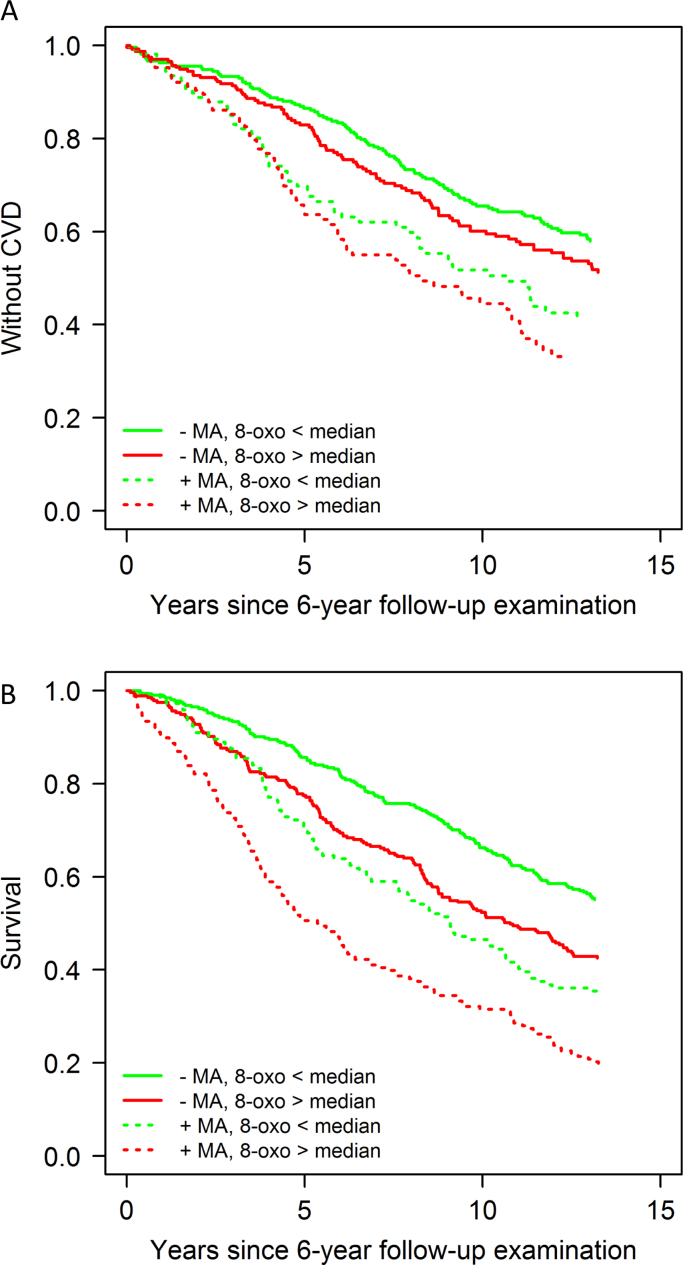
Urinary albumin is an important biomarker used to identify high risk patients with diabetes, but there is a need for new biomarkers that alone or in combination with urinary albumin could give an even better prediction of clinical patient outcomes. One promising biomarker is 8-oxo-7,8-dihydroguanosine (8-oxoGuo) that represents intracellular oxidative stress. We investigated the ability of microalbuminuria (MA) and urinary 8-oxoGuo, alone and in combination, to predict mortality and cardiovascular disease (CVD) in patients with type 2 diabetes. We used data from 1381 newly diagnosed diabetes patients, and urinary albumin and 8-oxoGuo were assessed in morning urine collected at the time of diabetes diagnosis and at a follow-up visit 6 years later. Associations between the urinary markers and mortality and CVD were assessed in Cox proportional hazards regression models. Test performance was assessed using sensitivity, specificity, positive predictive value and negative predictive value for 10-year mortality and 10-year incidence of CVD. Both 8-oxoGuo and urinary albumin were statistically significantly associated with all-cause mortality at diagnosis as well as at 6-year follow-up. At diagnosis only urinary albumin was associated with CVD. In contrast, only 8-oxoGuo was associated with CVD at 6-year follow-up. When investigating test performance, we found that by combining information from MA and 8-oxoGuo the ability to correctly identify patients at risk could be improved. The findings suggest that measurement of urinary 8-oxoGuo provides additional information about risk to that obtained from urinary albumin, and that the combined use of 8-oxoGuo and urinary albumin could be useful for a better identification of patients at risk of CVD and death.
尿白蛋白是用于识别糖尿病高危患者的重要生物标志物,但仍需要新的生物标志物,其单独使用或与尿白蛋白联合使用时,能够对临床患者的预后做出更好的预测。一种有前景的生物标志物是8-氧代-7,8-二氢鸟苷(8-氧代鸟嘌呤),它代表细胞内氧化应激。我们研究了微量白蛋白尿(MA)和尿8-氧代鸟嘌呤单独及联合使用时预测2型糖尿病患者死亡率和心血管疾病(CVD)的能力。我们使用了1381例新诊断糖尿病患者的数据,在糖尿病诊断时及6年后的随访时收集晨尿,评估尿白蛋白和8-氧代鸟嘌呤。在Cox比例风险回归模型中评估尿标志物与死亡率和CVD之间的关联。使用10年死亡率和10年CVD发病率的敏感性、特异性、阳性预测值和阴性预测值评估检测性能。8-氧代鸟嘌呤和尿白蛋白在诊断时以及6年随访时均与全因死亡率存在统计学显著关联。仅在诊断时尿白蛋白与CVD相关。相比之下,仅在6年随访时8-氧代鸟嘌呤与CVD相关。在研究检测性能时,我们发现通过结合MA和8-氧代鸟嘌呤的信息,可以提高正确识别高危患者的能力。研究结果表明,尿8-氧代鸟嘌呤的测量提供了从尿白蛋白获得的风险之外的额外信息,并且8-氧代鸟嘌呤和尿白蛋白的联合使用可能有助于更好地识别有CVD和死亡风险的患者。