Department of Neuroscience, Psychology, Drug Research and Child Health-NEUROFARBA-Section of Pharmacology and Toxicology, University of Florence, Viale Gaetano Pieraccini 6, Florence, Italy.
Oxid Med Cell Longev. 2019 May 12;2019:5953685. doi: 10.1155/2019/5953685. eCollection 2019.
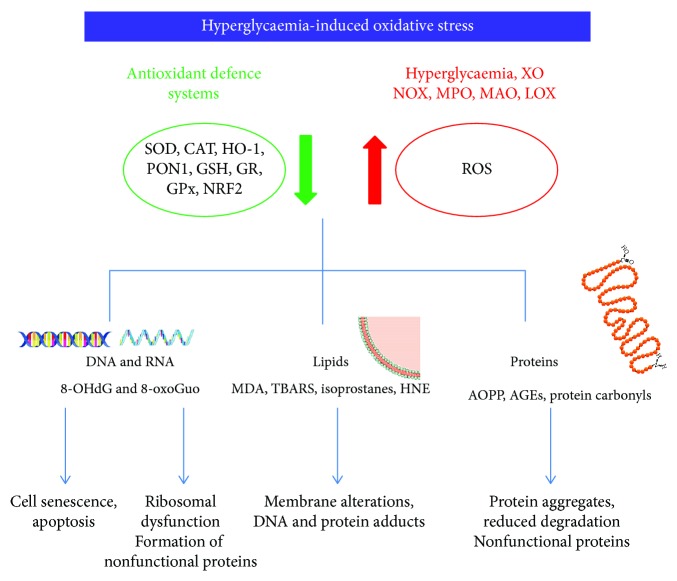
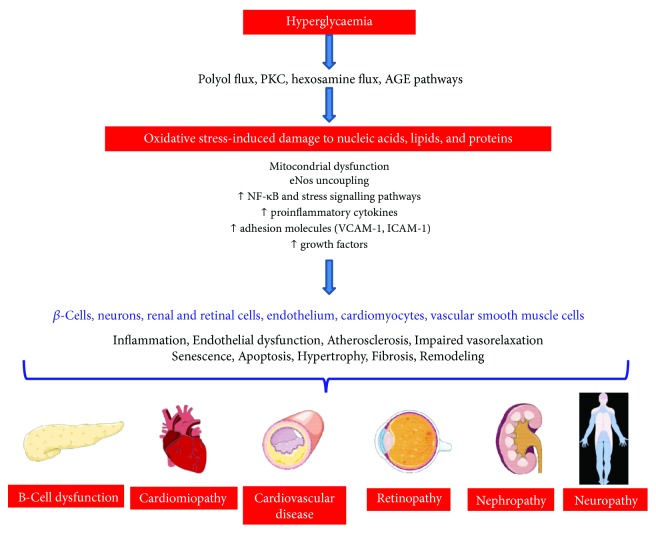
Type 2 diabetes (T2DM) and its complications constitute a major worldwide public health problem, with high rates of morbidity and mortality. Biomarkers for predicting the occurrence and development of the disease may therefore offer benefits in terms of early diagnosis and intervention. This review provides an overview of human studies on circulating biomarkers of oxidative stress and antioxidant defence systems and discusses their usefulness from a clinical perspective. Most case-control studies documented an increase in biomarkers of oxidative lipid, protein, and nucleic acid damage in patients with prediabetes and in those with a diagnosis of T2DM compared to controls, and similar findings were reported in T2DM with micro- and macrovascular complications compared to those without. The inconsistence of the results regarding antioxidant defence systems renders difficulty to draw a general conclusion. The clinical relevance of biomarkers of oxidative lipid and protein damage for T2DM progression is uncertain, but prospective studies suggest that markers of oxidative nucleic acid damage such as 8-hydroxy-2'-deoxyguanosine and 8-hydroxyguanosine are promising for predicting macrovascular complications of T2DM. Emerging evidence also points out the relationship between serum PON1 and serum HO1 in T2DM and its complications. Overall, enhanced oxidative damage represents an underlying mechanism of glucose toxicity in T2DM and its related micro- and macrovascular complications suggesting that it may be considered as a potential additional target for pharmacotherapy. Therefore, further studies are needed to understand whether targeting oxidative stress may yield clinical benefits. In this view, the measurement of oxidative stress biomarkers in clinical trials deserves to be considered as an additional tool to currently used parameters to facilitate a more individualized treatment of T2DM in terms of drug choice and patient selection.
2 型糖尿病(T2DM)及其并发症是全球主要的公共卫生问题,发病率和死亡率都很高。因此,预测疾病发生和发展的生物标志物可能在早期诊断和干预方面具有优势。本综述概述了关于氧化应激和抗氧化防御系统循环生物标志物的人体研究,并从临床角度讨论了它们的用途。大多数病例对照研究记录了与对照组相比,前驱糖尿病和 T2DM 患者的脂质、蛋白质和核酸氧化损伤的生物标志物增加,并且在伴有微血管和大血管并发症的 T2DM 中也有类似的发现。关于抗氧化防御系统的结果不一致,难以得出一般结论。氧化脂质和蛋白质损伤生物标志物对 T2DM 进展的临床相关性尚不确定,但前瞻性研究表明,氧化核酸损伤标志物如 8-羟基-2'-脱氧鸟苷和 8-羟基鸟嘌呤可能对预测 T2DM 的大血管并发症有帮助。新出现的证据还指出了 T2DM 及其并发症中血清 PON1 和血清 HO1 之间的关系。总的来说,增强的氧化损伤代表了 T2DM 及其相关的微血管和大血管并发症中葡萄糖毒性的潜在机制,这表明它可能被视为潜在的额外药物治疗靶点。因此,需要进一步研究以了解针对氧化应激是否可能带来临床益处。在这方面,在临床试验中测量氧化应激生物标志物值得被视为当前使用参数的附加工具,以促进根据药物选择和患者选择对 T2DM 进行更个体化的治疗。