Rydzik Anna M, Warminski Marcin, Sikorski Pawel J, Baranowski Marek R, Walczak Sylwia, Kowalska Joanna, Zuberek Joanna, Lukaszewicz Maciej, Nowak Elzbieta, W Claridge Timothy D, Darzynkiewicz Edward, Nowotny Marcin, Jemielity Jacek
Division of Biophysics, Institute of Experimental Physics, Faculty of Physics, University of Warsaw, Zwirki i Wigury 93, 02-089 Warsaw, Poland.
Chemistry Research Laboratory, University of Oxford, 12 Mansfield Road, Oxford OX1 3TA, UK.
Nucleic Acids Res. 2017 Sep 6;45(15):8661-8675. doi: 10.1093/nar/gkx569.
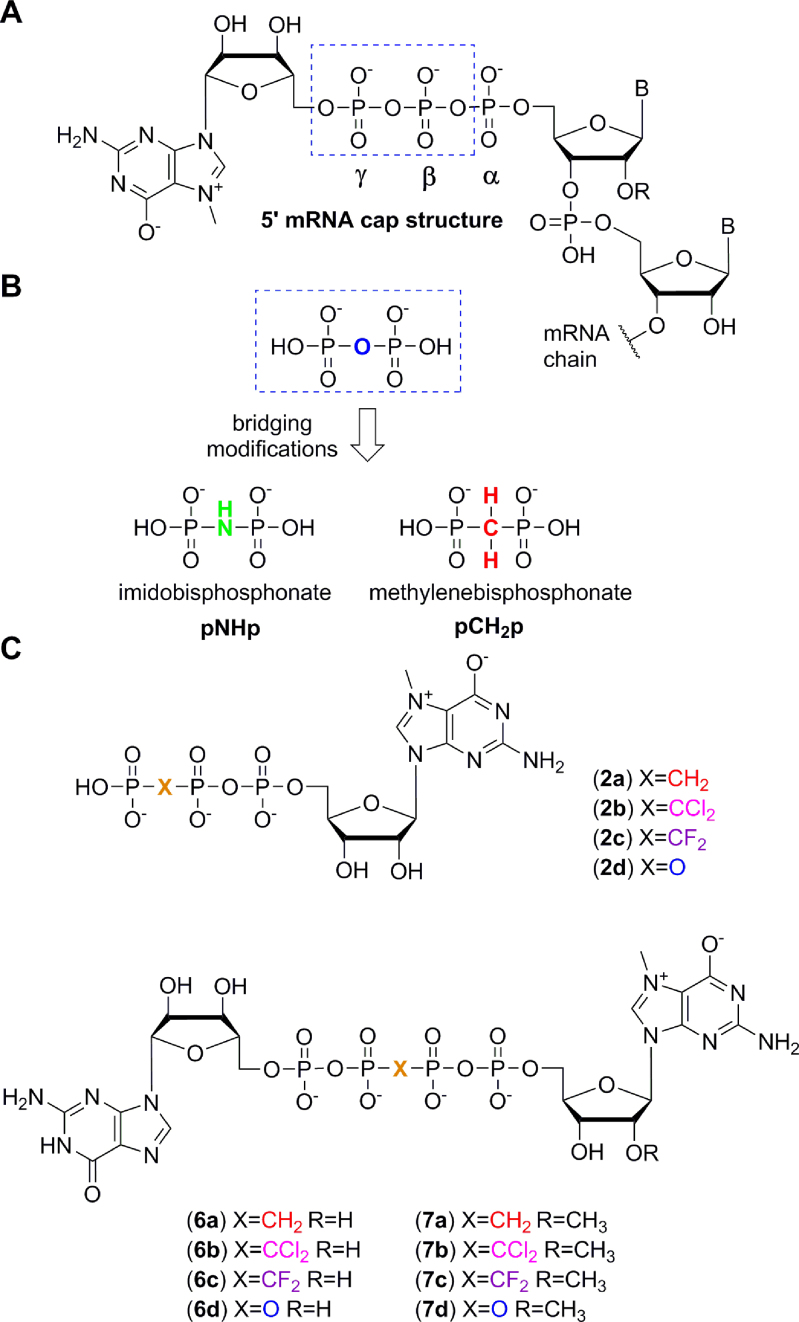
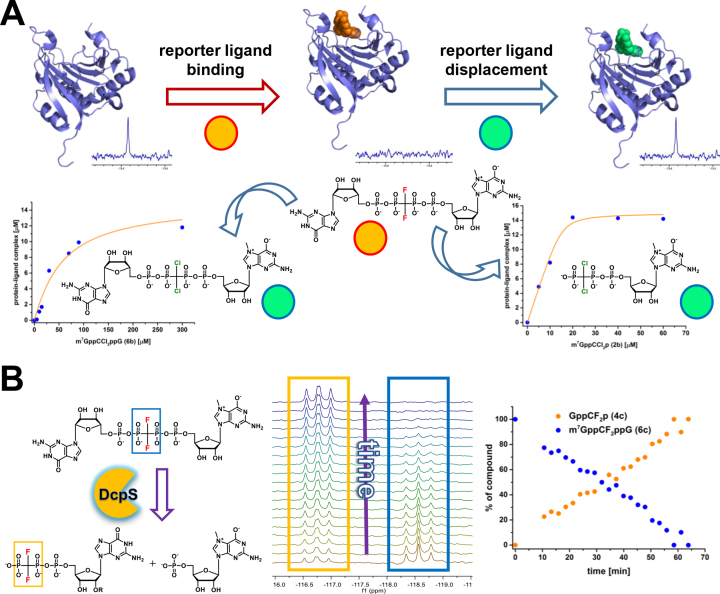
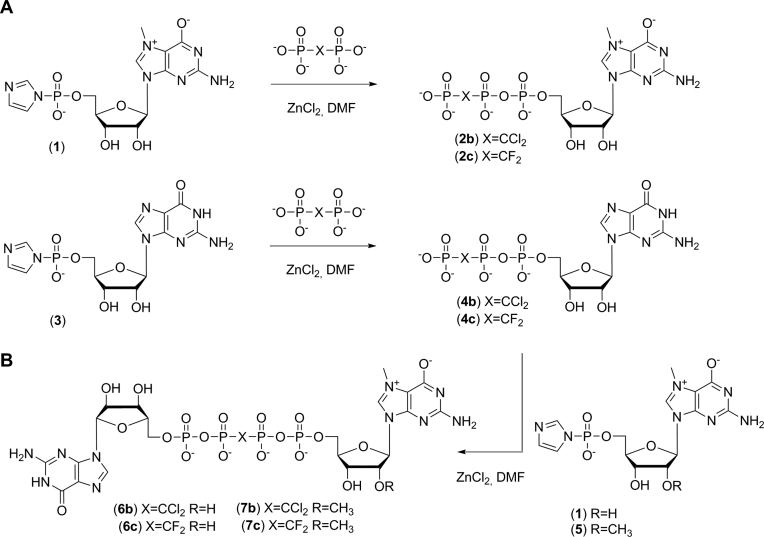
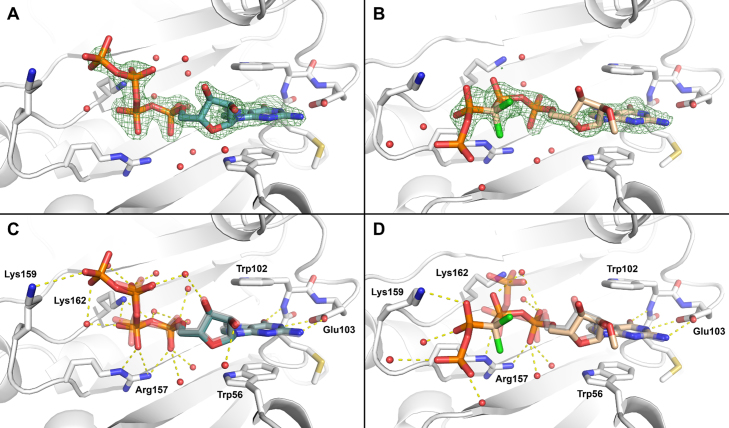
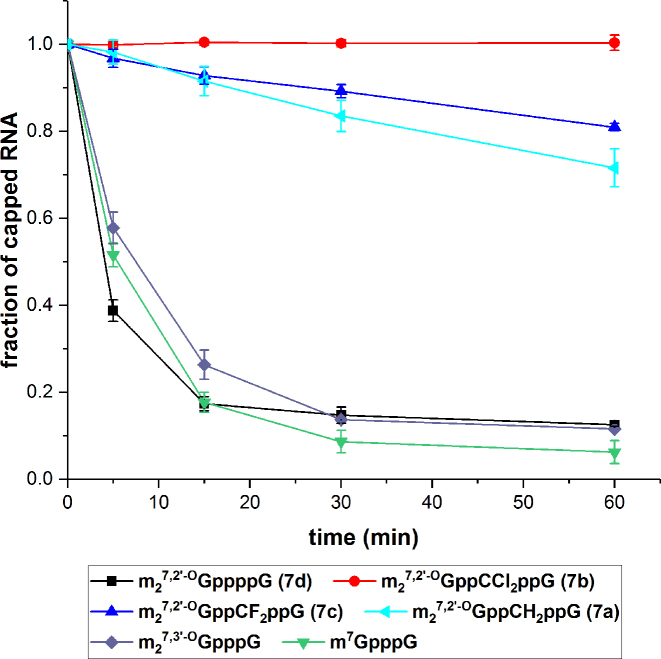
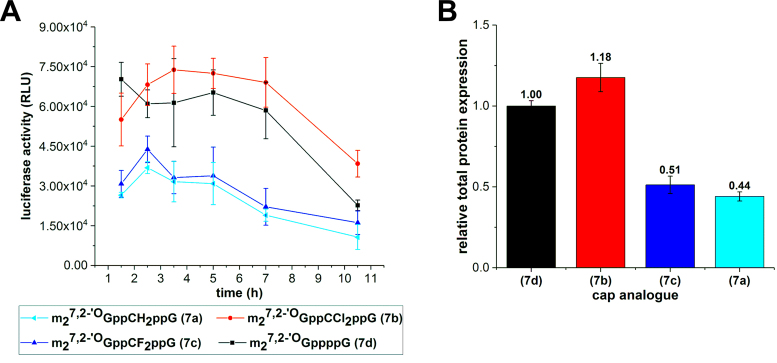
Analogues of the mRNA 5'-cap are useful tools for studying mRNA translation and degradation, with emerging potential applications in novel therapeutic interventions including gene therapy. We report the synthesis of novel mono- and dinucleotide cap analogues containing dihalogenmethylenebisphosphonate moiety (i.e. one of the bridging O atom substituted with CCl2 or CF2) and their properties in the context of cellular translational and decapping machineries, compared to phosphate-unmodified and previously reported CH2-substituted caps. The analogues were bound tightly to eukaryotic translation initiation factor 4E (eIF4E), with CCl2-substituted analogues having the highest affinity. When incorporated into mRNA, the CCl2-substituted dinucleotide most efficiently promoted cap-dependent translation. Moreover, the CCl2-analogues were potent inhibitors of translation in rabbit reticulocyte lysate. The crystal structure of eIF4E in complex with the CCl2-analogue revealed a significantly different ligand conformation compared to that of the unmodified cap analogue, which likely contributes to the improved binding. Both CCl2- and CF2- analogues showed lower susceptibility to hydrolysis by the decapping scavenger enzyme (DcpS) and, when incorporated into RNA, conferred stability against major cellular decapping enzyme (Dcp2) to transcripts. Furthermore, the use of difluoromethylene cap analogues was exemplified by the development of 19F NMR assays for DcpS activity and eIF4E binding.
mRNA 5'-帽类似物是研究 mRNA 翻译和降解的有用工具,在包括基因治疗在内的新型治疗干预中具有潜在的应用前景。我们报道了含有二卤代亚甲基双膦酸酯部分(即一个桥连 O 原子被 CCl2 或 CF2 取代)的新型单核苷酸和二核苷酸帽类似物的合成,以及它们在细胞翻译和去帽机制方面的性质,并与未修饰磷酸酯和先前报道的 CH2 取代帽进行了比较。这些类似物与真核翻译起始因子 4E(eIF4E)紧密结合,其中 CCl2 取代的类似物具有最高的亲和力。当掺入 mRNA 中时,CCl2 取代的二核苷酸最有效地促进了帽依赖性翻译。此外,CCl2 类似物是兔网织红细胞裂解物中翻译的有效抑制剂。eIF4E 与 CCl2 类似物复合物的晶体结构显示,与未修饰的帽类似物相比,配体构象有显著差异,这可能有助于改善结合。CCl2 和 CF2 类似物对去帽清除酶(DcpS)水解的敏感性较低,并且当掺入 RNA 中时,赋予转录本对主要细胞去帽酶(Dcp2)的稳定性。此外,通过开发用于 DcpS 活性和 eIF4E 结合的 19F NMR 测定法,举例说明了二氟亚甲基帽类似物的用途。