Pedley Adam J, Kitterick Pádraig T
Medical Research Council, Institute of Hearing Research, The University of Nottingham, University Park, NG7 2RD, UK.
NIHR Nottingham Biomedical Research Centre, Ropewalk House, 113 The Ropewalk, Nottingham, NG1 5DU, UK; Otology and Hearing Group, Division of Clinical Neuroscience, School of Medicine, University of Nottingham, Nottingham, NG7 2UH, UK.
Hear Res. 2017 Sep;353:104-111. doi: 10.1016/j.heares.2017.06.007. Epub 2017 Jun 21.
Contra-lateral routing of signals (CROS) devices re-route sound between the deaf and hearing ears of unilaterally-deaf individuals. This rerouting would be expected to disrupt access to monaural level cues that can support monaural localisation in the horizontal plane. However, such a detrimental effect has not been confirmed by clinical studies of CROS use. The present study aimed to exercise strict experimental control over the availability of monaural cues to localisation in the horizontal plane and the fitting of the CROS device to assess whether signal routing can impair the ability to locate sources of sound and, if so, whether CROS selectively disrupts monaural level or spectral cues to horizontal location, or both.
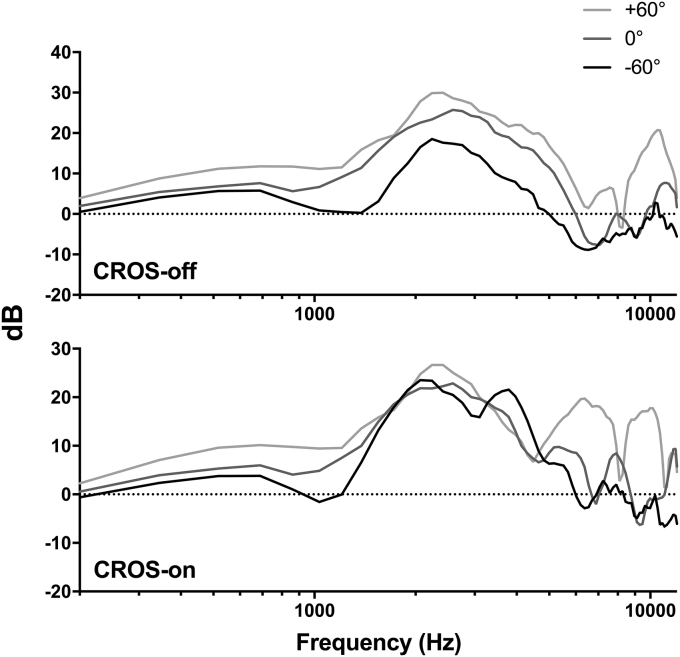
Unilateral deafness and CROS device use were simulated in twelve normal hearing participants. Monaural recordings of broadband white noise presented from three spatial locations (-60°, 0°, and +60°) were made in the ear canal of a model listener using a probe microphone with and without a CROS device. The recordings were presented to participants via an insert earphone placed in their right ear. The recordings were processed to disrupt either monaural level or spectral cues to horizontal sound location by roving presentation level or the energy across adjacent frequency bands, respectively. Localisation ability was assessed using a three-alternative forced-choice spatial discrimination task.
Participants localised above chance levels in all conditions. Spatial discrimination accuracy was poorer when participants only had access to monaural spectral cues compared to when monaural level cues were available. CROS use impaired localisation significantly regardless of whether level or spectral cues were available. For both cues, signal re-routing had a detrimental effect on the ability to localise sounds originating from the side of the deaf ear (-60°). CROS use also impaired the ability to use level cues to localise sounds originating from straight ahead (0°).
The re-routing of sounds can restrict access to the monaural cues that provide a basis for determining sound location in the horizontal plane. Perhaps encouragingly, the results suggest that both monaural level and spectral cues may not be disrupted entirely by signal re-routing and that it may still be possible to reliably identify sounds originating on the hearing side.
对侧信号路由(CROS)装置可在单侧聋患者的聋耳与听力正常的耳朵之间重新路由声音。预计这种重新路由会干扰对单耳水平线索的获取,而这些线索可支持在水平面内的单耳定位。然而,CROS使用的临床研究尚未证实这种有害影响。本研究旨在严格控制对水平面内定位的单耳线索的可用性以及CROS装置的适配情况,以评估信号路由是否会损害声音源定位能力,如果是,CROS是否会选择性地干扰单耳水平或频谱线索对水平位置的判断,或者两者都会干扰。
在12名听力正常的参与者中模拟单侧聋和CROS装置的使用。使用探头麦克风,在有和没有CROS装置的情况下,在模型听众的耳道中对来自三个空间位置(-60°、0°和+60°)的宽带白噪声进行单耳录音。录音通过插入式耳机呈现给参与者,插入式耳机置于他们的右耳。通过分别移动呈现水平或相邻频带的能量,对录音进行处理,以干扰单耳水平或频谱线索对水平声音位置的判断。使用三选一强制选择空间辨别任务评估定位能力。
在所有条件下,参与者的定位准确率均高于随机水平。与可获得单耳水平线索时相比,当参与者只能获得单耳频谱线索时,空间辨别准确率较低。无论是否有水平或频谱线索,使用CROS都会显著损害定位能力。对于这两种线索,信号重新路由对源自聋耳一侧(-60°)的声音定位能力都有不利影响。使用CROS也会损害利用水平线索对正前方(0°)传来的声音进行定位的能力。
声音的重新路由会限制对单耳线索的获取,而这些线索为确定水平面内的声音位置提供了基础。或许令人鼓舞的是,结果表明单耳水平和频谱线索可能不会因信号重新路由而完全被破坏,并且仍然有可能可靠地识别源自听力正常一侧的声音。