Clinical Enteric Neuroscience Translational and Epidemiological Research, Mayo Clinic, Rochester, Minnesota.
Department of Laboratory Medicine and Pathology, Mayo Clinic, Rochester, Minnesota.
Clin Gastroenterol Hepatol. 2018 Apr;16(4):522-527. doi: 10.1016/j.cgh.2017.06.039. Epub 2017 Jun 27.
BACKGROUND & AIMS: Short-term administration of delayed-release chenodeoxycholic acid to patients with irritable bowel syndrome with constipation (IBS-C) accelerates colonic transit and reduces symptoms. A preliminary study has shown that patients with IBS-C have reduced levels of bile acids (BAs) in feces and reduced synthesis of BA. We compared the levels of primary and secondary BAs in fecal samples collected over a 48-hour period from patients with IBS-C on a diet that contained 100 g fat per day, and compared them with levels in samples from healthy volunteers (controls). We also examined the relationship between overall colonic transit and biomarkers of BAs in patients with IBS-C.
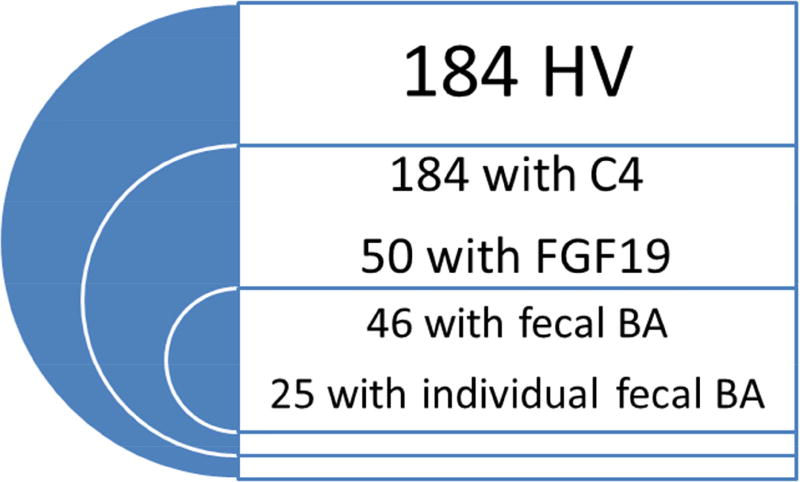
We performed a retrospective study of 45 patients with IBS-C and 184 controls. For controls, we estimated the 10th percentile of fasting serum levels of 7α-hydroxy-4-cholesten-3-one (C4, n = 184) and 48-hour fecal BAs (n = 46), and the 90th percentile of the fasting serum level of fibroblast growth factor 19 (FGF19, n = 50). Colonic transit was measured in patients using a validated scintigraphic method. Data from patients with IBS-C were analyzed using Spearman correlations to determine the relationships among levels of C4, FGF19, fecal BAs, and colonic transit.
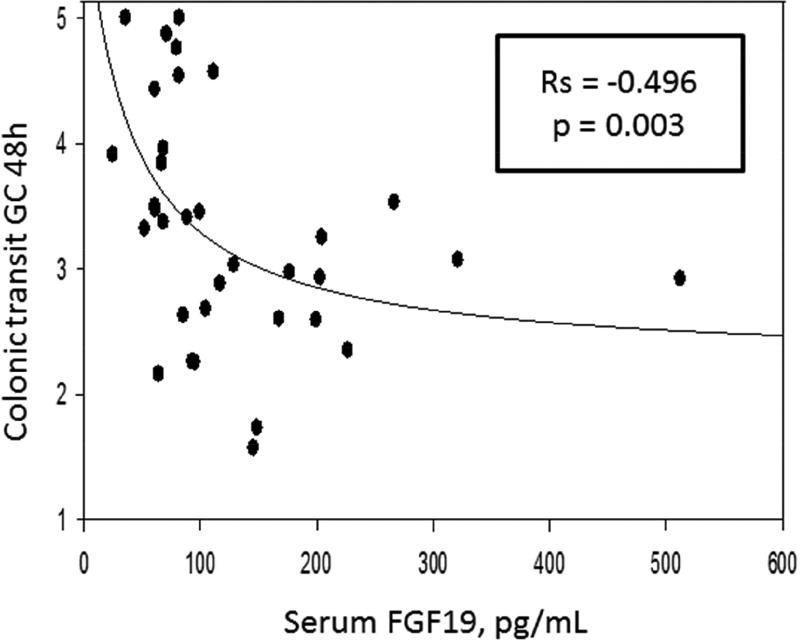
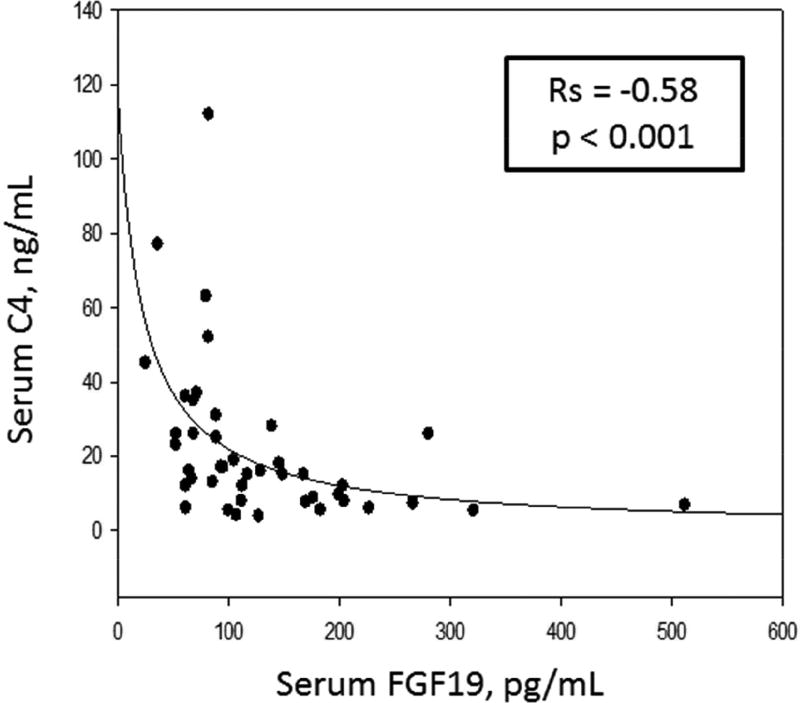
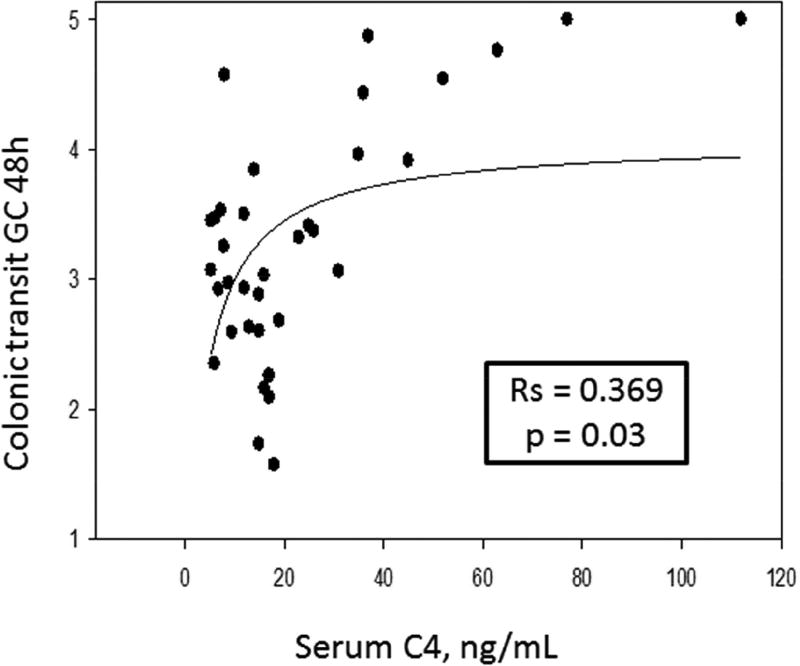
Among the patients with IBS-C, 2 of 45 had low serum levels of C4, 4 of 43 had increased serum levels of FGF19, and 6 of 39 had low levels of BAs in feces collected over 48 hours. Patients with IBS-C had a significant increase in the proportions of fecal lithocholic acid compared with controls (P = .04), and a decrease in deoxycholic acid compared with controls (P = .03). In patients with IBS-C, there were inverse relationships between serum levels of C4 and FGF19 and correlations among levels of 48-hour fecal BAs, colonic transit, and serum C4 and FGF19.
Approximately 15% of patients with IBS-C have reduced total BAs and level of deoxycholic acid in fecal samples collected over 48 hours on a 100 g fat diet. In these patients, lower levels of excretion of BAs into feces correlated with slower colonic transit.
短期给予迟发性释放鹅去氧胆酸可加速结肠转运并减轻便秘型肠易激综合征(IBS-C)患者的症状。初步研究表明,IBS-C 患者粪便中的胆汁酸(BA)水平降低,BA 合成减少。我们比较了 IBS-C 患者在 100 克脂肪饮食中收集的 48 小时粪便样本中初级和次级 BA 的水平,并将其与健康志愿者(对照组)样本中的水平进行了比较。我们还检查了 IBS-C 患者的总体结肠转运与 BA 生物标志物之间的关系。
我们对 45 例 IBS-C 患者和 184 例对照进行了回顾性研究。对于对照组,我们估计了 184 例空腹血清 7α-羟基-4-胆甾烷-3-酮(C4,n=184)和 46 例 48 小时粪便 BA(n=46)的第 10 百分位数,以及 50 例空腹血清成纤维细胞生长因子 19(FGF19,n=50)的第 90 百分位数。使用经过验证的闪烁照相法测量患者的结肠转运。使用 Spearman 相关性分析对 IBS-C 患者的数据进行分析,以确定 C4、FGF19、粪便 BA 和结肠转运之间的水平关系。
在 45 例 IBS-C 患者中,2 例患者血清 C4 水平低,43 例患者血清 FGF19 水平高,39 例患者粪便中 48 小时 BA 水平低。与对照组相比,IBS-C 患者粪便中的胆石酸比例显著增加(P=0.04),脱氧胆酸水平降低(P=0.03)。在 IBS-C 患者中,血清 C4 和 FGF19 之间存在负相关,48 小时粪便 BA、结肠转运以及血清 C4 和 FGF19 之间存在相关性。
大约 15%的 IBS-C 患者在 100 克脂肪饮食下收集的 48 小时粪便样本中总 BA 和脱氧胆酸水平降低。在这些患者中,粪便中 BA 排泄减少与结肠转运缓慢相关。