Franse Carmen B, Rietjens Judith Ac, Burdorf Alex, van Grieken Amy, Korfage Ida J, van der Heide Agnes, Mattace Raso Francesco, van Beeck Ed, Raat Hein
Department of Public Health, Erasmus University Medical Center, Rotterdam, The Netherlands.
Department of Internal Medicine, Erasmus University Medical Center, Section of Geriatric Medicine, Rotterdam, The Netherlands.
BMJ Open. 2017 Jun 30;7(6):e015827. doi: 10.1136/bmjopen-2017-015827.
The rate of falling among older citizens appears to vary across different countries, but the underlying aspects causing this variation are unexplained. We aim to describe between-country variation in falling and explore whether intrinsic fall risk factors can explain possible variation.
Prospective study on data from the cross-national Survey of Health, Ageing and Retirement in Europe (SHARE).
Twelve European countries (Austria, Belgium, Czech Republic, Denmark, Estonia, France, Germany, Italy, The Netherlands, Spain, Sweden, Switzerland).
Community-dwelling persons aged ≥65 years (n=18 596).
Socio-demographic factors (age, gender, education level and living situation) and intrinsic fall risk factors (less than good self-rated health (SRH), mobility limitations, limitations with activities of daily living (ADL), dizziness, impaired vision, depression and impaired cognition) were assessed in a baseline interview. Falling was assessed 2 years later by asking whether the participant had fallen within the 6 months prior to the follow-up interview.
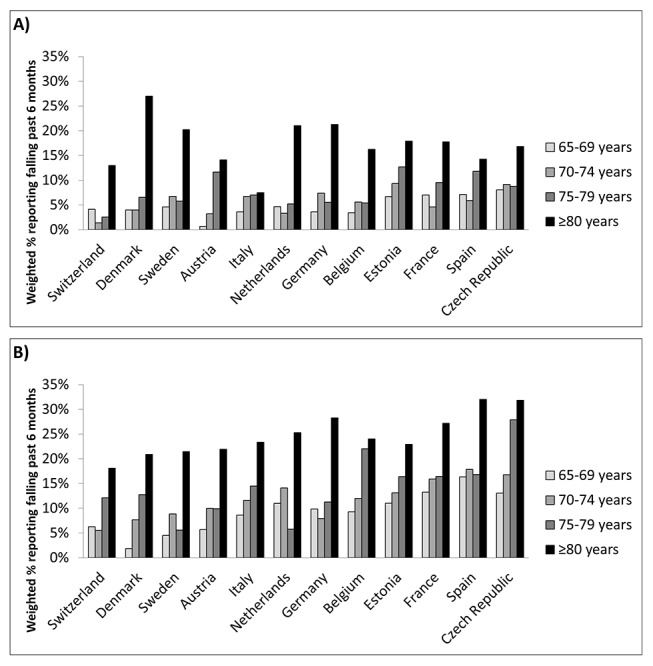
There was significant between-country variation in the rate of falling (varying from 7.9% in Switzerland to 16.2% in the Czech Republic). The prevalence of intrinsic fall risk factors varied twofold to fourfold between countries. Associations between factors age ≥80 years, less than good SRH, mobility limitations, ADL limitations, dizziness and depression, and falling were different between countries (p<0.05). Between-country differences in falling largely persisted after adjusting for socio-demographic differences but strongly attenuated after adjusting for differences in intrinsic fall risk factors.
There is considerable variation in the rate of falling between European countries, which can largely be explained by between-country variation in the prevalence of intrinsic fall risk factors. There are also country-specific variations in the association between these intrinsic risk factors and falling. These findings emphasise the importance of addressing intrinsic fall risk in (inter)national fall-prevention strategies, while highlighting country-specific priorities.
老年公民的跌倒发生率在不同国家似乎有所不同,但导致这种差异的潜在因素尚不清楚。我们旨在描述各国之间跌倒情况的差异,并探讨内在跌倒风险因素是否可以解释可能存在的差异。
对欧洲健康、老龄化与退休调查(SHARE)的跨国数据进行前瞻性研究。
12个欧洲国家(奥地利、比利时、捷克共和国、丹麦、爱沙尼亚、法国、德国、意大利、荷兰、西班牙、瑞典、瑞士)。
年龄≥65岁的社区居住者(n = 18596)。
在基线访谈中评估社会人口学因素(年龄、性别、教育水平和生活状况)和内在跌倒风险因素(自我评估健康状况不佳(SRH)、行动不便、日常生活活动(ADL)受限、头晕、视力受损、抑郁和认知障碍)。2年后通过询问参与者在随访访谈前6个月内是否跌倒来评估跌倒情况。
各国之间的跌倒发生率存在显著差异(从瑞士的7.9%到捷克共和国的16.2%不等)。内在跌倒风险因素的患病率在不同国家之间相差两倍至四倍。年龄≥80岁、SRH不佳、行动不便、ADL受限、头晕和抑郁等因素与跌倒之间的关联在不同国家有所不同(p<0.05)。在调整社会人口学差异后,各国之间跌倒的差异基本持续存在,但在调整内在跌倒风险因素的差异后,差异大幅减弱。
欧洲国家之间的跌倒发生率存在相当大的差异,这在很大程度上可以由内在跌倒风险因素患病率的国家间差异来解释。这些内在风险因素与跌倒之间的关联也存在国家特异性差异。这些发现强调了在(跨)国家跌倒预防策略中解决内在跌倒风险的重要性,同时突出了国家特异性重点。