Departments of Paediatrics and Psychiatry, Faculty of Medicine, Dentistry and Health Sciences, University of Melbourne, Melbourne, VIC, Australia.
University of Dundee, Dundee, UK.
CNS Drugs. 2017 Jul;31(7):625-638. doi: 10.1007/s40263-017-0443-y.
Attention-deficit/hyperactivity disorder (ADHD) is increasingly recognized as a persistent disorder requiring long-term management.
Our objective was to evaluate the 2-year safety and efficacy of lisdexamfetamine dimesylate (LDX) in children and adolescents with ADHD.
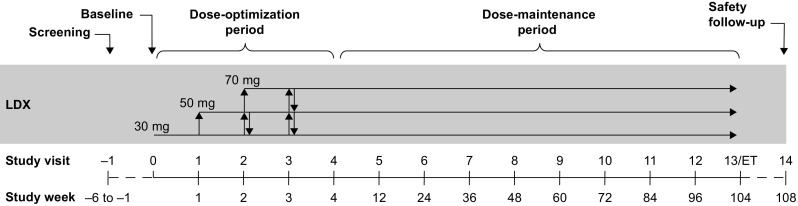
Participants (aged 6-17 years) with ADHD received open-label, dose-optimized LDX 30, 50, or 70 mg/day for 104 weeks. Safety monitoring included treatment-emergent adverse events (TEAEs), vital signs, electrocardiography, and growth. The TEAEs decreased appetite, weight decrease, insomnia events (including insomnia, initial insomnia, middle insomnia, and terminal insomnia), headache, and psychiatric TEAEs were pre-defined as being of special interest. Efficacy was assessed as a secondary objective using the ADHD Rating Scale IV (ADHD-RS-IV), the Clinical Global Impressions-Improvement (CGI-I) scale, and the CGI-Severity (CGI-S) scale.
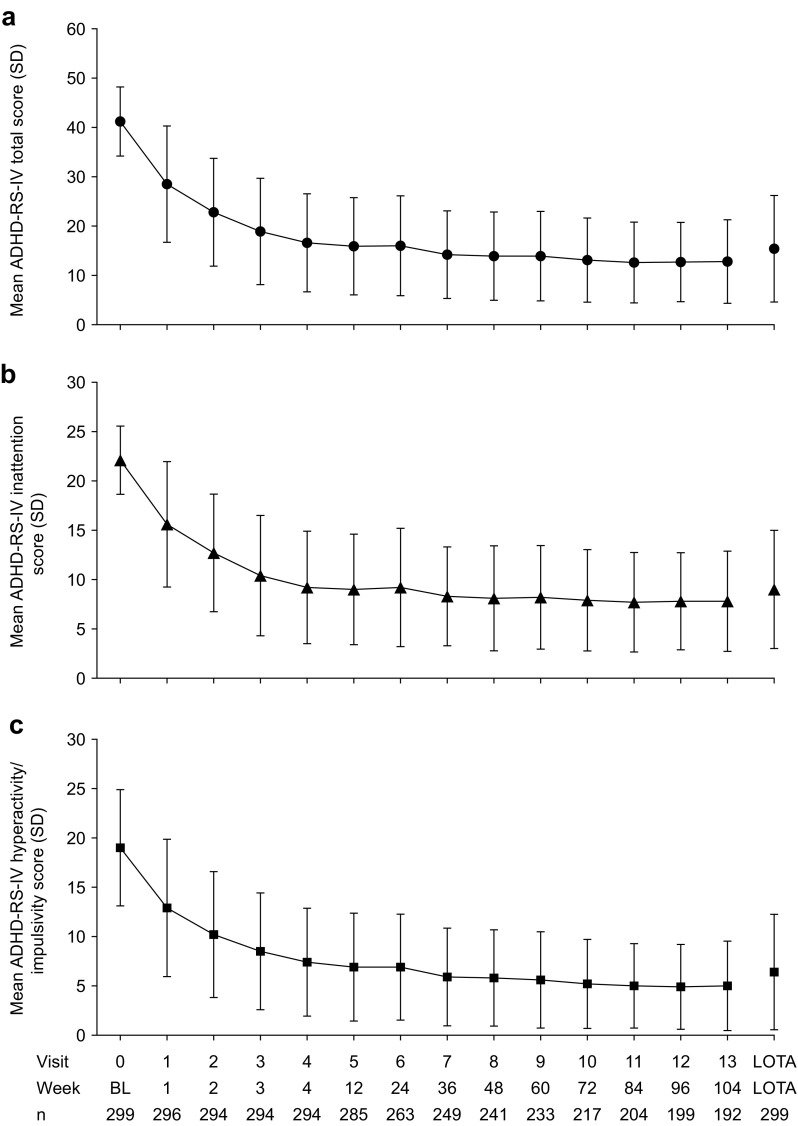
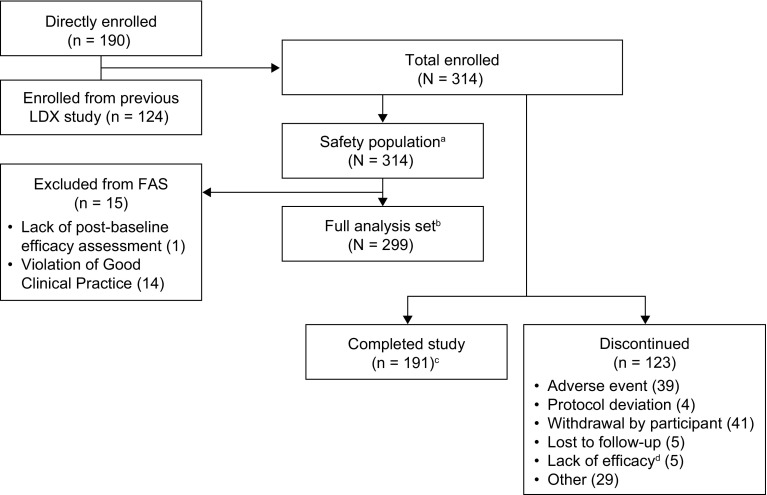
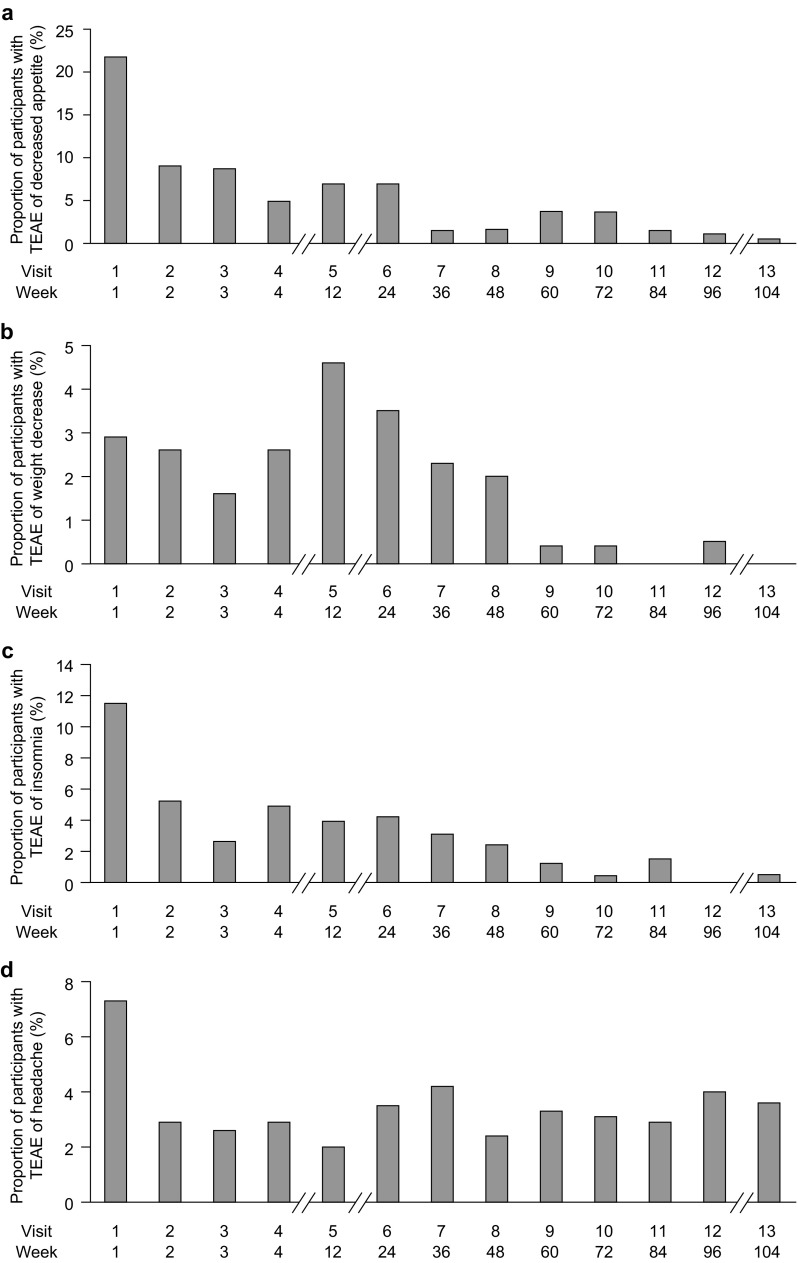
Of 314 participants enrolled, 191 completed the study. TEAEs were reported in 89.8% of participants, led to discontinuation in 12.4%, and were reported as serious in 8.9%. TEAEs that were reported by ≥5% of participants and considered by investigators as related to LDX were decreased appetite (49.4%), weight decrease (18.2%), insomnia (13.1%), initial insomnia (8.9%), irritability (8.6%), nausea (6.7%), headache (5.7%), and tic (5.1%). The median time to first onset and duration, respectively, of TEAEs of special interest were as follows: decreased appetite, 13.5 and 169.0 days; weight decrease, 29.0 and 225.0 days; insomnia, 17.0 and 42.8 days; and headache, 22.0 and 2.0 days. Reports of decreased appetite, weight decrease, insomnia, and headache were highest in the first 4-12 weeks. Psychiatric TEAEs were infrequent: psychosis and mania (n = 1), suicidal events (suicidal ideation, n = 2; suicide attempt, n = 1), and aggression events (aggression, n = 14; anger, n = 2; hostility, n = 1). At the last on-treatment assessment (LOTA), mean increases from baseline in vital signs were as follows: pulse rate, 7.0 bpm (95% confidence interval [CI] 5.7-8.2); systolic blood pressure (SBP), 3.4 mmHg (95% CI 2.2-4.5); and diastolic blood pressure (DBP), 3.2 mmHg (95% CI 2.2-4.2). Pre-defined thresholds for a potentially clinically important (PCI) high pulse rate were met at one or more visits by 22 participants (7.0%), for PCI high SBP were met by 45 children (22.4%) and 17 adolescents (15.2%), and for PCI high DBP were met by 78 children (38.8%) and 24 adolescents (21.4%). The mean QT interval corrected using Fridericia's formula (QTcF) decreased from baseline to LOTA (-0.6 ms [95% CI -2.3 to 1.2]; range -50 to +53). Mean changes in growth from baseline to LOTA were weight, 2.1 kg (95% CI 1.5-2.8); height, 6.1 cm (95% CI 5.6-6.7); and body mass index (BMI), -0.5 kg/m (95% CI -0.7 to -0.3). There was a general shift to lower z score categories for height, weight, and BMI from baseline to LOTA. The mean change in ADHD-RS-IV from baseline to LOTA was -25.8 (95% CI -27.0 to -24.5) for total score, -12.6 (95% CI -13.4 to -11.9) for the hyperactivity/impulsivity subscale score, and -13.1 (95% CI -13.8 to -12.4) for the inattention subscale score. At LOTA, 77.9% of participants had a CGI-I score of 1 or 2. In addition, 77.3 and 69.2% of participants were classified as treatment responders, based on a CGI-I score of 1 or 2 and a ≥30% or ≥50% reduction from baseline in ADHD-RS-IV total score, respectively.
The safety profile of LDX in this longer-term study was similar to that reported in previous studies. The efficacy of LDX was maintained throughout the 2-year study period. CLINICALTRIALS.
NCT01328756.
注意力缺陷/多动障碍(ADHD)越来越被认为是一种需要长期管理的持续性疾病。
我们旨在评估 lisdexamfetamine dimesylate(LDX)在患有 ADHD 的儿童和青少年中的 2 年安全性和疗效。
参与者(年龄 6-17 岁)接受开放标签、剂量优化的 LDX 30、50 或 70mg/天,共 104 周。安全性监测包括治疗出现的不良事件(TEAEs)、生命体征、心电图和生长情况。TEAEs 包括食欲减退、体重减轻、失眠事件(包括失眠、初始失眠、中期失眠和终末失眠)、头痛和精神科 TEAEs,这些都是特别关注的。使用 ADHD 评定量表 IV(ADHD-RS-IV)、临床总体印象-改善(CGI-I)量表和 CGI-Severity(CGI-S)量表评估疗效作为次要目标。
在 314 名入组的参与者中,有 191 名完成了研究。89.8%的参与者报告了 TEAEs,导致 12.4%的参与者停药,8.9%的参与者报告为严重 TEAEs。研究者认为与 LDX 相关的≥5%的参与者报告的 TEAEs 包括食欲减退(49.4%)、体重减轻(18.2%)、失眠(13.1%)、初始失眠(8.9%)、易激惹(8.6%)、恶心(6.7%)、头痛(5.7%)和抽搐(5.1%)。TEAEs 的中位首次发作时间和持续时间分别为:食欲减退 13.5 天和 169.0 天;体重减轻 29.0 天和 225.0 天;失眠 17.0 天和 42.8 天;头痛 22.0 天和 2.0 天。食欲减退、体重减轻、失眠和头痛的报告在最初的 4-12 周最高。精神科 TEAEs 很少见:精神病和躁狂症(n=1)、自杀事件(自杀意念,n=2;自杀企图,n=1)和攻击事件(攻击,n=14;愤怒,n=2;敌意,n=1)。在最后一次治疗评估(LOTA)时,与基线相比,生命体征的平均变化如下:脉搏率增加 7.0bpm(95%置信区间 [CI] 5.7-8.2);收缩压(SBP)增加 3.4mmHg(95%CI 2.2-4.5);舒张压(DBP)增加 3.2mmHg(95%CI 2.2-4.2)。22 名参与者(7.0%)在一次或多次就诊时达到潜在临床重要性(PCI)高脉搏率的阈值,45 名儿童(22.4%)和 17 名青少年(15.2%)达到 PCI 高 SBP 的阈值,78 名儿童(38.8%)和 24 名青少年(21.4%)达到 PCI 高 DBP 的阈值。QTcF 校正的 QT 间期(QTcF)自基线至 LOTA 下降(-0.6ms[95%CI -2.3 至 1.2];范围 -50 至 +53)。体重、身高和 BMI 的平均变化从基线到 LOTA 分别为:体重增加 2.1kg(95%CI 1.5-2.8);身高增加 6.1cm(95%CI 5.6-6.7);BMI 增加 -0.5kg/m(95%CI -0.7 至 -0.3)。身高、体重和 BMI 的 z 评分类别从基线到 LOTA 总体呈下降趋势。ADHD-RS-IV 总分从基线到 LOTA 的平均变化为-25.8(95%CI -27.0 至-24.5),多动/冲动分量表分数为-12.6(95%CI -13.4 至-11.9),注意力不集中分量表分数为-13.1(95%CI -13.8 至-12.4)。在 LOTA 时,77.9%的参与者的 CGI-I 评分达到 1 或 2。此外,基于 CGI-I 评分 1 或 2 和 ADHD-RS-IV 总分≥30%或≥50%的降低,分别有 77.3%和 69.2%的参与者被归类为治疗应答者。
在这项长期研究中,LDX 的安全性与之前的研究相似。LDX 的疗效在整个 2 年研究期间保持稳定。
临床试验.gov 标识符:NCT01328756。