Dittmann Ralf W, Cardo Esther, Nagy Peter, Anderson Colleen S, Bloomfield Ralph, Caballero Beatriz, Higgins Nicholas, Hodgkins Paul, Lyne Andrew, Civil Richard, Coghill David
CNS Drugs. 2013 Dec;27(12):1081-92. doi: 10.1007/s40263-013-0104-8.
The aim of this study was to compare the efficacy and safety of the prodrug psychostimulant lisdexamfetamine dimesylate (LDX) and the non-stimulant noradrenergic compound atomoxetine (ATX) in children and adolescents with attention-deficit/hyperactivity disorder (ADHD) who had previously responded inadequately to methylphenidate (MPH).
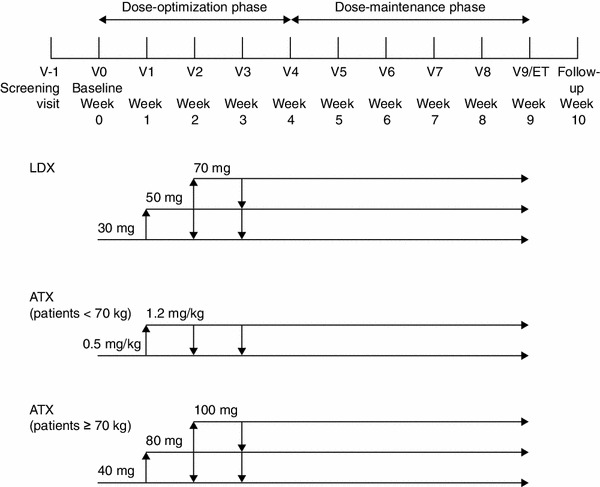
This 9-week, head-to-head, randomized, double-blind, active-controlled study (SPD489-317; ClinicalTrials.gov NCT01106430) enrolled patients (aged 6-17 years) with at least moderately symptomatic ADHD and an inadequate response to previous MPH therapy. Patients were randomized (1:1) to an optimized daily dose of LDX (30, 50 or 70 mg) or ATX (patients <70 kg, 0.5-1.2 mg/kg with total daily dose not to exceed 1.4 mg/kg; patients ≥70 kg, 40, 80 or 100 mg). The primary efficacy outcome was time (days) to first clinical response. Clinical response was defined as a Clinical Global Impressions-Improvement (CGI-I) score of 1 (very much improved) or 2 (much improved). Secondary efficacy outcomes included the proportion of responders at each study visit and the change from baseline in ADHD Rating Scale (ADHD-RS-IV) and CGI-Severity scores. Tolerability and safety were assessed by monitoring treatment-emergent adverse events (TEAEs), height and weight, vital signs and electrocardiogram parameters. Endpoint was defined as the last post-baseline, on-treatment visit with a valid assessment.
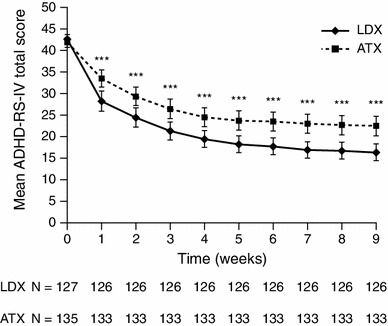
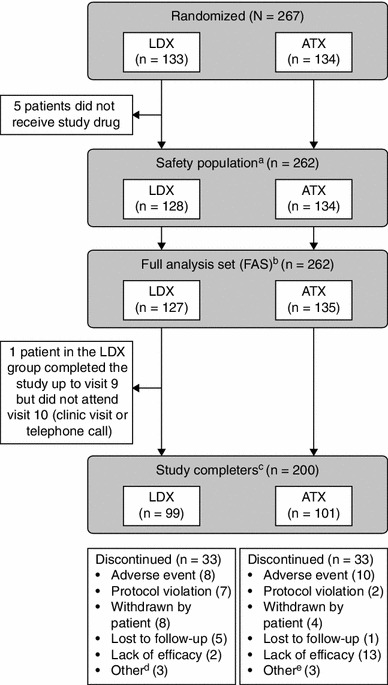
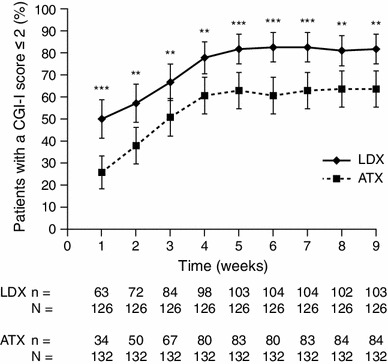
Of 267 patients randomized (LDX, n = 133; ATX, n = 134), 200 (74.9%) completed the study. The median time to first clinical response [95% confidence interval (CI)] was significantly shorter for patients receiving LDX [12.0 days (8.0-16.0)] than for those receiving ATX [21.0 days (15.0-23.0)] (p = 0.001). By week 9, 81.7% (95% CI 75.0-88.5) of patients receiving LDX had responded to treatment compared with 63.6% (95% CI 55.4-71.8) of those receiving ATX (p = 0.001). Also by week 9, the difference between LDX and ATX in least-squares mean change from baseline (95% CI) was significant in favour of LDX for the ADHD-RS-IV total score [-6.5 (-9.3 to -3.6); p < 0.001; effect size 0.56], inattentiveness subscale score [-3.4 (-4.9 to -1.8); p < 0.001; effect size 0.53] and the hyperactivity/impulsivity subscale score [-3.2 (-4.6 to -1.7); p < 0.001; effect size 0.53]. TEAEs were reported by 71.9 and 70.9% of patients receiving LDX and ATX, respectively. At endpoint, both treatments were associated with mean (standard deviation) increases in systolic blood pressure [LDX, +0.7 mmHg (9.08); ATX, +0.6 mmHg (7.96)], diastolic blood pressure [LDX, +0.1 mmHg (8.33); ATX, +1.3 mmHg (8.24)] and pulse rate [LDX, +3.6 bpm (10.49); ATX, +3.7 bpm (10.75)], and decreases in weight [LDX, -1.30 kg (1.806); ATX, -0.15 kg (1.434)].
LDX was associated with a faster and more robust treatment response than ATX in children and adolescents with at least moderately symptomatic ADHD who had previously responded inadequately to MPH. Both treatments displayed safety profiles consistent with findings from previous clinical trials.
本研究旨在比较前体药物精神兴奋剂二甲磺酸赖右苯丙胺(LDX)与非兴奋剂去甲肾上腺素能化合物托莫西汀(ATX)在既往对哌甲酯(MPH)反应欠佳的注意缺陷多动障碍(ADHD)儿童及青少年中的疗效和安全性。
这项为期9周的、直接比较的、随机、双盲、活性药物对照研究(SPD489 - 317;ClinicalTrials.gov NCT01106430)纳入了至少有中度症状的ADHD患者(6 - 17岁),且他们对既往MPH治疗反应欠佳。患者被随机(1:1)分为接受优化每日剂量的LDX(30、50或70毫克)或ATX(体重<70千克的患者,0.5 - 1.2毫克/千克,每日总剂量不超过1.4毫克/千克;体重≥70千克的患者,40、80或100毫克)。主要疗效指标是首次临床反应的时间(天)。临床反应定义为临床总体印象改善(CGI - I)评分为1(显著改善)或2(明显改善)。次要疗效指标包括每次研究访视时的反应者比例以及ADHD评定量表(ADHD - RS - IV)和CGI严重程度评分相对于基线的变化。通过监测治疗中出现的不良事件(TEAE)、身高和体重、生命体征及心电图参数来评估耐受性和安全性。终点定义为末次基线后、接受治疗且有有效评估的访视。
随机分组的267例患者中(LDX组,n = 133;ATX组,n = 134),200例(74.9%)完成了研究。接受LDX的患者首次临床反应的中位时间[95%置信区间(CI)]显著短于接受ATX的患者[12.0天(8.0 - 16.0)对21.0天(15.0 - 23.0)](p = 0.001)。到第9周时,接受LDX的患者中有81.7%(95% CI 75.0 - 88.5)对治疗有反应,而接受ATX的患者为63.6%(95% CI 55.4 - 71.8)(p = 0.001)。同样到第9周时,LDX与ATX在相对于基线的最小二乘均值变化(95% CI)方面的差异在ADHD - RS - IV总分[-6.5(-9.3至-3.6);p < 0.001;效应大小0.56]、注意力不集中子量表评分[-3.4(-4.9至-1.8);p < 0.001;效应大小0.53]和多动/冲动子量表评分[-3.2(-4.6至-1.7);p < 0.001;效应大小0.53]方面均显著有利于LDX。接受LDX和ATX的患者分别有71.9%和70.9%报告了TEAE。在终点时,两种治疗均与收缩压[LDX,+0.7 mmHg(9.08);ATX,+0.6 mmHg(7.96)]、舒张压[LDX,+0.1 mmHg(8.33);ATX,+1.3 mmHg(8.24)]和脉搏率[LDX,+3.6次/分钟(10.49);ATX,+3.7次/分钟(10.75)]的均值(标准差)升高以及体重[LDX,-1.30千克(1.806);ATX,-0.15千克(1.434)]降低相关。
在既往对MPH反应欠佳、至少有中度症状的ADHD儿童及青少年中,LDX比ATX治疗反应更快且更显著。两种治疗的安全性特征均与既往临床试验结果一致。