Patrick Ellis, Rajagopal Sathyapriya, Wong Hon-Kit Andus, McCabe Cristin, Xu Jishu, Tang Anna, Imboywa Selina H, Schneider Julie A, Pochet Nathalie, Krichevsky Anna M, Chibnik Lori B, Bennett David A, De Jager Philip L
Departments of Neurology and Psychiatry, Brigham and Women's Hospital, Program in Translational NeuroPsychiatric Genomics, Institute for the Neurosciences, 77 Avenue Louis Pasteur, NRB 168C, Boston, MA, 02115, USA.
Harvard Medical School, Boston, MA, USA.
Mol Neurodegener. 2017 Jul 1;12(1):51. doi: 10.1186/s13024-017-0191-y.
Given multiple studies of brain microRNA (miRNA) in relation to Alzheimer's disease (AD) with few consistent results and the heterogeneity of this disease, the objective of this study was to explore their mechanism by evaluating their relation to different elements of Alzheimer's disease pathology, confounding factors and mRNA expression data from the same subjects in the same brain region.
We report analyses of expression profiling of miRNA (n = 700 subjects) and lincRNA (n = 540 subjects) from the dorsolateral prefrontal cortex of individuals participating in two longitudinal cohort studies of aging.
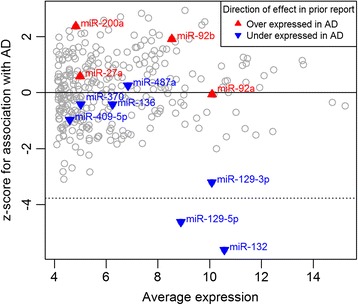
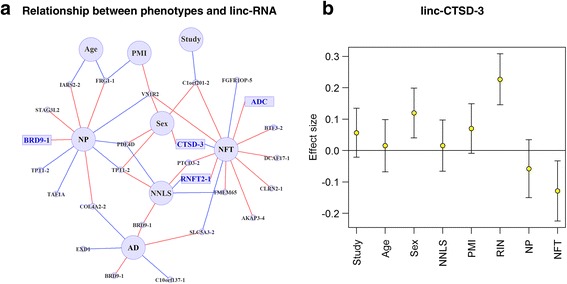
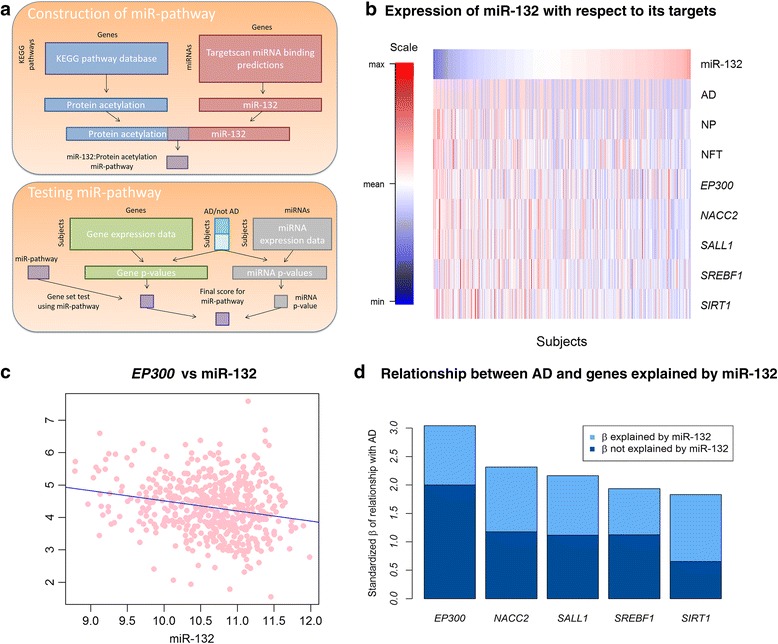
We confirm the association of two well-established miRNA (miR-132, miR-129) with pathologic AD in our dataset and then further characterize this association in terms of its component neuritic β-amyloid plaques and neurofibrillary tangle pathologies. Additionally, we identify one new miRNA (miR-99) and four lincRNA that are associated with these traits. Many other previously reported associations of microRNA with AD are associated with the confounders quantified in our longitudinal cohort. Finally, by performing analyses integrating both miRNA and RNA sequence data from the same individuals (525 samples), we characterize the impact of AD associated miRNA on human brain expression: we show that the effects of miR-132 and miR-129-5b converge on certain genes such as EP300 and find a role for miR200 and its target genes in AD using an integrated miRNA/mRNA analysis.
Overall, miRNAs play a modest role in human AD, but we observe robust evidence that a small number of miRNAs are responsible for specific alterations in the cortical transcriptome that are associated with AD.
鉴于多项关于脑微小RNA(miRNA)与阿尔茨海默病(AD)的研究结果缺乏一致性,且该疾病存在异质性,本研究的目的是通过评估miRNA与AD病理不同成分、混杂因素以及同一受试者同一脑区mRNA表达数据之间的关系来探究其机制。
我们报告了对参与两项衰老纵向队列研究个体的背外侧前额叶皮质中miRNA(n = 700名受试者)和长链非编码RNA(lincRNA,n = 540名受试者)表达谱的分析。
我们在数据集中证实了两种已明确的miRNA(miR - 132、miR - 129)与AD病理的关联,然后根据其组成部分神经炎性β淀粉样斑块和神经原纤维缠结病理进一步描述这种关联。此外,我们鉴定出一种新的miRNA(miR - 99)和四种与这些特征相关的lincRNA。许多先前报道的miRNA与AD的关联与我们纵向队列中量化的混杂因素有关。最后,通过对来自同一受试者(525个样本)的miRNA和RNA序列数据进行整合分析,我们描述了AD相关miRNA对人脑表达的影响:我们表明miR - 132和miR - 129 - 5b的作用汇聚于某些基因,如EP300,并通过整合miRNA/mRNA分析发现miR200及其靶基因在AD中的作用。
总体而言,miRNA在人类AD中起适度作用,但我们观察到有力证据表明少数miRNA导致了与AD相关的皮质转录组的特定改变。