Valeri Linda, Mazumdar Maitreyi M, Bobb Jennifer F, Claus Henn Birgit, Rodrigues Ema, Sharif Omar I A, Kile Molly L, Quamruzzaman Quazi, Afroz Sakila, Golam Mostafa, Amarasiriwardena Citra, Bellinger David C, Christiani David C, Coull Brent A, Wright Robert O
Laboratory for Psychiatric Biostatistics, McLean Hospital, Belmont, Massachussetts, USA.
Department of Psychiatry, Harvard Medical School, Boston, Massachussetts, USA.
Environ Health Perspect. 2017 Jun 26;125(6):067015. doi: 10.1289/EHP614.
Exposure to chemical mixtures is recognized as the real-life scenario in all populations, needing new statistical methods that can assess their complex effects.
We aimed to assess the joint effect of in utero exposure to arsenic, manganese, and lead on children's neurodevelopment.
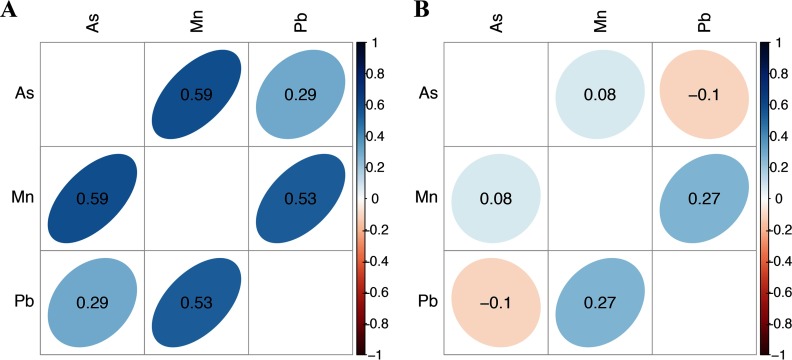
We employed a novel statistical approach, Bayesian kernel machine regression (BKMR), to study the joint effect of coexposure to arsenic, manganese, and lead on neurodevelopment using an adapted Bayley Scale of Infant and Toddler Development™. Third Edition, in 825 mother-child pairs recruited into a prospective birth cohort from two clinics in the Pabna and Sirajdikhan districts of Bangladesh. Metals were measured in cord blood using inductively coupled plasma-mass spectrometry.
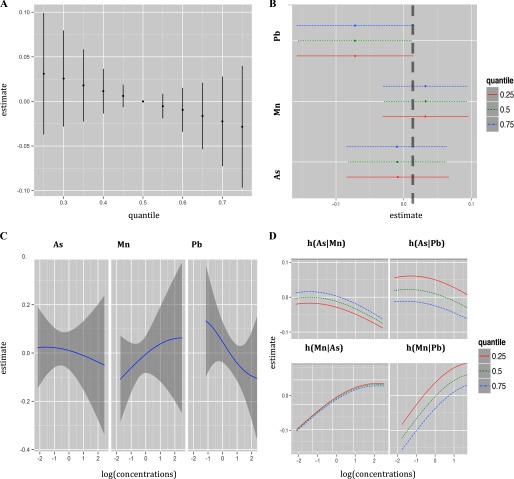
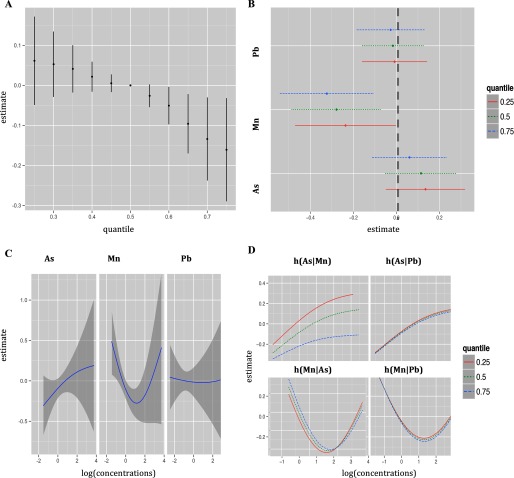
Analyses were stratified by clinic due to differences in exposure profiles. In the Pabna district, which displayed high manganese levels [interquartile range (IQR): 4.8, 18 μg/dl], we found a statistically significant negative effect of the mixture of arsenic, lead, and manganese on cognitive score when cord blood metals concentrations were all above the 60th percentile (As≥0.7 μg/dl, Mn≥6.6 μg/dl, Pb≥4.2 μg/dl) compared to the median (As=0.5 μg/dl, Mn=5.8 μg/dl, Pb=3.1 μg/dl). Evidence of a nonlinear effect of manganese was found. A change in log manganese from the 25th to the 75th percentile when arsenic and manganese were at the median was associated with a decrease in cognitive score of −0.3 (−0.5, −0.1) standard deviations. Our study suggests that arsenic might be a potentiator of manganese toxicity.
Employing a novel statistical method for the study of the health effects of chemical mixtures, we found evidence of neurotoxicity of the mixture, as well as potential synergism between arsenic and manganese. https://doi.org/10.1289/EHP614.
接触化学混合物被认为是所有人群的现实生活场景,需要能够评估其复杂影响的新统计方法。
我们旨在评估子宫内接触砷、锰和铅对儿童神经发育的联合影响。
我们采用了一种新颖的统计方法,即贝叶斯核机器回归(BKMR),使用适应性婴幼儿发展贝利量表第三版,研究砷、锰和铅共同暴露对神经发育的联合影响,该研究纳入了从孟加拉国帕布纳和锡拉杰迪汗地区两家诊所招募的825对母婴对。使用电感耦合等离子体质谱法测量脐血中的金属含量。
由于暴露情况不同,分析按诊所分层。在锰含量较高的帕布纳地区[四分位数间距(IQR):4.8,18μg/dl],当脐血金属浓度均高于第60百分位数(砷≥0.7μg/dl,锰≥6.6μg/dl,铅≥4.2μg/dl)时,与中位数(砷=0.5μg/dl,锰=5.8μg/dl,铅=3.1μg/dl)相比,我们发现砷、铅和锰的混合物对认知得分有统计学上显著的负面影响。发现了锰的非线性效应证据。当砷和锰处于中位数时,锰的对数从第25百分位数变化到第75百分位数与认知得分降低-0.3(-0.5,-0.1)标准差相关。我们的研究表明,砷可能是锰毒性的增强剂。
采用一种新颖的统计方法研究化学混合物的健康影响,我们发现了混合物神经毒性的证据,以及砷和锰之间的潜在协同作用。https://doi.org/10.1289/EHP614