Claus Henn Birgit, Ettinger Adrienne S, Hopkins Marianne R, Jim Rebecca, Amarasiriwardena Chitra, Christiani David C, Coull Brent A, Bellinger David C, Wright Robert O
Department of Environmental Health, Boston University School of Public Health, Boston, Massachusetts, USA.
Environ Health Perspect. 2016 Aug;124(8):1308-15. doi: 10.1289/ehp.1510070. Epub 2016 Feb 9.
Limited epidemiologic data exist on prenatal arsenic exposure and fetal growth, particularly in the context of co-exposure to other toxic metals.
We examined whether prenatal arsenic exposure predicts birth outcomes among a rural U.S. population, while adjusting for exposure to lead and manganese.
We collected maternal and umbilical cord blood samples at delivery from 622 mother-infant pairs residing near a mining-related Superfund site in Northeast Oklahoma. Whole blood arsenic, lead, and manganese were measured using inductively coupled plasma mass spectrometry. We modeled associations between arsenic concentrations and birth weight, gestational age, head circumference, and birth weight for gestational age.
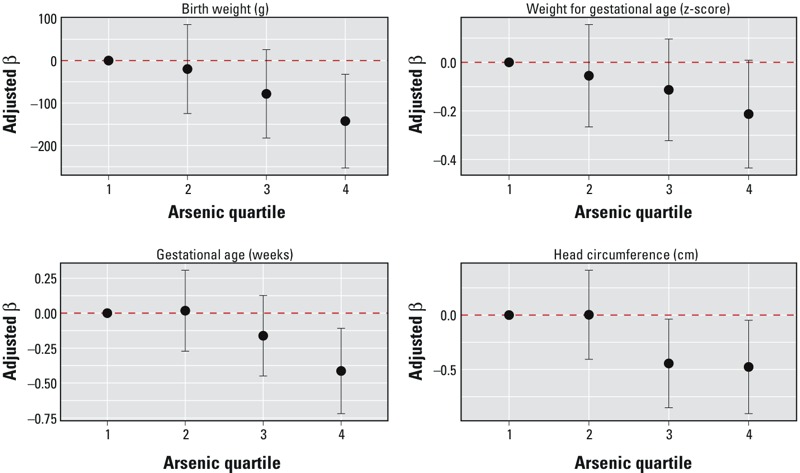
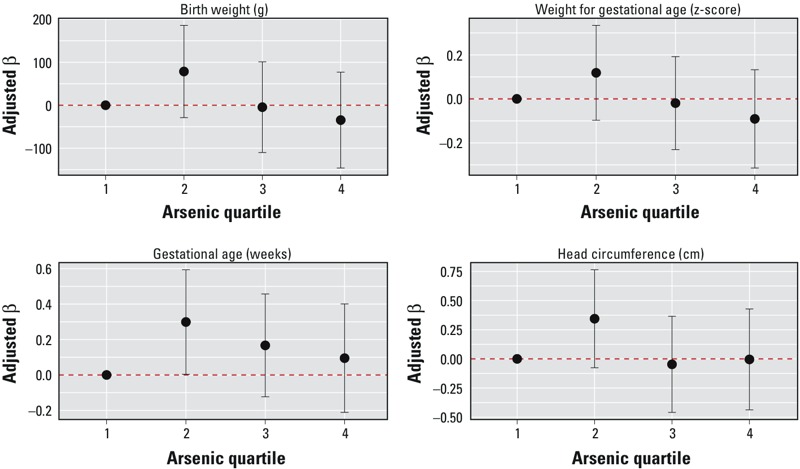
Median (25th-75th percentile) maternal and umbilical cord blood metal concentrations, respectively, were as follows: arsenic, 1.4 (1.0-2.3) and 2.4 (1.8-3.3) μg/L; lead, 0.6 (0.4-0.9) and 0.4 (0.3-0.6) μg/dL; manganese, 22.7 (18.8-29.3) and 41.7 (32.2-50.4) μg/L. We estimated negative associations between maternal blood arsenic concentrations and birth outcomes. In multivariable regression models adjusted for lead and manganese, an interquartile range increase in maternal blood arsenic was associated with -77.5 g (95% CI: -127.8, -27.3) birth weight, -0.13 weeks (95% CI: -0.27, 0.01) gestation, -0.22 cm (95% CI: -0.42, -0.03) head circumference, and -0.14 (95% CI: -0.24, -0.04) birth weight for gestational age z-score units. Interactions between arsenic concentrations and lead or manganese were not statistically significant.
In a population with environmental exposure levels similar to the U.S. general population, maternal blood arsenic was negatively associated with fetal growth. Given the potential for relatively common fetal and early childhood arsenic exposures, our finding that prenatal arsenic can adversely affect birth outcomes is of considerable public health importance.
Claus Henn B, Ettinger AS, Hopkins MR, Jim R, Amarasiriwardena C, Christiani DC, Coull BA, Bellinger DC, Wright RO. 2016. Prenatal arsenic exposure and birth outcomes among a population residing near a mining-related Superfund site. Environ Health Perspect 124:1308-1315; http://dx.doi.org/10.1289/ehp.1510070.
关于产前砷暴露与胎儿生长的流行病学数据有限,尤其是在同时暴露于其他有毒金属的情况下。
我们研究了在美国农村人群中,产前砷暴露在调整铅和锰暴露因素后是否能预测出生结局。
我们从居住在俄克拉荷马州东北部一个与采矿相关的超级基金场地附近的622对母婴中,在分娩时采集了母亲和脐带血样本。使用电感耦合等离子体质谱法测量全血中的砷、铅和锰。我们建立了砷浓度与出生体重、孕周、头围以及孕周别出生体重之间的关联模型。
母亲和脐带血中金属浓度的中位数(第25 - 75百分位数)分别如下:砷,1.4(1.0 - 2.3)和2.4(1.8 - 3.3)μg/L;铅,0.6(0.4 - 0.9)和0.4(0.3 - 0.6)μg/dL;锰,22.7(18.8 - 29.3)和41.7(32.2 - 50.4)μg/L。我们估计母亲血砷浓度与出生结局之间存在负相关。在调整了铅和锰的多变量回归模型中,母亲血砷增加一个四分位数间距与出生体重降低 - 77.5 g(95%可信区间: - 127.8, - 27.3)、孕周减少 - 0.13周(95%可信区间: - 0.27,0.01)、头围减少 - 0.22 cm(95%可信区间: - 0.42, - 0.03)以及孕周别出生体重z评分单位降低 - 0.14(95%可信区间: - 0.24, - 0.04)相关。砷浓度与铅或锰之间的相互作用无统计学意义。
在一个环境暴露水平与美国普通人群相似的人群中,母亲血砷与胎儿生长呈负相关。鉴于胎儿和幼儿期砷暴露相对常见,我们发现产前砷会对出生结局产生不利影响,这具有相当大的公共卫生重要性。
克劳斯·亨恩B,埃廷格AS,霍普金斯MR,吉姆R,阿马拉西里瓦德纳C,克里斯蒂亚尼DC,库尔BA,贝林格DC,赖特RO。2016年。居住在与采矿相关的超级基金场地附近人群的产前砷暴露与出生结局。《环境健康展望》124:1308 - 1315;http://dx.doi.org/10.1289/ehp.1510070 。