Ding Bo, Small Mark
AstraZeneca Gothenburg, Mölndal, Sweden.
Adelphi Real World, Bollington, Macclesfield, UK.
Int J Chron Obstruct Pulmon Dis. 2017 Jun 15;12:1753-1763. doi: 10.2147/COPD.S136314. eCollection 2017.
Asthma and chronic obstructive pulmonary disease (COPD) overlap syndrome (ACOS) is an increasingly recognized phenotype. Few randomized clinical trials have been conducted in patients with ACOS; therefore, scientific evidence concerning ACOS is scarce and a therapeutic approach remains unclear. The aim of this study was to evaluate current treatment trends for patients with ACOS, identified as those with a dual definition of asthma and COPD, in a real-world COPD cohort.
Data were analyzed from patients with asthma and COPD in the USA, France, Germany, Italy, Spain, and the UK who participated in the 2012 and 2013 Adelphi Respiratory Disease Specific Programmes (DSPs). Patients with ACOS were identified in the COPD population; these patients had a physician-confirmed, concomitant asthma diagnosis. Physicians completed a patient record form providing information on patient and disease characteristics including prescribed respiratory treatment. Pairwise comparisons were made between the ACOS, asthma, and COPD populations using tests.
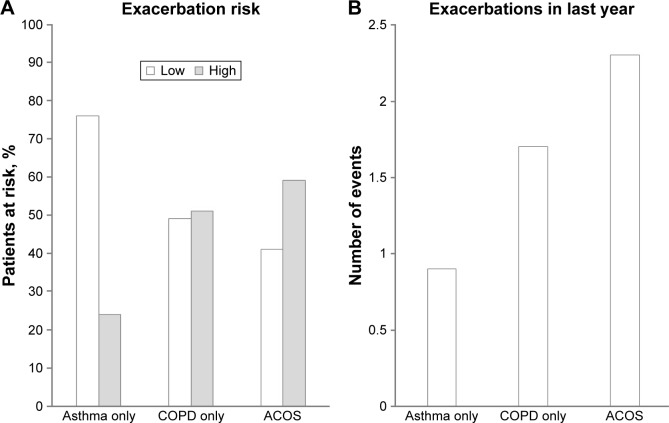
In total, 9,042 patients with asthma-only, 7,119 patients with COPD-only, and 523 patients with ACOS (a dual diagnosis of asthma and COPD) participated in the study. The most commonly prescribed regimens were inhaled corticosteroid/long-acting β-agonist (ICS/LABA) + long-acting muscarinic antagonist (LAMA); (ACOS 30%, asthma 1.4%, and COPD 32%), ICS/LABA (19%, 41.5%, and 17%, respectively), and LAMA (6%, 0.4%, and 19%, respectively); 18% of patients with ACOS were not prescribed an ICS. Patients with ACOS had a significantly higher incidence of gastroesophageal reflux disease, diabetes, and obesity and experienced more exacerbations in the past year than those with COPD or asthma.
The majority of patients with ACOS, as defined in this research, were prescribed similar treatment to those with COPD. There is a need, however, for better treatment for patients with ACOS, as indicated by symptoms and exacerbation levels. A clearer therapeutic approach for patients with ACOS is required.
哮喘与慢性阻塞性肺疾病(COPD)重叠综合征(ACOS)是一种日益受到认可的表型。针对ACOS患者开展的随机临床试验较少;因此,关于ACOS的科学证据稀缺,治疗方法仍不明确。本研究旨在评估在一个真实世界的COPD队列中,被确定为具有哮喘和COPD双重定义的ACOS患者的当前治疗趋势。
分析了来自美国、法国、德国、意大利、西班牙和英国参加2012年和2013年阿德尔菲呼吸系统疾病特定项目(DSPs)的哮喘和COPD患者的数据。在COPD人群中识别出ACOS患者;这些患者有医生确认的同时患有哮喘的诊断。医生填写了一份患者记录表,提供有关患者和疾病特征的信息,包括所开的呼吸治疗药物。使用检验对ACOS、哮喘和COPD人群进行两两比较。
共有9042例仅患有哮喘的患者、7119例仅患有COPD的患者和523例ACOS患者(哮喘和COPD的双重诊断)参与了研究。最常用的治疗方案是吸入性糖皮质激素/长效β受体激动剂(ICS/LABA)+长效毒蕈碱拮抗剂(LAMA)(ACOS患者中占30%,哮喘患者中占1.4%,COPD患者中占32%)、ICS/LABA(分别为19%、41.5%和17%)以及LAMA(分别为6%、0.4%和19%);18%的ACOS患者未使用ICS治疗。与COPD或哮喘患者相比,ACOS患者的胃食管反流病、糖尿病和肥胖发生率显著更高,且在过去一年中病情加重的情况更多。
本研究中定义的大多数ACOS患者接受了与COPD患者相似的治疗。然而,从症状和病情加重程度来看,ACOS患者需要更好的治疗。需要为ACOS患者制定更明确的治疗方法。