Kim Dong Joon, Park Min Keun, Jung Da Eun, Kang Jung Han, Kim Byung Moon
Department of Radiology, Yonsei University College of Medicine, Seoul 03722, Korea.
Korean J Radiol. 2017 Jul-Aug;18(4):722-728. doi: 10.3348/kjr.2017.18.4.722. Epub 2017 May 19.
Different angiographic protocols may influence the radiation dose and image quality. In this study, we aimed to investigate the effects of filtration and focal spot size on radiation dose and image quality for diagnostic cerebral angiography using an model and patient groups.
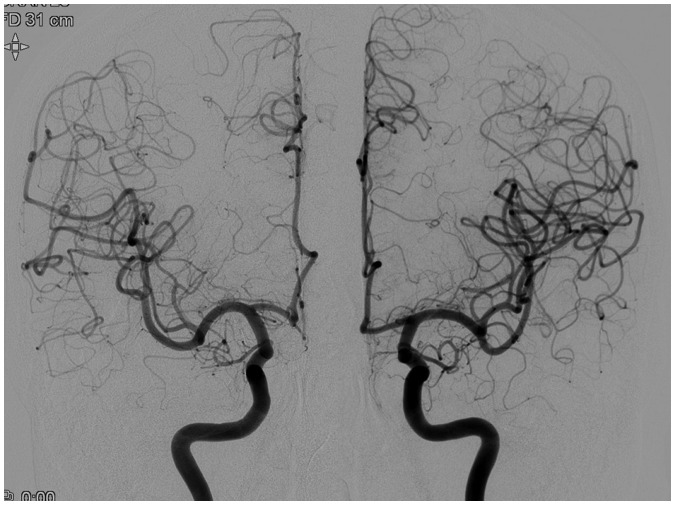
Radiation dose and image quality were analyzed by varying the filtration and focal spot size on digital subtraction angiography exposure protocols (1, inherent filtration + large focus; 2, inherent + small; 3, copper + large; 4, copper + small). For the analysis, a phantom was used for comparison of radiation dose. For the analysis, bilateral paired injections, and patient cohort groups were compared for radiation dose and image quality. Image quality analysis was performed in terms of contrast, sharpness, noise, and overall quality.
In the analysis, the mean air kerma (AK) and dose area product (DAP)/frame were significantly lower with added copper filtration (protocols 3 and 4). In the bilateral paired injections, AK and DAP/frame were significantly lower with filtration, without significant difference in image quality. The patient cohort groups with added filtration (protocols 3 and 4) showed significant reduction of total AK and DAP/patient without compromise to the image quality. Variations in focal spot size showed no significant differences in radiation dose and image quality.
Addition of filtration for angiographic exposure studies can result in significant total radiation dose reduction without loss of image quality. Focal spot size does not influence radiation dose and image quality. The routine angiographic protocol should be judiciously investigated and implemented.
不同的血管造影方案可能会影响辐射剂量和图像质量。在本研究中,我们旨在使用模型和患者组来研究过滤和焦点尺寸对诊断性脑血管造影的辐射剂量和图像质量的影响。
通过在数字减影血管造影曝光方案(1,固有过滤+大焦点;2,固有+小焦点;3,铜过滤+大焦点;4,铜过滤+小焦点)上改变过滤和焦点尺寸来分析辐射剂量和图像质量。对于模型分析,使用体模来比较辐射剂量。对于患者分析,比较双侧配对注射以及患者队列组的辐射剂量和图像质量。图像质量分析从对比度、清晰度、噪声和整体质量方面进行。
在模型分析中,添加铜过滤(方案3和4)时,平均空气比释动能(AK)和剂量面积乘积(DAP)/帧显著更低。在患者双侧配对注射中,过滤时AK和DAP/帧显著更低,图像质量无显著差异。添加过滤(方案3和4)的患者队列组显示总AK和DAP/患者显著降低,且不影响图像质量。焦点尺寸的变化在辐射剂量和图像质量方面无显著差异。
在血管造影曝光研究中添加过滤可显著降低总辐射剂量且不损失图像质量。焦点尺寸不影响辐射剂量和图像质量。应审慎研究并实施常规血管造影方案。