Wei Shu-Chen, Chang Ting-An, Chao Te-Hsin, Chen Jinn-Shiun, Chou Jen-Wei, Chou Yenn-Hwei, Chuang Chiao-Hsiung, Hsu Wen-Hung, Huang Tien-Yu, Hsu Tzu-Chi, Lin Chun-Chi, Lin Hung-Hsin, Lin Jen-Kou, Lin Wei-Chen, Ni Yen-Hsuan, Shieh Ming-Jium, Shih I-Lun, Shun Chia-Tung, Tsang Yuk-Ming, Wang Cheng-Yi, Wang Horng-Yuan, Weng Meng-Tzu, Wu Deng-Chyang, Wu Wen-Chieh, Yen Hsu-Heng, Wong Jau-Min
Department of Internal Medicine, National Taiwan University Hospital, National Taiwan University College of Medicine, Taipei, Taiwan.
Department of Pathology, Taipei City Hospital Renai Branch, Taipei, Taiwan.
Intest Res. 2017 Jul;15(3):266-284. doi: 10.5217/ir.2017.15.3.266. Epub 2017 Jun 12.
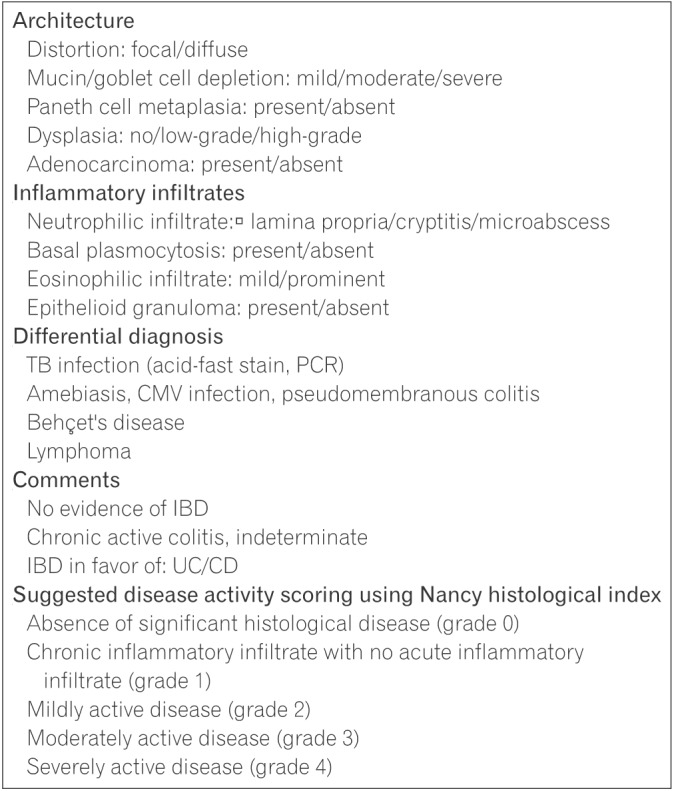
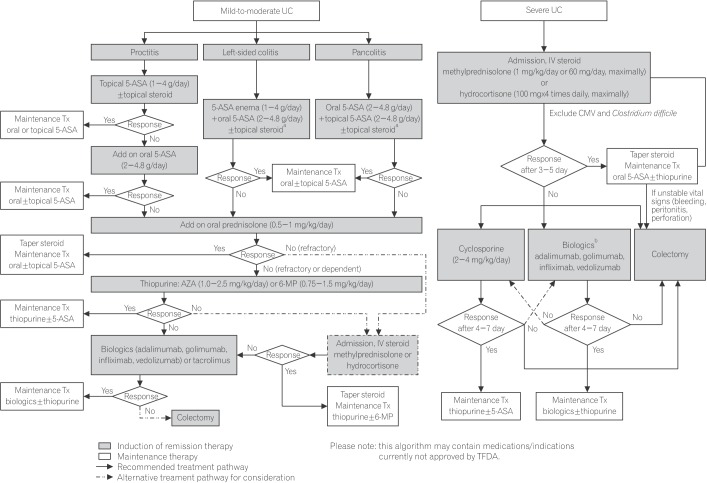
Ulcerative colitis (UC) is an inflammatory bowel disease characterized by chronic mucosal inflammation of the colon, and the prevalence and incidence of UC have been steadily increasing in Taiwan. A steering committee was established by the Taiwan Society of Inflammatory Bowel Disease to formulate statements on the diagnosis and management of UC taking into account currently available evidence and the expert opinion of the committee. Accurate diagnosis of UC requires thorough clinical, endoscopic, and histological assessment and careful exclusion of differential diagnoses, particularly infectious colitis. The goals of UC therapy are to induce and maintain remission, reduce the risk of complications, and improve quality of life. As outlined in the recommended treatment algorithm, choice of treatment is dictated by severity, extent, and course of disease. Patients should be evaluated for hepatitis B virus and tuberculosis infection prior to immunosuppressive treatment, especially with steroids and biologic agents, and should be regularly monitored for reactivation of latent infection. These consensus statements are also based on current local evidence with consideration of factors, and could be serve as concise and practical guidelines for supporting clinicians in the management of UC in Taiwan.
溃疡性结肠炎(UC)是一种以结肠慢性黏膜炎症为特征的炎症性肠病,在台湾,UC的患病率和发病率一直在稳步上升。台湾炎症性肠病学会成立了一个指导委员会,以结合现有证据和委员会的专家意见,制定关于UC诊断和管理的声明。UC的准确诊断需要全面的临床、内镜和组织学评估,并仔细排除鉴别诊断,尤其是感染性结肠炎。UC治疗的目标是诱导并维持缓解、降低并发症风险以及改善生活质量。正如推荐的治疗算法中所概述的,治疗方案的选择取决于疾病的严重程度、范围和病程。在进行免疫抑制治疗之前,尤其是使用类固醇和生物制剂时,应对患者进行乙型肝炎病毒和结核感染评估,并应定期监测潜伏感染的再激活情况。这些共识声明也是基于当前的本地证据并考虑了相关因素,可作为简洁实用的指南,支持台湾临床医生对UC的管理。