Besga Ariadna, Chyzhyk Darya, Gonzalez-Ortega Itxaso, Echeveste Jon, Graña-Lecuona Marina, Graña Manuel, Gonzalez-Pinto Ana
Centre for Biomedical Research Network on Mental HealthSpain.
Department of Internal Medicine of Hospital Universitario de AlavaVitoria, Spain.
Front Aging Neurosci. 2017 Jun 16;9:179. doi: 10.3389/fnagi.2017.00179. eCollection 2017.
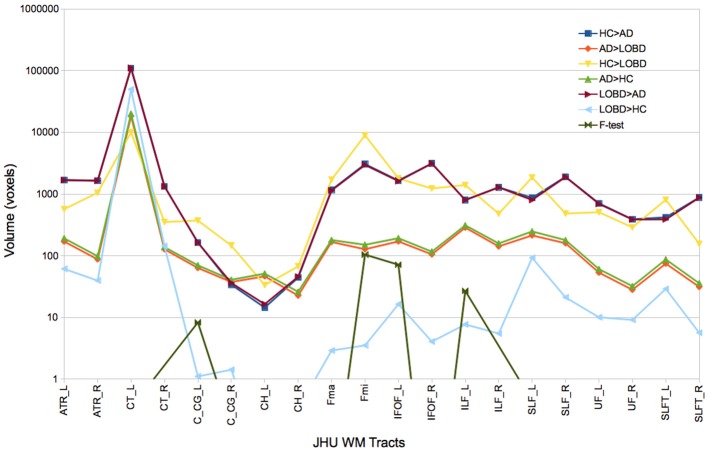
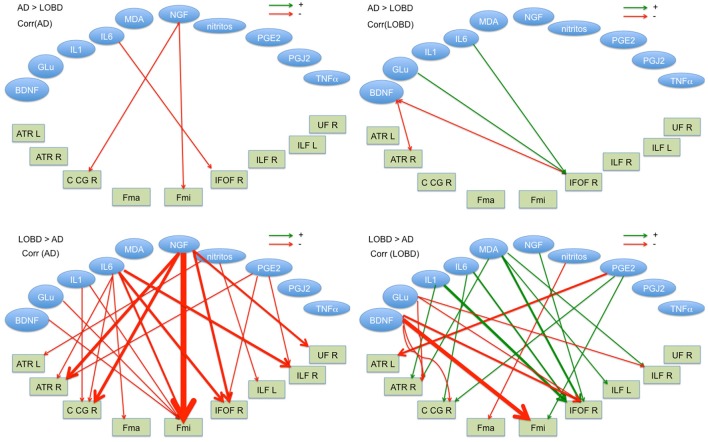
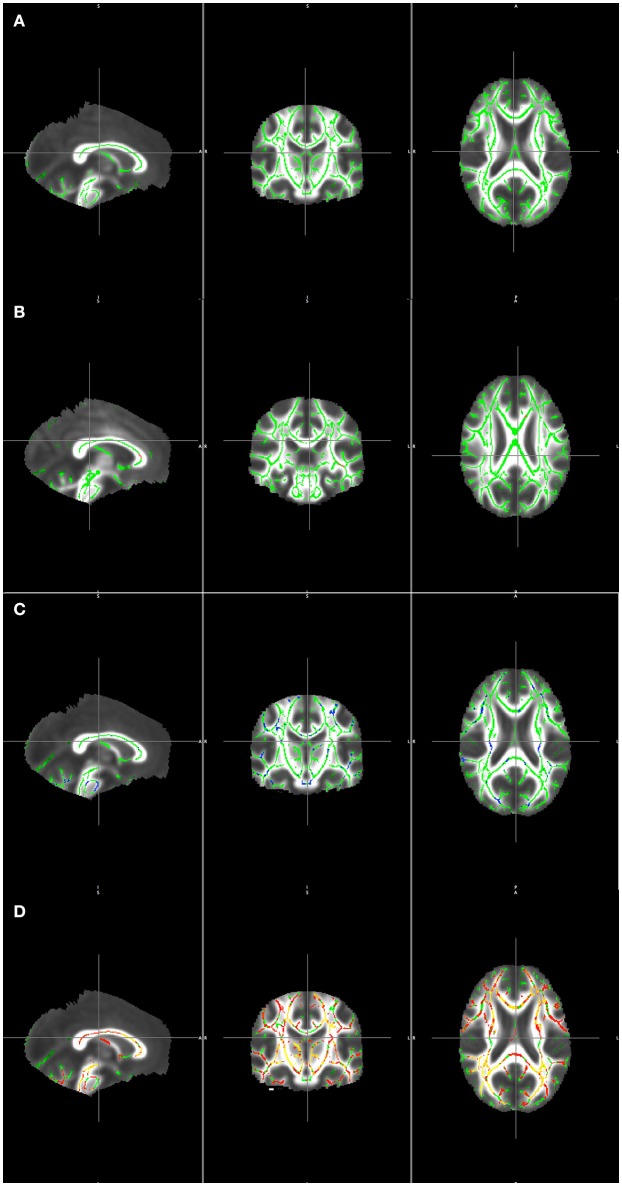
Late Onset Bipolar Disorder (LOBD) is the development of Bipolar Disorder (BD) at an age above 50 years old. It is often difficult to differentiate from other aging dementias, such as Alzheimer's Disease (AD), because they share cognitive and behavioral impairment symptoms. We look for WM tract voxel clusters showing significant differences when comparing of AD vs. LOBD, and its correlations with systemic blood plasma biomarkers (inflammatory, neurotrophic factors, and oxidative stress). A sample of healthy controls (HC) ( = 19), AD patients ( = 35), and LOBD patients ( = 24) was recruited at the Alava University Hospital. Blood plasma samples were obtained at recruitment time and analyzed to extract the inflammatory, oxidative stress, and neurotrophic factors. Several modalities of MRI were acquired for each subject, Fractional anisotropy (FA) coefficients are obtained from diffusion weighted imaging (DWI). Tract based spatial statistics (TBSS) finds FA skeleton clusters of WM tract voxels showing significant differences for all possible contrasts between HC, AD, and LOBD. An ANOVA -test over all contrasts is carried out. Results of -test are used to mask TBSS detected clusters for the AD > LOBD and LOBD > AD contrast to select the image clusters used for correlation analysis. Finally, Pearson's correlation coefficients between FA values at cluster sites and systemic blood plasma biomarker values are computed. The TBSS contrasts with by ANOVA -test has identified strongly significant clusters in the forceps minor, inferior longitudinal fasciculus, inferior fronto-occipital fasciculus, and cingulum gyrus. The correlation analysis of these tract clusters found strong negative correlation of AD with the nerve growth factor (NGF) and brain derived neurotrophic factor (BDNF) blood biomarkers. Negative correlation of AD and positive correlation of LOBD with inflammation biomarker IL6 was also found. TBSS voxel clusters tract atlas localizations are consistent with greater behavioral impairment and mood disorders in LOBD than in AD. Correlation analysis confirms that neurotrophic factors (i.e., NGF, BDNF) play a great role in AD while are absent in LOBD pathophysiology. Also, correlation results of IL1 and IL6 suggest stronger inflammatory effects in LOBD than in AD.
迟发性双相情感障碍(LOBD)是指在50岁以上发病的双相情感障碍(BD)。它通常很难与其他老年痴呆症区分开来,比如阿尔茨海默病(AD),因为它们有共同的认知和行为损害症状。我们寻找在比较AD与LOBD时显示出显著差异的白质束体素簇,以及其与全身血浆生物标志物(炎症、神经营养因子和氧化应激)的相关性。在阿拉瓦大学医院招募了健康对照组(HC)(n = 19)、AD患者(n = 35)和LOBD患者(n = 24)的样本。在招募时采集血浆样本并进行分析,以提取炎症、氧化应激和神经营养因子。为每个受试者采集了几种MRI模态,从扩散加权成像(DWI)中获得分数各向异性(FA)系数。基于体素的空间统计学(TBSS)找出白质束体素的FA骨架簇,这些簇在HC、AD和LOBD之间的所有可能对比中显示出显著差异。对所有对比进行方差分析(ANOVA)检验。t检验的结果用于掩盖TBSS检测到的AD > LOBD和LOBD > AD对比的簇,以选择用于相关性分析的图像簇。最后,计算簇位点处的FA值与全身血浆生物标志物值之间的皮尔逊相关系数。通过方差分析检验的TBSS对比在小钳、下纵束、下额枕束和扣带回中识别出了高度显著的簇。这些束簇的相关性分析发现,AD与神经生长因子(NGF)和脑源性神经营养因子(BDNF)血液生物标志物呈强烈负相关。还发现AD与炎症生物标志物IL6呈负相关,而LOBD与炎症生物标志物IL6呈正相关。TBSS体素簇束图谱定位与LOBD中比AD中更严重的行为损害和情绪障碍一致。相关性分析证实,神经营养因子(即NGF、BDNF)在AD中起重要作用,而在LOBD病理生理学中不存在。此外,IL1和IL6的相关性结果表明,LOBD中的炎症效应比AD中更强。