Mumtaz Aaida, Khalid Aqsa, Jamil Zehra, Fatima Syeda Sadia, Arif Sara, Rehman Rehana
Medical College, Aga Khan University, Karachi, Pakistan.
Biological and Biomedical Sciences, Aga Khan University, Karachi, Pakistan.
Int J Fertil Steril. 2017 Jul-Sep;11(2):99-104. doi: 10.22074/ijfs.2017.4957. Epub 2017 Feb 16.
Kisspeptin (KP) is a neuropeptide that causes the release of the gonadotropin releasing hormone, which controls hypothalamo pituitary ovarian axis and exerts a number of peripheral effects on reproductive organs. The primary objective of this study was to compare baseline KP levels in females with different types of infertility and identify possible correlations with risk of failure to conceive, preclinical abortion and pregnancy after intracytoplasmic sperm injection (ICSI).
A longitudinal cohort study was carried out from August 2014 until May 2015 by recruiting 124 female patients undergoing ICSI, after obtaining ethical approval from the Australian Concept Infertility Medical Center. Cause of infertility due to male, female and unexplained factors was at a frequency of 32 (24%), 33 (31%) and 59 (45%) among the individuals respectively. KP levels were measured by ELISA assay before the initiation of the ICSI treatment protocol. Outcome of ICSI was categorized into three groups of non-pregnant with beta-human chorionic gonadotropin (β-hCG)<5-25 mIU/ml, preclinical abortion with β-hCG>25 mIU/ml and no cardiac activity, and clinical pregnancy declared upon confirmation of cardiac activity. Results based on cause of infertility and outcome groups were analyzed by one-way ANOVA.
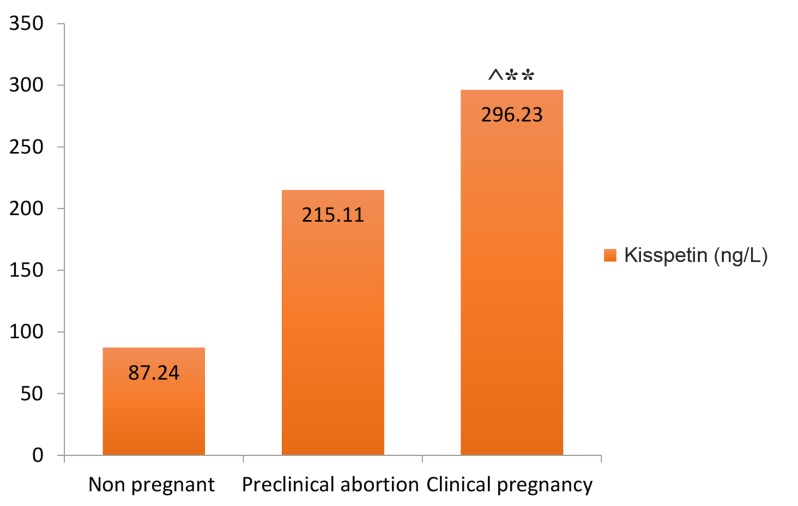
Females with unexplained infertility had significantly lower levels of KP when compared with those with male factor infertility (176.69 ± 5.03 vs. 397.6 ± 58.2, P=0.001). Clinical pregnancy was observed in 28 (23%) females of which 17 (71%) had a female cause of infertility. In the non-pregnant group of 66 (53%) females, common cause of infertility was unexplained 56(85%). A weak positive correlation of KP levels with fertilized oocytes and endometrial thickness was observed (P=0.04 and 0.01 respectively).
Deficiency of KP in females with unexplained infertility was associated with reduced chances of implantation after ICSI.
kisspeptin(KP)是一种神经肽,可导致促性腺激素释放激素的释放,该激素控制下丘脑 - 垂体 - 卵巢轴,并对生殖器官产生多种外周作用。本研究的主要目的是比较不同类型不孕症女性的基线KP水平,并确定与受孕失败、临床前流产和卵胞浆内单精子注射(ICSI)后妊娠风险的可能相关性。
2014年8月至2015年5月进行了一项纵向队列研究,在获得澳大利亚概念不孕医学中心的伦理批准后,招募了124名接受ICSI的女性患者。男性、女性和不明原因因素导致的不孕原因在个体中的发生率分别为32例(24%)、33例(31%)和59例(45%)。在启动ICSI治疗方案之前,通过ELISA测定法测量KP水平。ICSI的结果分为三组:β-人绒毛膜促性腺激素(β-hCG)<5-25 mIU/ml的未妊娠组、β-hCG>25 mIU/ml且无心脏活动的临床前流产组以及确认有心脏活动后宣布的临床妊娠组。根据不孕原因和结果组的结果通过单因素方差分析进行分析。
与男性因素不孕的女性相比,不明原因不孕的女性KP水平显著降低(176.69±5.03 vs. 397.6±58.2,P = 0.001)。28名(23%)女性观察到临床妊娠,其中17名(71%)有女性不孕原因。在66名(53%)未妊娠女性组中,不孕的常见原因是不明原因56例(85%)。观察到KP水平与受精卵和子宫内膜厚度呈弱正相关(分别为P = 0.04和0.01)。
不明原因不孕女性的KP缺乏与ICSI后着床机会减少有关。