1 Center of Excellence in Rehabilitation Medicine, Brain Center Rudolf Magnus, University Medical Center Utrecht and De Hoogstraat Rehabilitation, Utrecht, The Netherlands.
2 Department of Neurology, Brain Center Rudolf Magnus, University Medical Center Utrecht, Utrecht, The Netherlands.
Palliat Med. 2018 Jan;32(1):231-245. doi: 10.1177/0269216317709965. Epub 2017 Jul 3.
Informal caregivers of patients with amyotrophic lateral sclerosis experience increased levels of caregiver burden as the disease progresses. Insight in the factors related to caregiver burden is needed in order to develop supportive interventions.
To evaluate the evidence on patient and caregiver factors associated with caregiver burden in amyotrophic lateral sclerosis informal caregivers.
A systematic review.
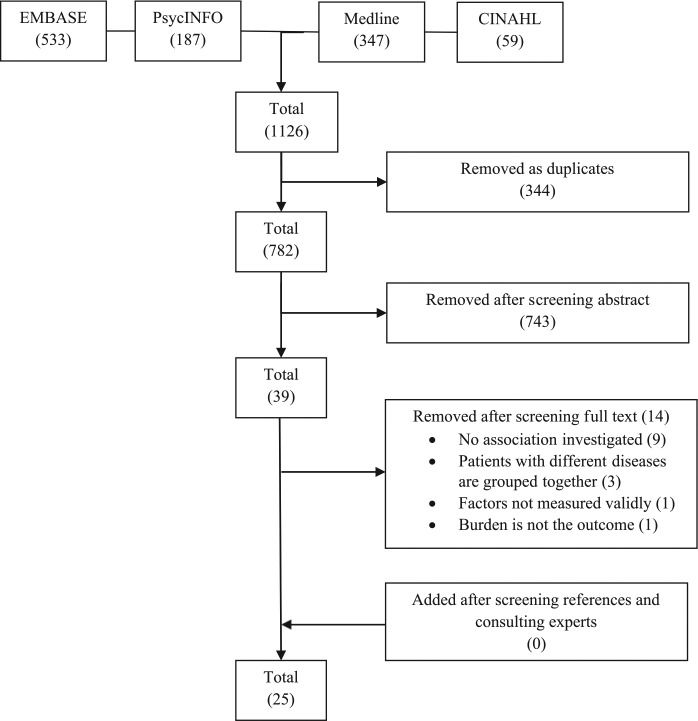
Four electronic databases were searched up to 2017. Studies that investigated quantitative relations between patient or caregiver factors and caregiver burden were included. The overall quality of evidence for factors was assessed using the Grading of Recommendations Assessment, Development and Evaluation approach.
A total of 25 articles were included. High quality of evidence was found for the relation between caregiver burden and the factor "behavioral impairments." Moderate quality of evidence was found for the relations between caregiver burden and the factors "feelings of depression" of the caregiver and "physical functioning" of the patient. The remaining rated caregiver factors-"feelings of anxiety," "distress," "social support," "family functioning," and "age"-and patient factors-"bulbar function," "motor function," "respiratory function," "disease duration," "disinhibition," "executive functioning," "cognitive functioning," "feelings of depression," and "age"-showed low to very low quality of evidence for their association with caregiver burden.
Higher caregiver burden is associated with greater behavioral and physical impairment of the patient and with more depressive feelings of the caregiver. This knowledge enables the identification of caregivers at risk for caregiver burden and guides the development of interventions to diminish caregiver burden.
随着疾病的进展,肌萎缩侧索硬化症患者的非专业照护者的照护负担会增加。为了制定支持性干预措施,需要了解与照护负担相关的因素。
评估与肌萎缩侧索硬化症非专业照护者的照护负担相关的患者和照护者因素的证据。
系统评价。
四个电子数据库检索至 2017 年。纳入了调查患者或照护者因素与照护者负担之间定量关系的研究。使用推荐评估、制定与评估分级方法评估了因素的总体证据质量。
共纳入 25 篇文章。发现照护者负担与“行为障碍”因素之间存在高度证据质量关系。发现照护者负担与照护者“抑郁情绪”和患者“躯体功能”之间存在中度证据质量关系。其余评估的照护者因素——“焦虑情绪”、“痛苦”、“社会支持”、“家庭功能”和“年龄”,以及患者因素——“球部功能”、“运动功能”、“呼吸功能”、“疾病持续时间”、“脱抑制”、“执行功能”、“认知功能”、“抑郁情绪”和“年龄”——与照护者负担的相关性证据质量为低到极低。
照护者负担与患者的行为和躯体功能障碍程度更高,以及照护者的抑郁情绪更严重有关。这些知识可帮助识别有照护负担风险的照护者,并指导制定减轻照护负担的干预措施。