Kong Eunjung, Chun Kyung Ah, Cho Ihn Ho
Department of Nuclear Medicine, Yeungnam University Medical School and Hospital, Daegu, Republic of Korea.
PLoS One. 2017 Jul 3;12(7):e0180184. doi: 10.1371/journal.pone.0180184. eCollection 2017.
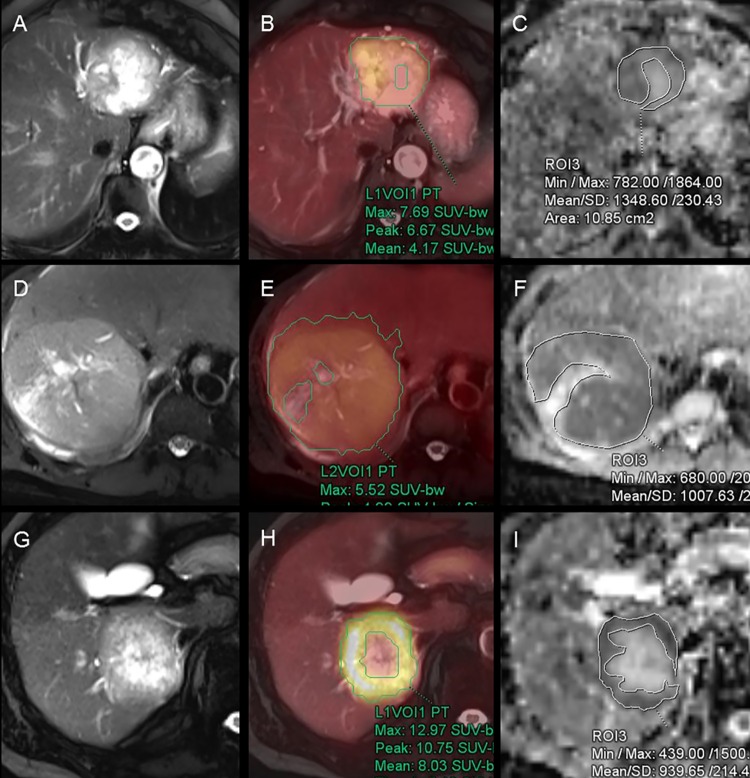
Metabolism and water diffusion may have a relationship or an effect on each other in the same tumor. Knowledge of their relationship could expand the understanding of tumor biology and serve the field of oncologic imaging. This study aimed to evaluate the relationship between metabolism and water diffusivity in hepatic tumors using a simultaneous positron emission tomography/magnetic resonance imaging (PET/MRI) system with F-18 fluorodeoxyglucose (FDG) and to reveal the metabolic and diffusional characteristics of each type of hepatic tumor.
Forty-one patients (mean age 63 ± 13 years, 31 male) with hepatic tumors (18 hepatocellular carcinoma [HCC], six cholangiocarcinoma [CCC], 10 metastatic tumors, one neuroendocrine malignancy, and six benign lesions) underwent FDG PET/MRI before treatment. Maximum standard uptake (SUVmax) values from FDG PET and the apparent diffusion coefficient (ADC) from the diffusion-weighted images were obtained for the tumor and their relationships were examined. We also investigated the difference in SUVmax and ADC for each type of tumor.
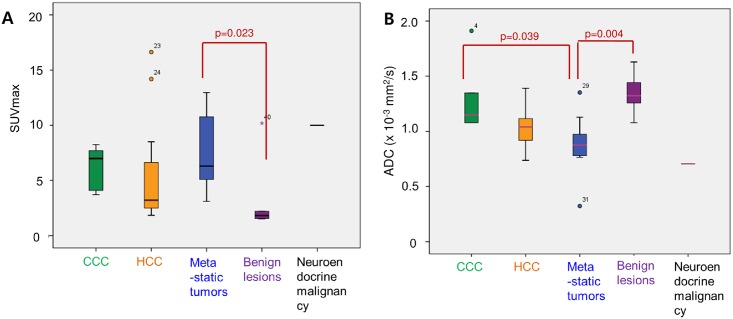
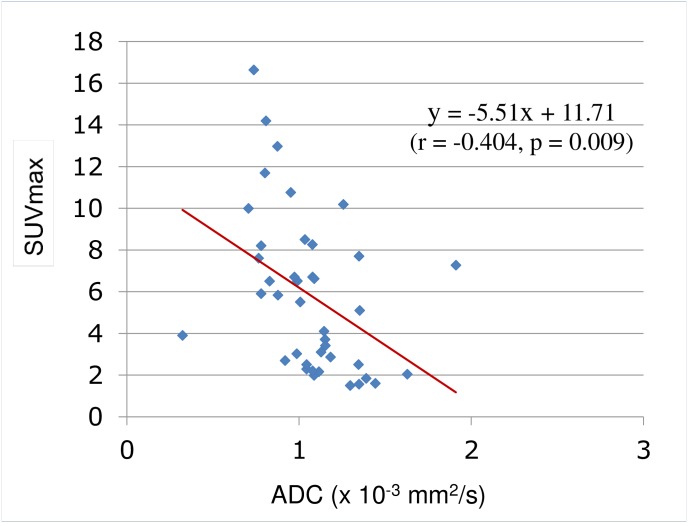
SUVmax showed a negative correlation with ADC (r = -0.404, p = 0.009). The median of SUVmax was 3.22 in HCC, 6.99 in CCC, 6.30 in metastatic tumors, and 1.82 in benign lesions. The median of ADC was 1.039 × 10⁻³ mm/s2 in HCC, 1.148 × 10⁻³ mm/s2 in CCC, 0.876 × 10⁻³ mm/s2 in metastatic tumors, and 1.323 × 10⁻³ mm/s2 in benign lesions. SUVmax was higher in metastatic tumors than in benign lesions (p = 0.023). Metastatic tumors had a lower ADC than CCC (p = 0.039) and benign lesions (p = 0.004). HCC had a lower ADC than benign lesions, with a suggestive trend (p = 0.06).
Our results indicate that SUVmax is negatively correlated with ADC in hepatic tumors, and each group of tumors has different metabolic and water diffusivity characteristics. Evaluation of hepatic tumors by PET/MRI could be helpful in understanding tumor characteristics.
在同一肿瘤中,代谢与水扩散可能相互关联或相互影响。了解它们之间的关系有助于拓展对肿瘤生物学的认识,并服务于肿瘤影像学领域。本研究旨在使用配备F-18氟脱氧葡萄糖(FDG)的正电子发射断层扫描/磁共振成像(PET/MRI)系统评估肝肿瘤中代谢与水扩散率之间的关系,并揭示每种类型肝肿瘤的代谢和扩散特征。
41例肝肿瘤患者(平均年龄63±13岁,男性31例)(18例肝细胞癌[HCC]、6例胆管癌[CCC]、10例转移瘤、1例神经内分泌恶性肿瘤和6例良性病变)在治疗前接受了FDG PET/MRI检查。获取肿瘤的FDG PET最大标准摄取值(SUVmax)和扩散加权图像的表观扩散系数(ADC),并检查它们之间的关系。我们还研究了每种肿瘤类型在SUVmax和ADC方面的差异。
SUVmax与ADC呈负相关(r = -0.404,p = 0.009)。HCC的SUVmax中位数为3.22,CCC为6.99,转移瘤为6.30,良性病变为1.82。HCC的ADC中位数为1.039×10⁻³mm/s2,CCC为1.148×10-3mm/s2,转移瘤为0.876×10-3mm/s2,良性病变为1.323×10-3mm/s2。转移瘤的SUVmax高于良性病变(p = 0.023)。转移瘤的ADC低于CCC(p = 0.039)和良性病变(p = 0.004)。HCC的ADC低于良性病变,有提示性趋势(p = 0.06)。
我们的结果表明,肝肿瘤中SUVmax与ADC呈负相关,且每组肿瘤具有不同的代谢和水扩散特征。PET/MRI对肝肿瘤的评估有助于了解肿瘤特征。