Floberg John M, Fowler Kathryn J, Fuser Dominique, DeWees Todd A, Dehdashti Farrokh, Siegel Barry A, Wahl Richard L, Schwarz Julie K, Grigsby Perry W
Department of Radiation Oncology, Washington University School of Medicine, 660 S. Euclid Ave, Box 8224, St. Louis, MO, 63110, USA.
Mallinckrodt Institute of Radiology, Washington University School of Medicine, 660 S. Euclid Ave, Box 8131, St. Louis, MO, 63110, USA.
EJNMMI Res. 2018 Jun 15;8(1):52. doi: 10.1186/s13550-018-0403-7.
This study investigated the spatial relationship of 2-deoxy-2-[F]-fluoro-D-glucose positron emission tomography ([F]FDG-PET) standardized uptake values (SUVs) and apparent diffusion coefficients (ADCs) derived from magnetic resonance (MR) diffusion imaging on a voxel level using simultaneously acquired PET/MR data. We performed an institutional retrospective analysis of patients with newly diagnosed cervical cancer who received a pre-treatment simultaneously acquired [F]FDG-PET/MR. Voxel SUV and ADC values, and global tumor metrics including maximum SUV (SUV), mean ADC (ADC), and mean tumor-to-muscle ADC ratio (ADC) were compared. The impacts of histology, grade, and tumor volume on the voxel SUV to ADC relationship were also evaluated. The potential prognostic value of the voxel SUV/ADC relationship was evaluated in an exploratory analysis using Kaplan-Meier/log-rank and univariate Cox analysis.
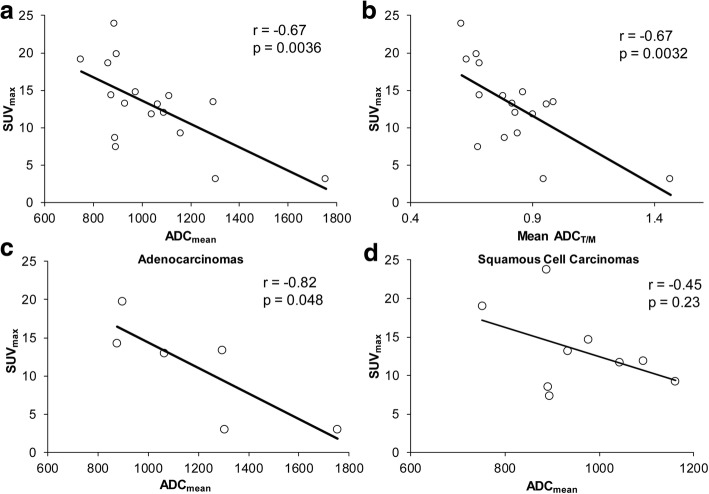
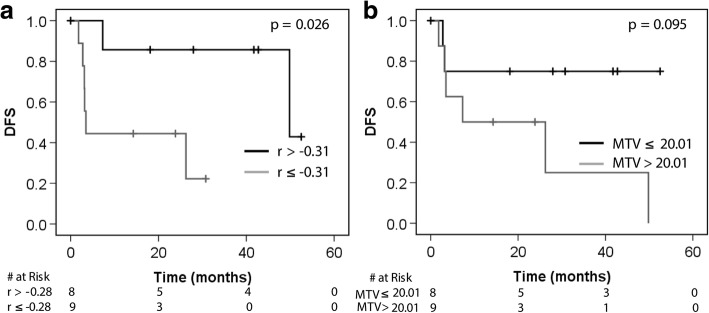
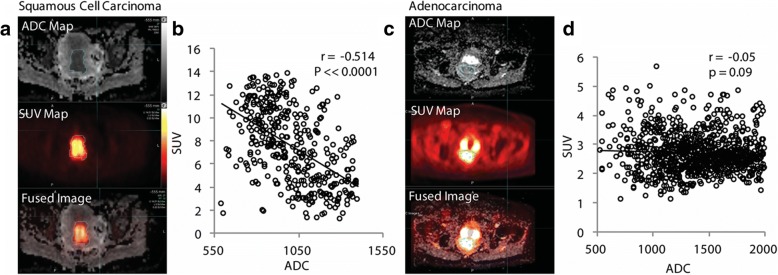
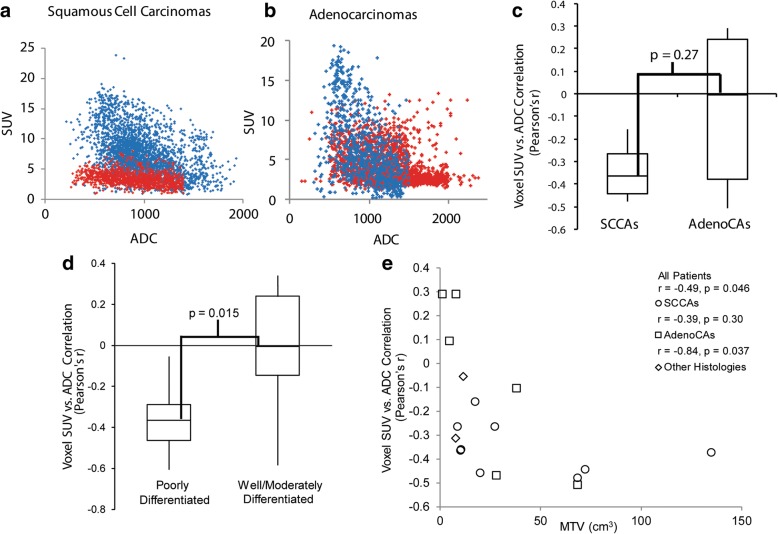
Seventeen patients with PET/MR scans were identified. There was a significant inverse correlation between SUV and ADC, and SUV and ADC. In the voxelwise analysis, squamous cell carcinomas (SCCAs) and poorly differentiated tumors showed a consistent significant inverse correlation between voxel SUV and ADC values; adenocarcinomas (AdenoCAs) and well/moderately differentiated tumors did not. The strength of the voxel SUV/ADC correlation varied with metabolic tumor volume (MTV). On log-rank analysis, the correlation between voxel SUV/ADC values was prognostic of disease-free survival (DFS).
In this hypothesis-generating study, a consistent inverse correlation between voxel SUV and ADC values was seen in SCCAs and poorly differentiated tumors. On univariate statistical analysis, correlation between voxel SUV and ADC values was prognostic for DFS.
本研究使用同时采集的PET/MR数据,在体素水平上研究了2-脱氧-2-[F]-氟-D-葡萄糖正电子发射断层扫描([F]FDG-PET)标准化摄取值(SUVs)与磁共振(MR)扩散成像得出的表观扩散系数(ADCs)之间的空间关系。我们对新诊断的宫颈癌患者进行了一项机构回顾性分析,这些患者在治疗前同时接受了[F]FDG-PET/MR检查。比较了体素SUV和ADC值,以及包括最大SUV(SUV)、平均ADC(ADC)和平均肿瘤与肌肉ADC比值(ADC)在内的整体肿瘤指标。还评估了组织学、分级和肿瘤体积对体素SUV与ADC关系的影响。在一项探索性分析中,使用Kaplan-Meier/对数秩检验和单变量Cox分析评估了体素SUV/ADC关系的潜在预后价值。
确定了17例进行PET/MR扫描的患者。SUV与ADC以及SUV与ADC之间存在显著的负相关。在体素分析中,鳞状细胞癌(SCCAs)和低分化肿瘤在体素SUV与ADC值之间显示出一致的显著负相关;腺癌(AdenoCAs)和高/中分化肿瘤则没有。体素SUV/ADC相关性的强度随代谢肿瘤体积(MTV)而变化。对数秩分析显示,体素SUV/ADC值之间的相关性对无病生存期(DFS)具有预后意义。
在这项产生假设的研究中,SCCAs和低分化肿瘤在体素SUV与ADC值之间存在一致的负相关。单变量统计分析显示,体素SUV与ADC值之间的相关性对DFS具有预后意义。