Lee Changhyun, Doo Eunyoung, Choi Ji Min, Jang Seung-Ho, Ryu Han-Seung, Lee Ju Yup, Oh Jung Hwan, Park Jung Ho, Kim Yong Sung
Department of Internal Medicine and Healthcare Research Institute, Healthcare System Gangnam Center, Seoul National University Hospital, Seoul, Korea.
Department of Psychiatry, School of Medicine, Wonkwang University, Iksan, Jeollabuk-do, Korea.
J Neurogastroenterol Motil. 2017 Jul 30;23(3):349-362. doi: 10.5056/jnm16220.
BACKGROUND/AIMS: Irritable bowel syndrome (IBS) patients commonly experience psychiatric disorders, such as depression and anxiety. This meta-analysis sought to compare depression and anxiety levels between IBS patients and healthy controls.
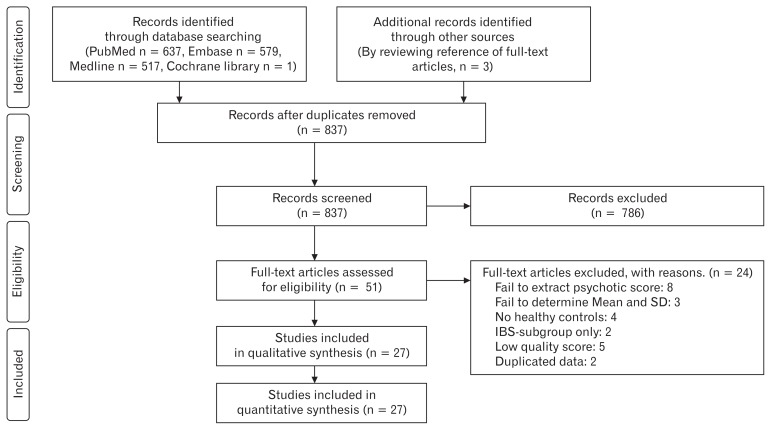
We searched major electronic databases (PubMed, EMBASE, MEDLINE, and Cochrane library) to find comparative studies on IBS patients and healthy controls. The primary outcome was a standardized mean difference (SMD) of anxiety and depression levels; sub-group analyses were conducted according to IBS-subtypes.
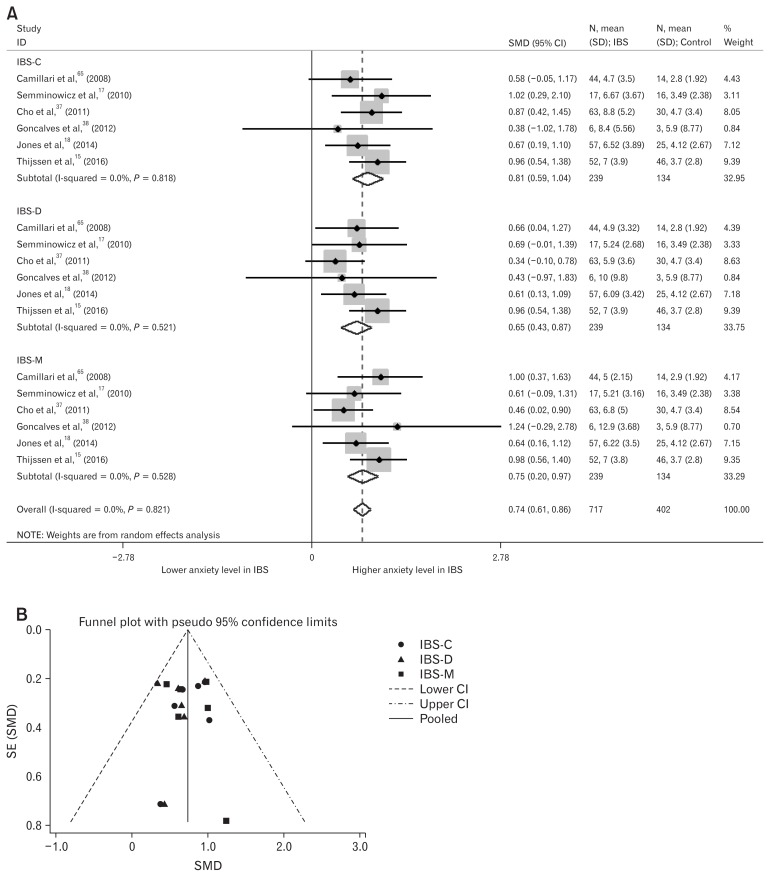
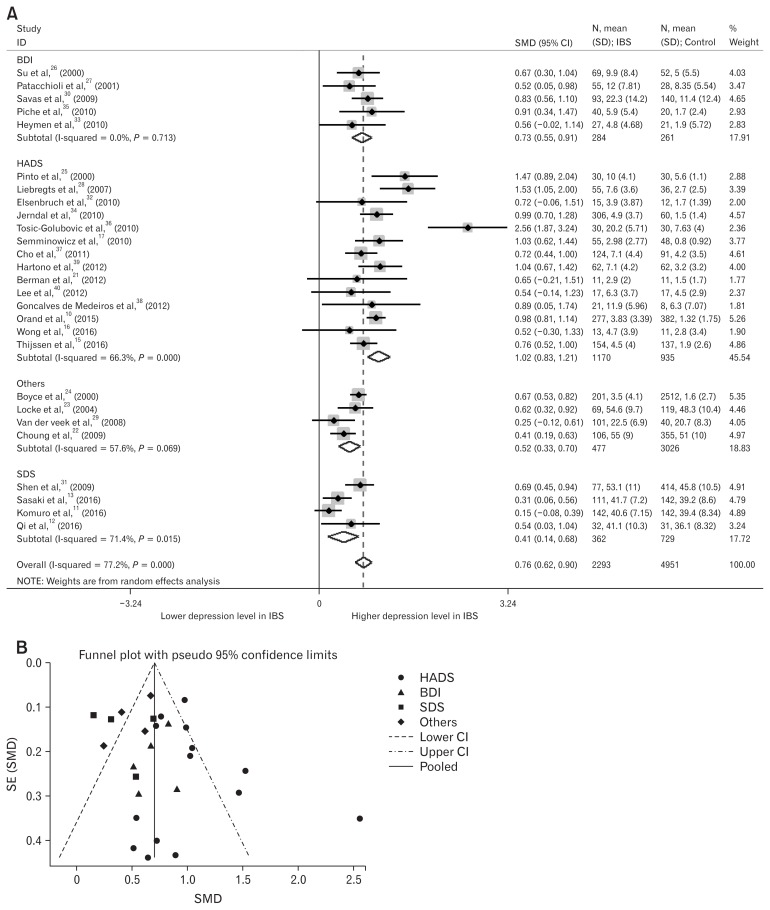
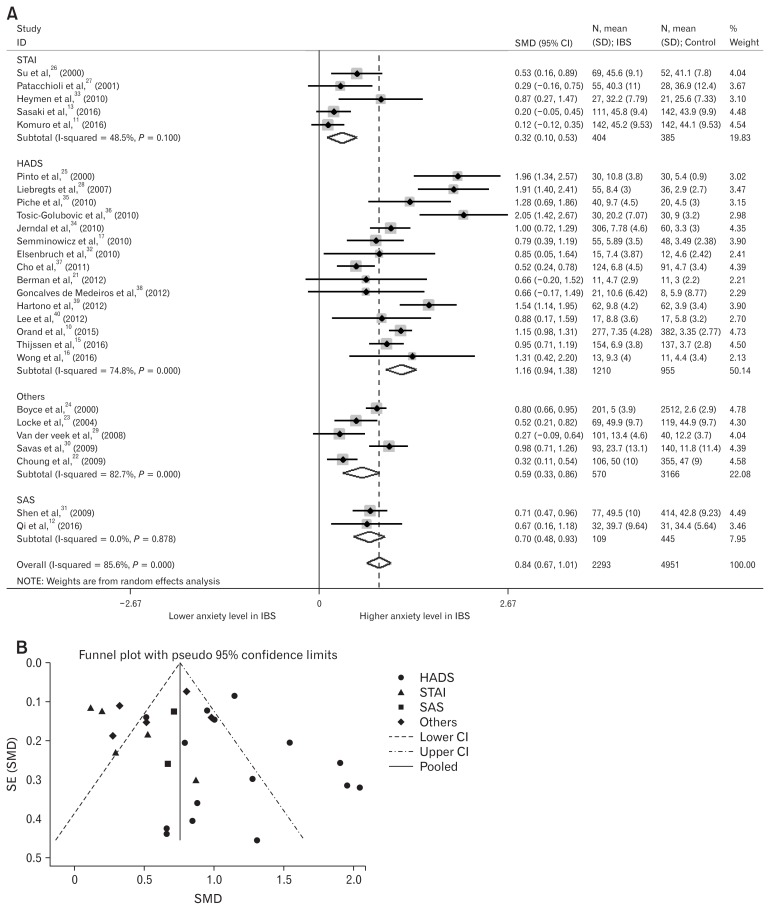
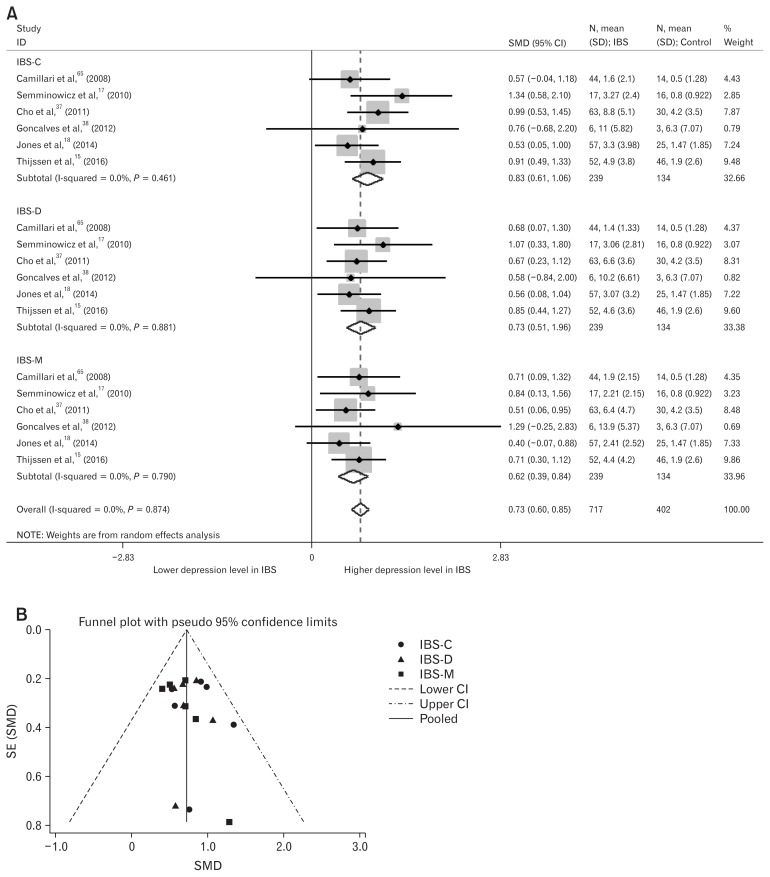
In total, 2293 IBS patients and 4951 healthy controls from 27 studies were included. In random effect analysis, depression and anxiety levels were significantly higher in IBS patients (pooled SMD = 0.76; 95% CI, 0.62-0.90; < 0.001; = 77.2% and pooled SMD = 0.84; 95% CI, 0.67-1.01; < 0.001; = 85.6%, respectively). Both analyses' funnel plots showed symmetry. In meta-regression analysis, heterogeneity was due to the studied region and questionnaire type for both depression and anxiety. In sub-group analyses of IBS-subtype, the pooled SMDs of depression and anxiety levels (IBS with predominant constipation: 0.83 and 0.81, IBS with predominant diarrhea: 0.73 and 0.65, and IBS with mixed bowel habits: 0.62 and 0.75; < 0.001, respectively) were significantly higher in all IBS-subtypes.
The present meta-analysis showed depression and anxiety levels to be higher in IBS patients than in healthy controls, regardless of IBS-subtype. However, the gender effect on psychological factors among IBS patients could not be determined and should be evaluated in prospective studies.
背景/目的:肠易激综合征(IBS)患者常伴有精神障碍,如抑郁和焦虑。本荟萃分析旨在比较IBS患者与健康对照者的抑郁和焦虑水平。
我们检索了主要电子数据库(PubMed、EMBASE、MEDLINE和Cochrane图书馆),以查找关于IBS患者与健康对照者的比较研究。主要结局是焦虑和抑郁水平的标准化均值差(SMD);根据IBS亚型进行亚组分析。
总共纳入了来自27项研究的2293例IBS患者和4951例健康对照者。在随机效应分析中,IBS患者的抑郁和焦虑水平显著更高(合并SMD = 0.76;95% CI,0.62 - 0.90;P < 0.001;I² = 77.2%,合并SMD = 0.84;95% CI,0.67 - 1.01;P < 0.001;I² = 85.6%)。两项分析的漏斗图均显示对称。在meta回归分析中,抑郁和焦虑的异质性均归因于研究地区和问卷类型。在IBS亚型的亚组分析中,所有IBS亚型的抑郁和焦虑水平合并SMD(以便秘为主的IBS:0.83和0.81,以腹泻为主的IBS:0.73和0.65,以及混合型IBS:0.62和0.75;P均 < 0.001)均显著更高。
本荟萃分析表明,无论IBS亚型如何,IBS患者的抑郁和焦虑水平均高于健康对照者。然而,IBS患者心理因素的性别效应尚无法确定,应在前瞻性研究中进行评估。