Zou Runmei, Xue Junli, Huang Qi, Dai Zhe, Xu Yancheng
Department of Endocrinology, Zhongnan Hospital of Wuhan University, Wuhan, Hubei 430071, P.R. China.
Children's Medical Center, The Second Xiangya Hospital of Central South University, Changsha, Hunan 410011, P.R. China.
Exp Ther Med. 2017 Jul;14(1):483-494. doi: 10.3892/etm.2017.4544. Epub 2017 Jun 2.
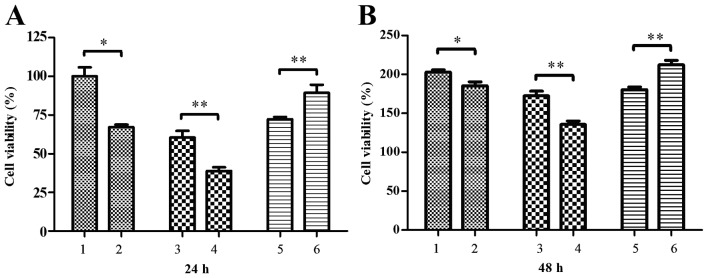
Receptor-interacting protein 140 (RIP140) in macrophages stimulates the nuclear factor-κB subunit RelA to activate tumor necrosis factor (TNF)-α and interleukin (IL)-6 transcription. However, under lipotoxic conditions, the involvement of RIP140 in the infiltration of beta cells by macrophages remains unknown. In the present study, murine RAW264.7 macrophages were transfected with a RIP140 overexpression plasmid or siRNA prior to macrophage activation with 500 µM palmitate. Palmitate-free conditioned media was then collected and added to murine insulinoma MIN6 cells. Significant decreases were observed in cell viability (P<0.01), glucose-stimulated insulin secretion (P<0.01) and levels of peroxisome proliferator-activated receptor-γ coactivator-1α (P<0.05), phosphoenolpyruvate carboxykinase and proliferating cell nuclear antigen mRNA (P<0.01) in MIN6 cells. In addition, conditioned media from palmitate-treated and RIP140-upregulated macrophages significantly increased the levels of uncoupling protein-2 (P<0.01), inducible nitric oxide synthase 1 (P<0.01) and pancreatic and duodenal homeobox 1 (P<0.05) mRNA and levels of activated Jun N-terminal kinase (JNK) (P<0.01) and extracellular signal-regulated kinase (ERK) 1/2 (P<0.01). In turn, the conditioned media was found to be significantly enriched in TNF-α and IL-6 (both P<0.05). These results were the opposite of those obtained from MIN6 cells treated with conditioned media from palmitate-treated and RIP140-knockdown macrophages. MIN6 cells were transfected with RIP140 overexpression plasmid or siRNA prior to treatment with 500 µM palmitate and supernatant was collected for use in macrophage chemotaxis assays. In the palmitate-activated and RIP140-overexpressing MIN6 cells, TNF-α and IL-6 secretion increased significantly (both P<0.05) and macrophage chemotaxis towards MIN6 cells was enhanced. By contrast, downregulating RIP140 in MIN6 cells had the opposite effect. These data suggest that RIP140 in macrophages mediates the transcription of inflammatory cytokines when concentration of palmitate is high. Macrophage RIP140 may also impair beta cell function by activating the JNK and ERK1/2 signaling pathways and promoting specific gene transcription. Furthermore, expression of RIP140 in pancreatic beta cells may stimulate macrophage chemotaxis, thus triggering local low-grade inflammation.
巨噬细胞中的受体相互作用蛋白140(RIP140)刺激核因子κB亚基RelA激活肿瘤坏死因子(TNF)-α和白细胞介素(IL)-6转录。然而,在脂毒性条件下,RIP140在巨噬细胞对β细胞浸润中的作用尚不清楚。在本研究中,在用500µM棕榈酸酯激活巨噬细胞之前,用RIP140过表达质粒或小干扰RNA(siRNA)转染小鼠RAW264.7巨噬细胞。然后收集无棕榈酸酯的条件培养基并添加到小鼠胰岛素瘤MIN6细胞中。观察到MIN6细胞的细胞活力(P<0.01)、葡萄糖刺激的胰岛素分泌(P<0.01)以及过氧化物酶体增殖物激活受体γ辅激活因子-1α水平(P<0.05)、磷酸烯醇丙酮酸羧激酶和增殖细胞核抗原mRNA水平(P<0.01)显著降低。此外,来自棕榈酸酯处理和RIP140上调的巨噬细胞的条件培养基显著增加了解偶联蛋白-2水平(P<0.01)、诱导型一氧化氮合酶1水平(P<0.01)和胰腺十二指肠同源盒1水平(P<0.05)以及活化的Jun氨基末端激酶(JNK)水平(P<0.01)和细胞外信号调节激酶(ERK)1/2水平(P<0.01)。反过来,发现条件培养基中TNF-α和IL-6显著富集(均P<0.05)。这些结果与用来自棕榈酸酯处理和RIP140敲低的巨噬细胞的条件培养基处理的MIN6细胞所获得的结果相反。在用500µM棕榈酸酯处理之前,用RIP过表达质粒或siRNA转染MIN6细胞,并收集上清液用于巨噬细胞趋化性测定。在棕榈酸酯激活且RIP140过表达的MIN6细胞中,TNF-α和IL-6分泌显著增加(均P<0.05),并且巨噬细胞对MIN6细胞的趋化性增强。相比之下,在MIN6细胞中下调RIP140则产生相反的效果。这些数据表明,当棕榈酸酯浓度较高时,巨噬细胞中的RIP140介导炎症细胞因子的转录。巨噬细胞RIP140还可能通过激活JNK和ERK1/2信号通路并促进特定基因转录来损害β细胞功能。此外,RIP140在胰腺β细胞中的表达可能刺激巨噬细胞趋化性,从而引发局部低度炎症。