Oh Bo Ram, Suh Dong-Hyeon, Bae Daekwon, Ha Nina, Choi Young Il, Yoo Hyun Jung, Park Jin Kyun, Lee Eun Young, Lee Eun Bong, Song Yeong Wook
Department of Molecular Medicine and Biopharmaceutical Sciences, BK 21 plus Graduate School of Convergence Science and Technology, College of Medicine, Seoul National University, Seoul, Korea.
Department of Pharmacology and Toxicology, CKD Research Institute, CKD Pharmaceutical Company, Seoul, Korea.
Arthritis Res Ther. 2017 Jul 3;19(1):154. doi: 10.1186/s13075-017-1357-2.
Histone deacetylase (HDAC) inhibitor has recently been reported to have a therapeutic effect as an anti-inflammatory agent in collagen-induced arthritis (CIA). We investigated the therapeutic effect of a new selective HDAC6 inhibitor, CKD-L, compared to ITF 2357 or Tubastatin A on CIA and regulatory T (Treg) cells in patients with rheumatoid arthritis (RA).
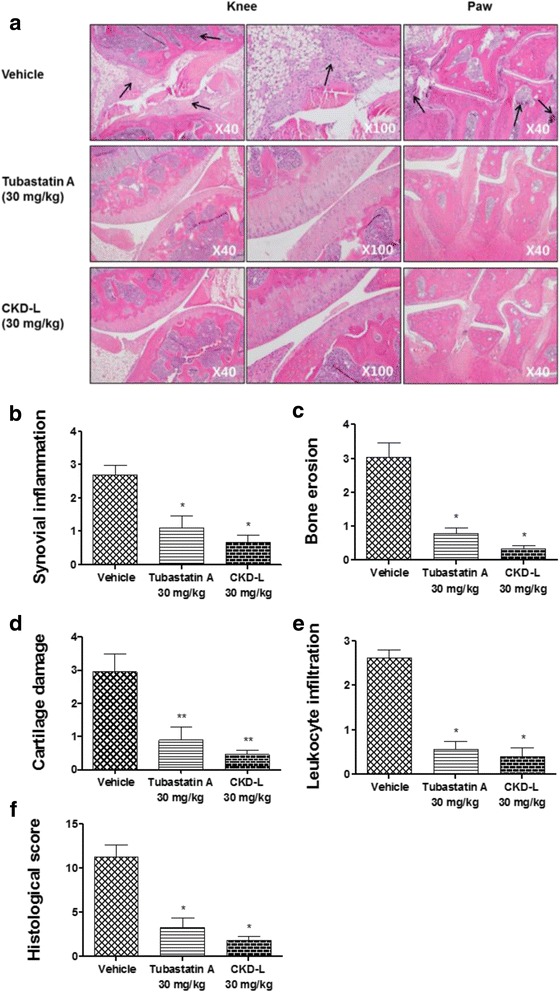
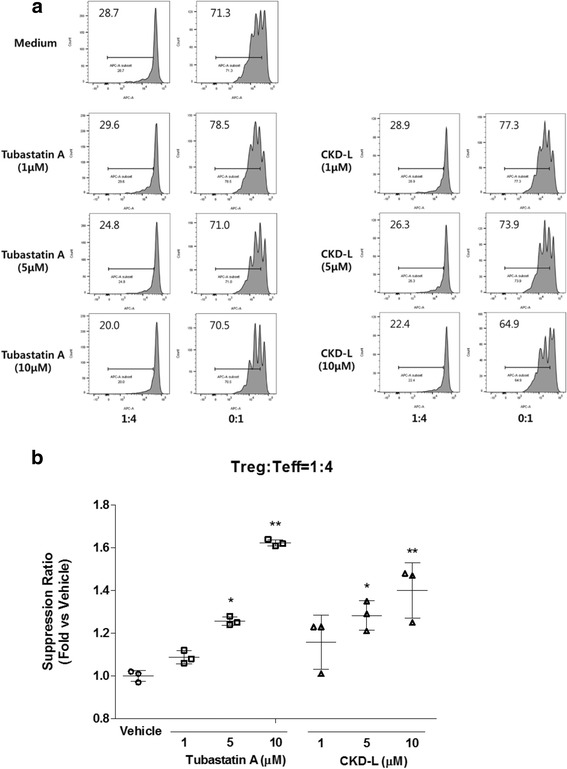
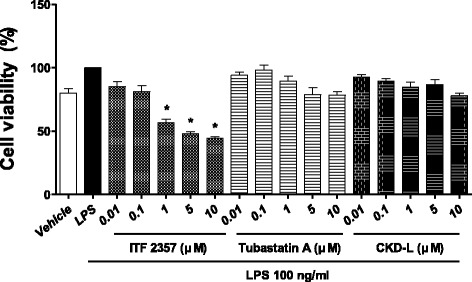
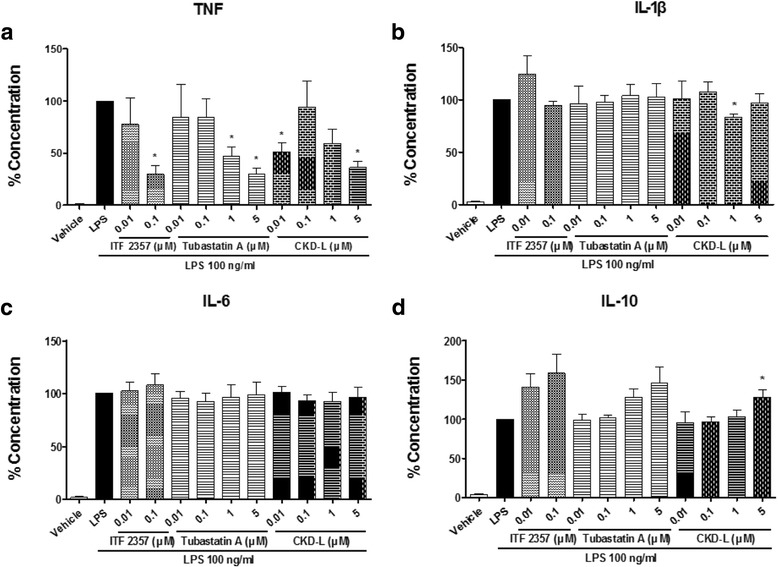
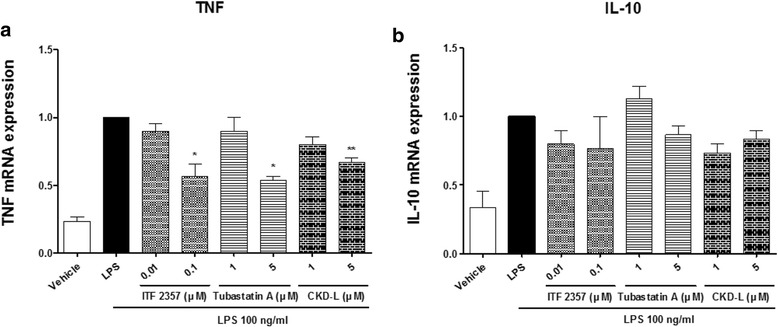
CIA was induced by bovine type II collagen (CII) in DBA/1 J mice. Mice were treated with HDAC inhibitor for 18 days. Arthritis score was assessed and histological analysis was performed by hematoxylin and eosin (H&E) stain. Cytotoxic T-lymphocyte associated protein (CTLA)-4 expression in induced Treg cells was analyzed and suppression assay was analyzed using Treg cells and effector T (Teff) cells isolated from naive C57BL/6 mice by flow cytometry. Cytokines were analyzed in peripheral blood mononuclear cells (PBMC) of five patients with RA by enzyme-linked immunosorbent assay (ELISA) and real-time polymerase chain reaction (PCR). Tumor necrosis factor (TNF) was analyzed using PMA- activated THP-1 cells by ELISA. Suppression assay was analyzed using Treg cells and Teff cells isolated from RA patients by flow cytometry.
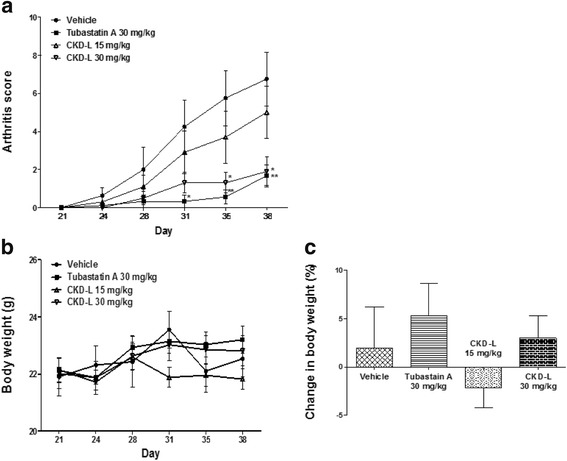
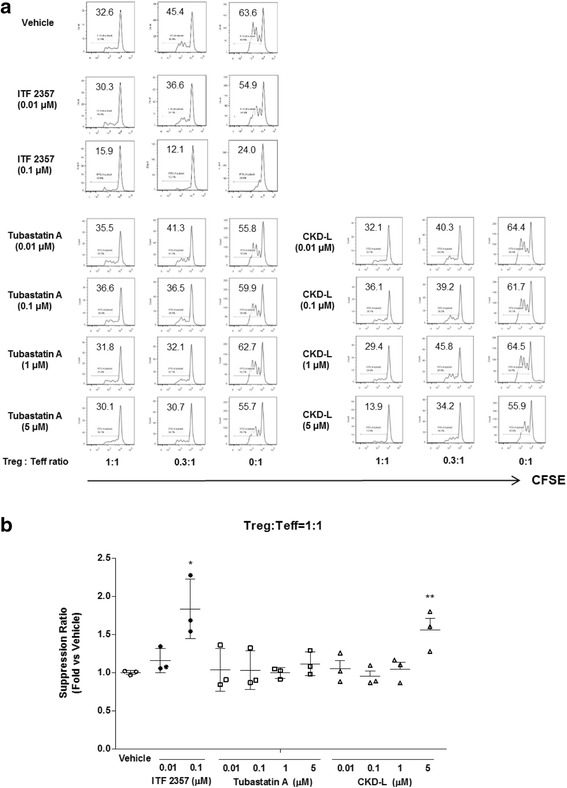
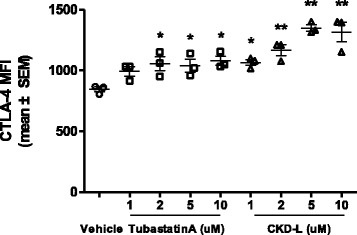
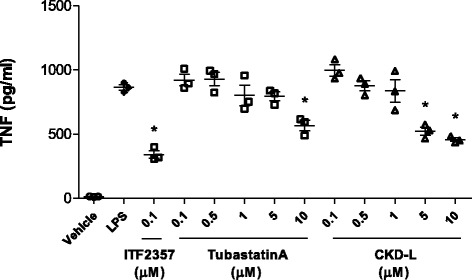
In the CIA model, CKD-L and Tubastatin A significantly decreased the arthritis score. CKD-L increased CTLA-4 expression in Foxp3 T cells and inhibited the proliferation of Teff cells in the suppression assay. In RA PBMC, CKD-L significantly inhibited TNF and interleukin (IL)-1β, and increased IL-10. CKD-L and Tubastatin A inhibited TNF secretion from PMA-activated THP-1 cells. CKD-L and ITF 2357 inhibited the proliferation of Teff cells in RA patients in the suppression assay. Tubastatin A had no effect on inhibition of proliferation.
CKD-L decreased the arthritis score in CIA, reduced the expression of TNF and IL-1β, and increased the expression of IL-10 in PBMC from RA patients. CKD-L increased CTLA-4 expression and the suppressive function of Treg cells. These results suggest that CKD-L may have a beneficial effect in the treatment of RA.
最近有报道称组蛋白去乙酰化酶(HDAC)抑制剂作为一种抗炎剂在胶原诱导的关节炎(CIA)中具有治疗作用。我们研究了一种新型选择性HDAC6抑制剂CKD-L与ITF 2357或Tubastatin A相比,对类风湿关节炎(RA)患者的CIA和调节性T(Treg)细胞的治疗效果。
用牛II型胶原(CII)在DBA/1 J小鼠中诱导CIA。小鼠用HDAC抑制剂治疗18天。评估关节炎评分,并通过苏木精和伊红(H&E)染色进行组织学分析。通过流式细胞术分析诱导的Treg细胞中细胞毒性T淋巴细胞相关蛋白(CTLA)-4的表达,并使用从新生C57BL/6小鼠分离的Treg细胞和效应T(Teff)细胞进行抑制试验分析。通过酶联免疫吸附测定(ELISA)和实时聚合酶链反应(PCR)分析5例RA患者外周血单个核细胞(PBMC)中的细胞因子。使用PMA激活的THP-1细胞通过ELISA分析肿瘤坏死因子(TNF)。通过流式细胞术使用从RA患者分离的Treg细胞和Teff细胞进行抑制试验分析。
在CIA模型中,CKD-L和Tubastatin A显著降低了关节炎评分。CKD-L增加了Foxp3 T细胞中CTLA-4的表达,并在抑制试验中抑制了Teff细胞的增殖。在RA PBMC中,CKD-L显著抑制TNF和白细胞介素(IL)-1β,并增加IL-10。CKD-L和Tubastatin A抑制了PMA激活的THP-1细胞中TNF的分泌。在抑制试验中,CKD-L和ITF 2357抑制了RA患者中Teff细胞的增殖。Tubastatin A对增殖抑制没有影响。
CKD-L降低了CIA中的关节炎评分,降低了TNF和IL-1β的表达,并增加了RA患者PBMC中IL-10的表达。CKD-L增加了CTLA-4的表达和Treg细胞的抑制功能。这些结果表明CKD-L可能对RA的治疗具有有益作用。