Laddu Deepika R, Wertheim Betsy C, Garcia David O, Brunner Robert, Groessl Erik, Shadyab Aladdin H, Going Scott B, LaMonte Michael J, Cannell Brad, LeBoff Meryl S, Cauley Jane A, Thomson Cynthia A, Stefanick Marcia L
Department of Physical Therapy, University of Illinois at Chicago, Chicago, Illinois.
University of Arizona Cancer Center, Tucson, Arizona.
J Am Geriatr Soc. 2017 Oct;65(10):2176-2181. doi: 10.1111/jgs.14991. Epub 2017 Jul 4.
To examine prospective associations between changes in physical activity (PA) and changes in physical performance measures (PPMs) over 6 years in older women.
Prospective cohort study.
Forty clinical centers in the United States.
Women aged 65 and older (mean age 69.8) enrolled in the Women's Health Initiative Clinical Trials with gait speed, timed chair stand, grip strength, and self-reported recreational PA data assessed at baseline (1993-98) and follow-up Years 1, 3, and 6 (N = 5,092).
Mixed-effects linear regression models were used to determine the association between time-varying PA and change in each PPM. Potential interactions between time-varying PA and age (<70, ≥70) were also tested.
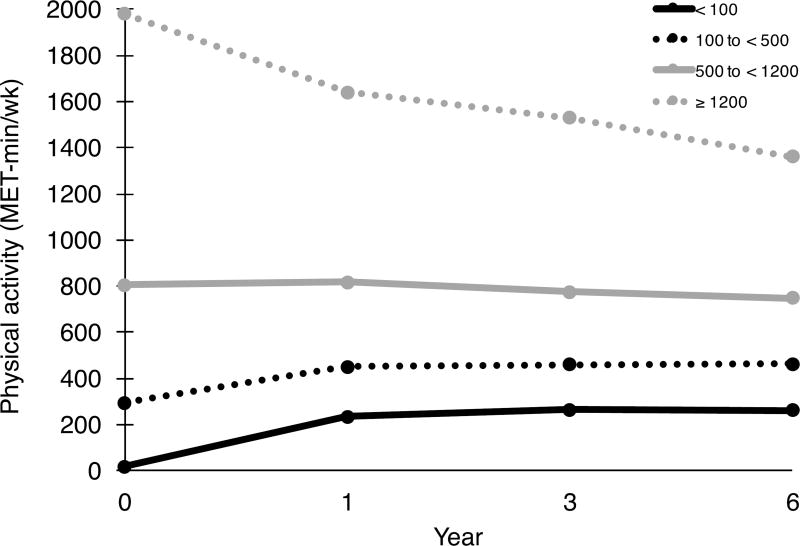
Significan, dose-response associations between PA and improvements in all PPMs were observed over the 6 years of follow-up after adjusting for important covariates. High PA groups (≥1,200 metabolic equivalent (MET)-min/wk) had stronger grip strength (0.48 kg greater; P < .01), more chair stands (0.35 more; P < .001), and faster gait speeds (0.06 m/s faster; P < .001) than sedentary women (<100 MET-min/wk). Higher PA levels were associated with a greater increase in chair stands over time in women aged 70 and older (P < .001) than in those younger than 70 (P = .01).
In postmenopausal women, maintaining high PA levels over time is associated with better lower extremity function. These data support the view that regular PA plays an important role in maintaining functional status during aging in older women.
研究老年女性6年间身体活动(PA)变化与身体机能指标(PPMs)变化之间的前瞻性关联。
前瞻性队列研究。
美国40个临床中心。
年龄在65岁及以上(平均年龄69.8岁)的女性,她们参与了女性健康倡议临床试验,在基线期(1993 - 1998年)以及随访的第1年、第3年和第6年评估了步态速度、定时起立试验、握力和自我报告的休闲PA数据(N = 5092)。
采用混合效应线性回归模型来确定随时间变化的PA与每个PPM变化之间的关联。还测试了随时间变化的PA与年龄(<70岁、≥70岁)之间的潜在相互作用。
在调整重要协变量后,随访的6年中观察到PA与所有PPMs改善之间存在显著的剂量反应关联。高PA组(≥1200代谢当量(MET)-分钟/周)比久坐女性(<100 MET-分钟/周)握力更强(多0.48千克;P <.01),起立次数更多(多0.35次;P <.001),步态速度更快(快0.06米/秒;P <.001)。与70岁以下女性(P = 0.01)相比,70岁及以上女性随着时间推移,较高的PA水平与起立次数增加幅度更大相关(P <.001)。
在绝经后女性中,长期保持高水平的PA与更好的下肢功能相关。这些数据支持了这样的观点,即规律的PA在老年女性衰老过程中维持功能状态方面起着重要作用。