Center for Digestive Diseases, Karolinska University Hospital, Stockholm, Sweden.
Department of Clinical Sciences, Intervention and Technology (CLINTEC), Karolinska Institutet, Stockholm, Sweden.
Mol Oncol. 2017 Oct;11(10):1413-1429. doi: 10.1002/1878-0261.12108. Epub 2017 Aug 8.
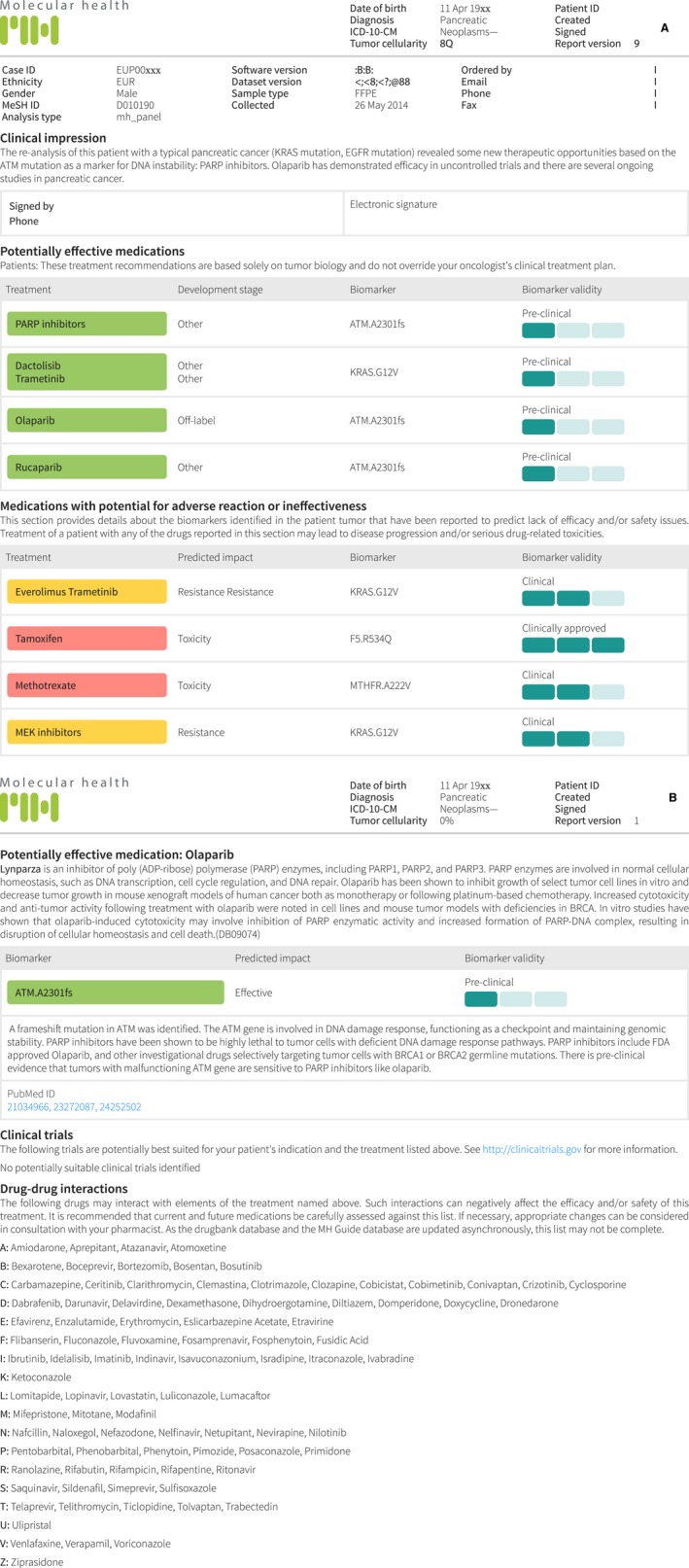
Pancreatic ductal adenocarcinoma (PDAC) is a tumor with an extremely poor prognosis, predominantly as a result of chemotherapy resistance and numerous somatic mutations. Consequently, PDAC is a prime candidate for the use of sequencing to identify causative mutations, facilitating subsequent administration of targeted therapy. In a feasibility study, we retrospectively assessed the therapeutic recommendations of a novel, evidence-based software that analyzes next-generation sequencing (NGS) data using a large panel of pharmacogenomic biomarkers for efficacy and toxicity. Tissue from 14 patients with PDAC was sequenced using NGS with a 620 gene panel. FASTQ files were fed into treatmentmap. The results were compared with chemotherapy in the patients, including all side effects. No changes in therapy were made. Known driver mutations for PDAC were confirmed (e.g. KRAS, TP53). Software analysis revealed positive biomarkers for predicted effective and ineffective treatments in all patients. At least one biomarker associated with increased toxicity could be detected in all patients. Patients had been receiving one of the currently approved chemotherapy agents. In two patients, toxicity could have been correctly predicted by the software analysis. The results suggest that NGS, in combination with an evidence-based software, could be conducted within a 2-week period, thus being feasible for clinical routine. Therapy recommendations were principally off-label use. Based on the predominant KRAS mutations, other drugs were predicted to be ineffective. The pharmacogenomic biomarkers indicative of increased toxicity could be retrospectively linked to reported negative side effects in the respective patients. Finally, the occurrence of somatic and germline mutations in cancer syndrome-associated genes is noteworthy, despite a high frequency of these particular variants in the background population. These results suggest software-analysis of NGS data provides evidence-based information on effective, ineffective and toxic drugs, potentially forming the basis for precision cancer medicine in PDAC.
胰腺导管腺癌(PDAC)是一种预后极差的肿瘤,主要是由于化疗耐药和大量体细胞突变所致。因此,PDAC 是使用测序来识别致病突变的主要候选者,从而促进随后的靶向治疗。在一项可行性研究中,我们回顾性评估了一种新型的、基于证据的软件的治疗建议,该软件使用大量的药物基因组生物标志物分析下一代测序(NGS)数据,以评估疗效和毒性。14 名 PDAC 患者的组织使用 NGS 进行了 620 个基因panel 的测序。将 FASTQ 文件输入 treatmentmap。将结果与患者的化疗进行了比较,包括所有的副作用。没有对治疗方案进行任何改变。确认了 PDAC 的已知驱动突变(如 KRAS、TP53)。软件分析显示,在所有患者中,对预测有效和无效治疗均有阳性生物标志物。在所有患者中都能检测到至少一个与毒性增加相关的生物标志物。患者正在接受一种目前批准的化疗药物。在两名患者中,软件分析可以正确预测毒性。结果表明,NGS 结合基于证据的软件可以在 2 周内完成,因此在临床常规中是可行的。治疗建议主要是标签外用药。基于主要的 KRAS 突变,预测其他药物无效。预示毒性增加的药物基因组生物标志物可以回溯性地与相应患者报告的负面副作用相关联。最后,尽管这些特定变体在背景人群中的频率很高,但在癌症综合征相关基因中仍发现了体细胞和种系突变。这些结果表明,NGS 数据的软件分析提供了有效、无效和有毒药物的基于证据的信息,可能为 PDAC 的精准癌症医学奠定基础。