Department of Clinical Pharmacology, Faculty of Medicine, Aristotle University of Thessaloniki, Thessaloniki, Greece.
Department of Medicine, University of California San Diego, La Jolla, CA, United States.
Curr Neuropharmacol. 2018;16(8):1210-1223. doi: 10.2174/1570159X15666170630163616.
Antipsychotic-induced metabolic side effects are major concerns in psychopharmacology and clinical psychiatry. Their pathogenetic mechanisms are still not elucidated.
Herein, we review the impact of neurotransmitters on metabolic regulation, providing insights into antipsychotic-induced metabolic side effects.
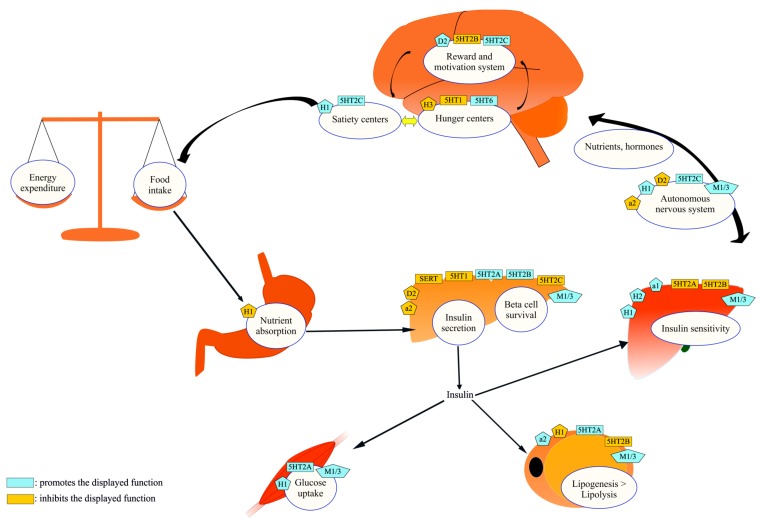
Antipsychotic drugs seem to interfere with feeding behaviors and energy balance, processes that control metabolic regulation. Reward and energy balance centers in central nervous system constitute the central level of metabolic regulation. The peripheral level consists of skeletal muscles, the liver, the pancreas, the adipose tissue and neuroendocrine connections. Neurotransmitter receptors have crucial roles in metabolic regulation and they are also targets of antipsychotic drugs. Interaction of antipsychotics with neurotransmitters could have both protective and harmful effects on metabolism.
Emerging evidence suggests that antipsychotics have different liabilities to induce obesity, diabetes and dyslipidemia. However this diversity cannot be explained merely by drugs'pharmacodynamic profiles, highlighting the need for further research.
抗精神病药引起的代谢副作用是精神药理学和临床精神病学的主要关注点。但其发病机制仍不清楚。
本文综述了神经递质对代谢调节的影响,为抗精神病药引起的代谢副作用提供了见解。
抗精神病药物似乎干扰了进食行为和能量平衡,而这些过程控制着代谢调节。中枢神经系统的奖励和能量平衡中心构成了代谢调节的中枢水平。外周水平包括骨骼肌、肝脏、胰腺、脂肪组织和神经内分泌连接。神经递质受体在代谢调节中起着至关重要的作用,也是抗精神病药物的作用靶点。抗精神病药与神经递质的相互作用可能对代谢既有保护作用,也有损害作用。
新出现的证据表明,抗精神病药在引起肥胖、糖尿病和血脂异常方面有不同的风险。然而,这种多样性不能仅仅用药物的药效学特征来解释,这凸显了进一步研究的必要性。