Marmesat Elena, Schmidt Krzysztof, Saveljev Alexander P, Seryodkin Ivan V, Godoy José A
Department of Integrative Ecology, Estación Biológica de Doñana (CSIC), C/Américo Vespucio, 26, 41092, Sevilla, Spain.
Mammal Research Institute, Polish Academy of Sciences, 17-230, Białowieża, Poland.
BMC Evol Biol. 2017 Jul 4;17(1):158. doi: 10.1186/s12862-017-1006-z.
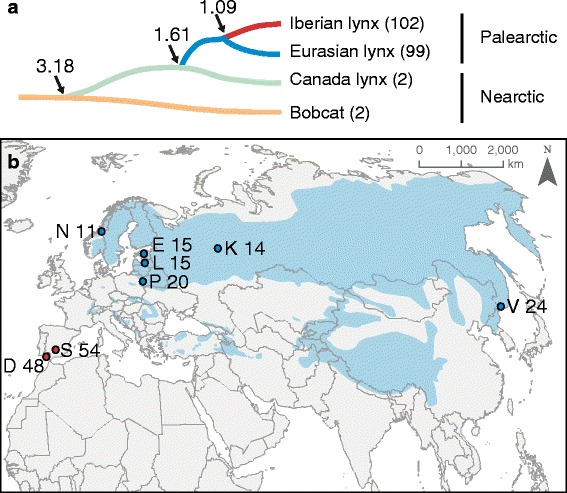
Demographic bottlenecks erode genetic diversity and may increase endangered species' extinction risk via decreased fitness and adaptive potential. The genetic status of species is generally assessed using neutral markers, whose dynamic can differ from that of functional variation due to selection. The MHC is a multigene family described as the most important genetic component of the mammalian immune system, with broad implications in ecology and evolution. The genus Lynx includes four species differing immensely in demographic history and population size, which provides a suitable model to study the genetic consequences of demographic declines: the Iberian lynx being an extremely bottlenecked species and the three remaining ones representing common and widely distributed species. We compared variation in the most variable exon of the MHCI and MHCII-DRB loci among the four species of the Lynx genus.
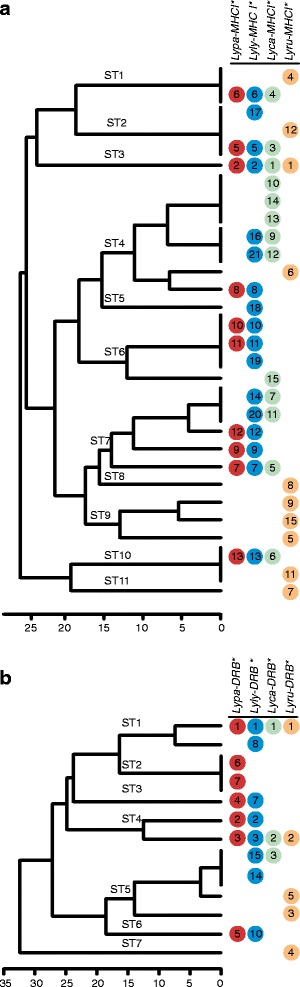
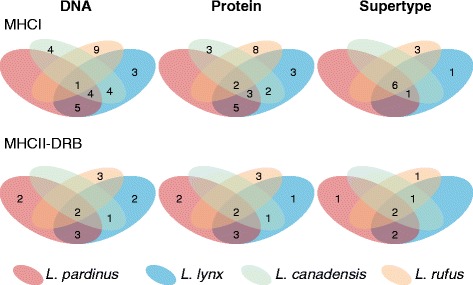
The Iberian lynx was characterised by lower number of MHC alleles than its sister species (the Eurasian lynx). However, it maintained most of the functional genetic variation at MHC loci present in the remaining and genetically healthier lynx species at all nucleotide, amino acid, and supertype levels.
Species-wide functional genetic diversity can be maintained even in the face of severe population bottlenecks, which caused devastating whole genome genetic erosion. This could be the consequence of divergent alleles being retained across paralogous loci, an outcome that, in the face of frequent gene conversion, may have been favoured by balancing selection.
种群瓶颈会侵蚀遗传多样性,并可能通过降低适应性和适应潜力增加濒危物种的灭绝风险。物种的遗传状况通常使用中性标记进行评估,由于选择作用,中性标记的动态变化可能与功能变异不同。主要组织相容性复合体(MHC)是一个多基因家族,被认为是哺乳动物免疫系统最重要的遗传组成部分,在生态学和进化方面具有广泛影响。猞猁属包括四个物种,它们在种群历史和种群规模上差异巨大,这为研究种群数量下降的遗传后果提供了一个合适的模型:伊比利亚猞猁是一个极度瓶颈化的物种,其余三个物种代表常见且分布广泛的物种。我们比较了猞猁属四个物种中MHCI和MHCII - DRB基因座最可变外显子的变异情况。
伊比利亚猞猁的MHC等位基因数量低于其姐妹物种(欧亚猞猁)。然而,在所有核苷酸、氨基酸和超型水平上,它在其余遗传状况更健康的猞猁物种所具有的MHC基因座上保持了大部分功能遗传变异。
即使面对严重的种群瓶颈,导致整个基因组遗传物质遭到毁灭性侵蚀,全物种的功能遗传多样性仍可得以维持。这可能是由于在旁系同源基因座上保留了不同的等位基因,面对频繁的基因转换,这种结果可能受到平衡选择的青睐。