Xie Xiaoxu, Zhou Weimin, Lin Lingyan, Fan Si, Lin Fen, Wang Long, Guo Tongjun, Ma Chuyang, Zhang Jingkun, He Yuan, Chen Yixin
Graduate School of Peking Union Medical College, Beijing, China.
National Research Institute for Health and Family Planning, Beijing, China.
J Med Internet Res. 2017 Jul 4;19(7):e239. doi: 10.2196/jmir.7854.
The Internet hospital, an innovative approach to providing health care, is rapidly developing in China because it has the potential to provide widely accessible outpatient service delivery via Internet technologies. To date, China's Internet hospitals have not been systematically investigated.
The aim of this study was to describe the characteristics of China's Internet hospitals, and to assess their health service capacity.
We searched Baidu, the popular Chinese search engine, to identify Internet hospitals, using search terms such as "Internet hospital," "web hospital," or "cloud hospital." All Internet hospitals in mainland China were eligible for inclusion if they were officially registered. Our search was carried out until March 31, 2017.
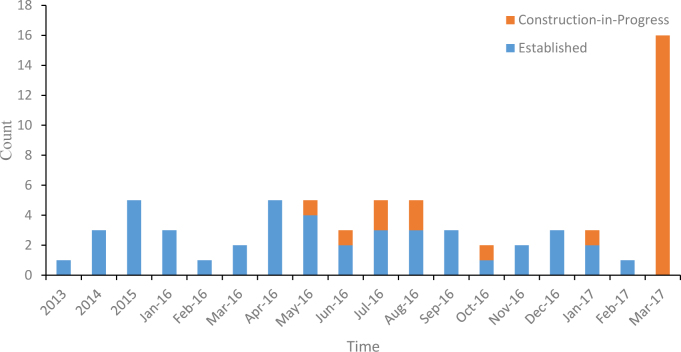
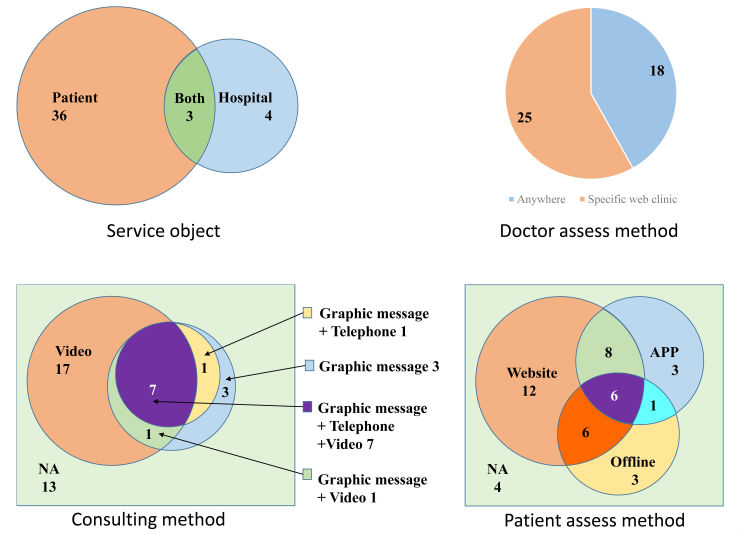
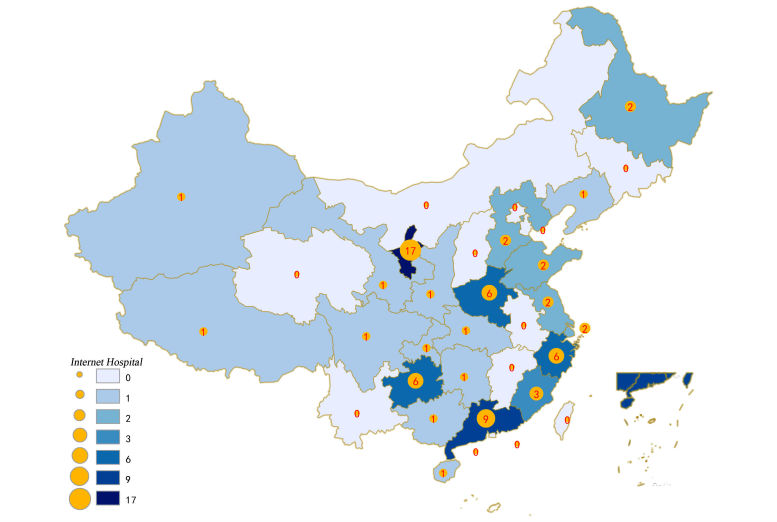
We identified 68 Internet hospitals, of which 43 have been put into use and 25 were under construction. Of the 43 established Internet hospitals, 13 (30%) were in the hospital informatization stage, 24 (56%) were in the Web ward stage, and 6 (14%) were in full Internet hospital stage. Patients accessed outpatient service delivery via website (74%, 32/43), app (42%, 18/43), or offline medical consultation facility (37%, 16/43) from the Internet hospital. Furthermore, 25 (58%) of the Internet hospitals asked doctors to deliver health services at a specific Web clinic, whereas 18 (42%) did not. The consulting methods included video chat (60%, 26/43), telephone (19%, 8/43), and graphic message (28%, 12/43); 13 (30%) Internet hospitals cannot be consulted online any more. Only 6 Internet hospitals were included in the coverage of health insurance. The median number of doctors available online was zero (interquartile range [IQR] 0 to 5; max 16,492). The median consultation fee per time was ¥20 (approximately US $2.90, IQR ¥0 to ¥200).
Internet hospitals provide convenient outpatient service delivery. However, many of the Internet hospitals are not yet mature and are faced with various issues such as online doctor scarcity and the unavailability of health insurance coverage. China's Internet hospitals are heading in the right direction to improve provision of health services, but much more remains to be done.
互联网医院作为一种创新的医疗服务提供方式,在中国正迅速发展,因为它有潜力通过互联网技术提供广泛可及的门诊服务。迄今为止,中国的互联网医院尚未得到系统研究。
本研究旨在描述中国互联网医院的特征,并评估其医疗服务能力。
我们在中国流行的搜索引擎百度上进行搜索,使用“互联网医院”“网络医院”或“云医院”等搜索词来识别互联网医院。中国大陆所有正式注册的互联网医院均符合纳入标准。我们的搜索持续到2017年3月31日。
我们识别出68家互联网医院,其中43家已投入使用,25家正在建设中。在已建成的43家互联网医院中,13家(30%)处于医院信息化阶段,24家(56%)处于网络病房阶段,6家(14%)处于完整的互联网医院阶段。患者通过互联网医院的网站(74%,32/43)、应用程序(42%,18/43)或线下医疗咨询设施(37%,16/43)获取门诊服务。此外,25家(58%)互联网医院要求医生在特定的网络诊所提供医疗服务,而18家(42%)则没有。咨询方式包括视频聊天(60%,26/43)、电话(19%,8/43)和图文消息(28%,12/43);13家(30%)互联网医院无法再进行在线咨询。只有6家互联网医院纳入了医保覆盖范围。在线医生的中位数人数为零(四分位间距[IQR]为0至5;最大值为16492)。每次咨询费用的中位数为20元人民币(约合2.90美元,IQR为0至200元人民币)。
互联网医院提供了便捷的门诊服务。然而,许多互联网医院尚未成熟,面临着诸如在线医生稀缺和医保覆盖不足等各种问题。中国的互联网医院在改善医疗服务提供方面正朝着正确的方向发展,但仍有许多工作要做。