• 文献检索
  • 文档翻译
  • 深度研究
  • 学术资讯
  • Suppr Zotero 插件Zotero 插件
  • 邀请有礼
  • 套餐&价格
  • 历史记录
应用&插件
Suppr Zotero 插件Zotero 插件浏览器插件Mac 客户端Windows 客户端微信小程序
定价
高级版会员购买积分包购买API积分包
服务
文献检索文档翻译深度研究API 文档MCP 服务
关于我们
关于 Suppr公司介绍联系我们用户协议隐私条款
关注我们

Suppr 超能文献

核心技术专利:CN118964589B侵权必究
粤ICP备2023148730 号-1Suppr @ 2026

文献检索

告别复杂PubMed语法,用中文像聊天一样搜索,搜遍4000万医学文献。AI智能推荐,让科研检索更轻松。

立即免费搜索

文件翻译

保留排版,准确专业,支持PDF/Word/PPT等文件格式,支持 12+语言互译。

免费翻译文档

深度研究

AI帮你快速写综述,25分钟生成高质量综述,智能提取关键信息,辅助科研写作。

立即免费体验

用于将人机自主(HMA)系统与自适应证据源集成的模糊决策融合器(FDMF)。

Fuzzy Decision-Making Fuser (FDMF) for Integrating Human-Machine Autonomous (HMA) Systems with Adaptive Evidence Sources.

作者信息

Liu Yu-Ting, Pal Nikhil R, Marathe Amar R, Wang Yu-Kai, Lin Chin-Teng

机构信息

Faculty of Engineering and Information Technology, Center for Artificial Intelligence, University of Technology SydneySydney, NSW, Australia.

Electronics and Communication Sciences Unit, Indian Statistical InstituteCalcutta, India.

出版信息

Front Neurosci. 2017 Jun 20;11:332. doi: 10.3389/fnins.2017.00332. eCollection 2017.

DOI:10.3389/fnins.2017.00332
PMID:28676734
原文链接:https://pmc.ncbi.nlm.nih.gov/articles/PMC5477567/
Abstract

A brain-computer interface (BCI) creates a direct communication pathway between the human brain and an external device or system. In contrast to patient-oriented BCIs, which are intended to restore inoperative or malfunctioning aspects of the nervous system, a growing number of BCI studies focus on designing auxiliary systems that are intended for everyday use. The goal of building these BCIs is to provide capabilities that augment existing intact physical and mental capabilities. However, a key challenge to BCI research is human variability; factors such as fatigue, inattention, and stress vary both across different individuals and for the same individual over time. If these issues are addressed, autonomous systems may provide additional benefits that enhance system performance and prevent problems introduced by individual human variability. This study proposes a human-machine autonomous (HMA) system that simultaneously aggregates human and machine knowledge to recognize targets in a rapid serial visual presentation (RSVP) task. The HMA focuses on integrating an RSVP BCI with computer vision techniques in an image-labeling domain. A fuzzy decision-making fuser (FDMF) is then applied in the HMA system to provide a natural adaptive framework for evidence-based inference by incorporating an integrated summary of the available evidence (i.e., human and machine decisions) and associated uncertainty. Consequently, the HMA system dynamically aggregates decisions involving uncertainties from both human and autonomous agents. The collaborative decisions made by an HMA system can achieve and maintain superior performance more efficiently than either the human or autonomous agents can achieve independently. The experimental results shown in this study suggest that the proposed HMA system with the FDMF can effectively fuse decisions from human brain activities and the computer vision techniques to improve overall performance on the RSVP recognition task. This conclusion demonstrates the potential benefits of integrating autonomous systems with BCI systems.

摘要

脑机接口(BCI)在人脑与外部设备或系统之间创建了一条直接的通信路径。与旨在恢复神经系统无法正常运作或出现故障的部分功能的面向患者的BCI不同,越来越多的BCI研究专注于设计供日常使用的辅助系统。构建这些BCI的目标是提供增强现有完好的身体和心理能力的功能。然而,BCI研究面临的一个关键挑战是人类的变异性;诸如疲劳、注意力不集中和压力等因素在不同个体之间以及同一个体随时间推移都会有所不同。如果解决了这些问题,自主系统可能会带来额外的好处,即提高系统性能并防止个体人类变异性带来的问题。本研究提出了一种人机自主(HMA)系统,该系统同时整合人类和机器知识,以在快速序列视觉呈现(RSVP)任务中识别目标。HMA专注于在图像标注领域将RSVP BCI与计算机视觉技术相结合。然后,在HMA系统中应用模糊决策融合器(FDMF),通过纳入可用证据(即人类和机器决策)的综合摘要以及相关不确定性,为基于证据的推理提供一个自然的自适应框架。因此,HMA系统动态地整合涉及人类和自主智能体不确定性的决策。HMA系统做出的协作决策能够比人类或自主智能体单独实现的决策更高效地实现并维持卓越性能。本研究中展示的实验结果表明,所提出的带有FDMF的HMA系统能够有效地融合来自人类大脑活动和计算机视觉技术的决策,从而提高RSVP识别任务的整体性能。这一结论证明了将自主系统与BCI系统集成的潜在好处。
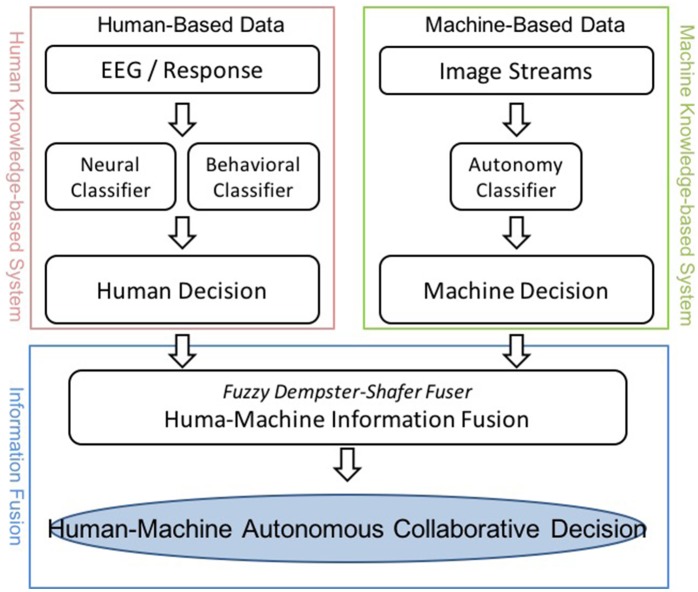
https://cdn.ncbi.nlm.nih.gov/pmc/blobs/adc8/5477567/5b5da2219b53/fnins-11-00332-g0004.jpg
https://cdn.ncbi.nlm.nih.gov/pmc/blobs/adc8/5477567/b48cb9ea39ce/fnins-11-00332-g0001.jpg
https://cdn.ncbi.nlm.nih.gov/pmc/blobs/adc8/5477567/3d4c4a1574c8/fnins-11-00332-g0002.jpg
https://cdn.ncbi.nlm.nih.gov/pmc/blobs/adc8/5477567/61473e6c5218/fnins-11-00332-g0003.jpg
https://cdn.ncbi.nlm.nih.gov/pmc/blobs/adc8/5477567/5b5da2219b53/fnins-11-00332-g0004.jpg
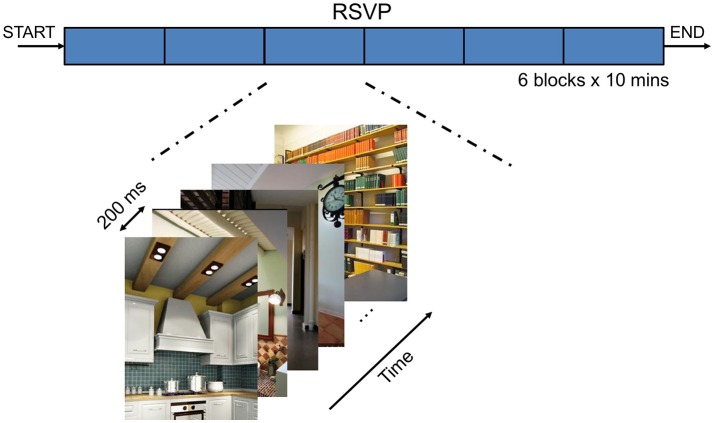
https://cdn.ncbi.nlm.nih.gov/pmc/blobs/adc8/5477567/b48cb9ea39ce/fnins-11-00332-g0001.jpg
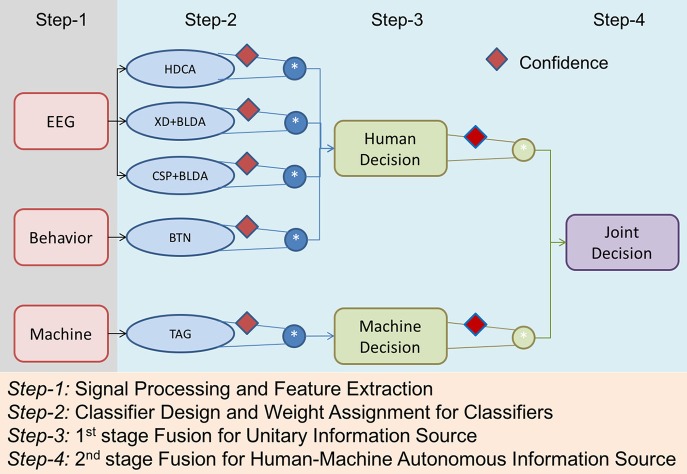
https://cdn.ncbi.nlm.nih.gov/pmc/blobs/adc8/5477567/3d4c4a1574c8/fnins-11-00332-g0002.jpg
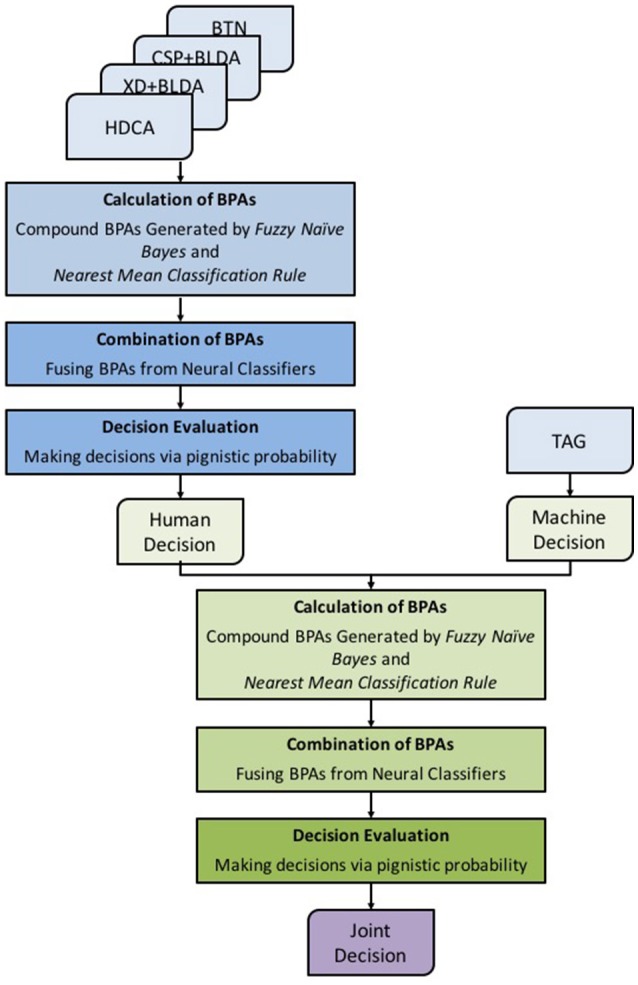
https://cdn.ncbi.nlm.nih.gov/pmc/blobs/adc8/5477567/61473e6c5218/fnins-11-00332-g0003.jpg
https://cdn.ncbi.nlm.nih.gov/pmc/blobs/adc8/5477567/5b5da2219b53/fnins-11-00332-g0004.jpg

相似文献

1
Fuzzy Decision-Making Fuser (FDMF) for Integrating Human-Machine Autonomous (HMA) Systems with Adaptive Evidence Sources.用于将人机自主(HMA)系统与自适应证据源集成的模糊决策融合器(FDMF)。
Front Neurosci. 2017 Jun 20;11:332. doi: 10.3389/fnins.2017.00332. eCollection 2017.
2
Bio-inspired EEG signal computing using machine learning and fuzzy theory for decision making in future-oriented brain-controlled vehicles.采用机器学习和模糊理论的生物启发式 EEG 信号计算,用于面向未来的脑控车辆中的决策。
SLAS Technol. 2024 Oct;29(5):100187. doi: 10.1016/j.slast.2024.100187. Epub 2024 Aug 28.
3
A Cross-Session Dataset for Collaborative Brain-Computer Interfaces Based on Rapid Serial Visual Presentation.一个基于快速序列视觉呈现的用于协作式脑机接口的跨会话数据集。
Front Neurosci. 2020 Oct 22;14:579469. doi: 10.3389/fnins.2020.579469. eCollection 2020.
4
Group-member selection for RSVP-based collaborative brain-computer interfaces.基于RSVP的协作式脑机接口的组成员选择
Front Neurosci. 2024 Aug 21;18:1402154. doi: 10.3389/fnins.2024.1402154. eCollection 2024.
5
Improving the Cross-Subject Performance of the ERP-Based Brain-Computer Interface Using Rapid Serial Visual Presentation and Correlation Analysis Rank.利用快速序列视觉呈现和相关分析排序提高基于事件相关电位的脑机接口的跨主体性能。
Front Hum Neurosci. 2020 Jul 31;14:296. doi: 10.3389/fnhum.2020.00296. eCollection 2020.
6
Multimodal collaborative brain-computer interfaces aid human-machine team decision-making in a pandemic scenario.多模态协同脑机接口在大流行场景中辅助人机团队决策。
J Neural Eng. 2022 Oct 17;19(5). doi: 10.1088/1741-2552/ac96a5.
7
Examining sensory ability, feature matching and assessment-based adaptation for a brain-computer interface using the steady-state visually evoked potential.使用稳态视觉诱发电位研究用于脑机接口的感觉能力、特征匹配和基于评估的适应性。
Disabil Rehabil Assist Technol. 2019 Apr;14(3):241-249. doi: 10.1080/17483107.2018.1428369. Epub 2018 Jan 31.
8
An approach to fuzzy soft sets in decision making based on grey relational analysis and Dempster-Shafer theory of evidence: An application in medical diagnosis.一种基于灰色关联分析和证据理论的模糊软集决策方法:医学诊断中的应用
Artif Intell Med. 2015 Jul;64(3):161-71. doi: 10.1016/j.artmed.2015.05.002. Epub 2015 May 14.
9
Brain-computer interfaces for communication and control.用于通信和控制的脑机接口。
Clin Neurophysiol. 2002 Jun;113(6):767-91. doi: 10.1016/s1388-2457(02)00057-3.
10
Autonomous Parameter Adjustment for SSVEP-Based BCIs with a Novel BCI Wizard.基于稳态视觉诱发电位的脑机接口的自主参数调整与新型脑机接口向导
Front Neurosci. 2015 Dec 22;9:474. doi: 10.3389/fnins.2015.00474. eCollection 2015.

引用本文的文献

1
Dynamic probability integration for electroencephalography-based rapid serial visual presentation performance enhancement: Application in nighttime vehicle detection.基于脑电图的快速序列视觉呈现性能增强的动态概率积分:在夜间车辆检测中的应用。
Front Comput Neurosci. 2022 Oct 14;16:1006361. doi: 10.3389/fncom.2022.1006361. eCollection 2022.
2
Decision fusion in healthcare and medicine: a narrative review.医疗保健与医学中的决策融合:一篇叙述性综述
Mhealth. 2022 Jan 20;8:8. doi: 10.21037/mhealth-21-15. eCollection 2022.
3
Multi-Sensor Perception Strategy to Enhance Autonomy of Robotic Operation for Uncertain Peg-in-Hole Task.

本文引用的文献

1
Extracting patterns of single-trial EEG using an adaptive learning algorithm.使用自适应学习算法提取单次试验脑电图的模式。
Annu Int Conf IEEE Eng Med Biol Soc. 2015;2015:6642-5. doi: 10.1109/EMBC.2015.7319916.
2
Brain Dynamics in Predicting Driving Fatigue Using a Recurrent Self-Evolving Fuzzy Neural Network.基于递归自进化模糊神经网络的驾驶疲劳预测中的大脑动力学研究。
IEEE Trans Neural Netw Learn Syst. 2016 Feb;27(2):347-60. doi: 10.1109/TNNLS.2015.2496330. Epub 2015 Nov 18.
3
Estimating endogenous changes in task performance from EEG.
多传感器感知策略增强机器人在不确定的销钉孔任务中的自主操作能力。
Sensors (Basel). 2021 May 31;21(11):3818. doi: 10.3390/s21113818.
从脑电图估计任务表现中的内源性变化。
Front Neurosci. 2014 Jun 13;8:155. doi: 10.3389/fnins.2014.00155. eCollection 2014.
4
Demonstration of a semi-autonomous hybrid brain-machine interface using human intracranial EEG, eye tracking, and computer vision to control a robotic upper limb prosthetic.利用人类颅内脑电图、眼动追踪和计算机视觉控制机器人上肢假肢的半自主混合脑机接口演示。
IEEE Trans Neural Syst Rehabil Eng. 2014 Jul;22(4):784-96. doi: 10.1109/TNSRE.2013.2294685. Epub 2013 Dec 12.
5
How Many People Could Use an SSVEP BCI?有多少人可以使用 SSVEP BCI?
Front Neurosci. 2012 Nov 19;6:169. doi: 10.3389/fnins.2012.00169. eCollection 2012.
6
Measuring the objectness of image windows.测量图像窗口的目标性。
IEEE Trans Pattern Anal Mach Intell. 2012 Nov;34(11):2189-202. doi: 10.1109/TPAMI.2012.28.
7
Closing the loop in cortically-coupled computer vision: a brain-computer interface for searching image databases.闭环皮质耦合计算机视觉:用于搜索图像数据库的脑机接口。
J Neural Eng. 2011 Jun;8(3):036025. doi: 10.1088/1741-2560/8/3/036025. Epub 2011 May 12.
8
A robust sensor-selection method for P300 brain-computer interfaces.一种用于 P300 脑机接口的鲁棒传感器选择方法。
J Neural Eng. 2011 Feb;8(1):016001. doi: 10.1088/1741-2560/8/1/016001. Epub 2011 Jan 19.
9
The influence of psychological state and motivation on brain-computer interface performance in patients with amyotrophic lateral sclerosis - a longitudinal study.心理状态和动机对肌萎缩侧索硬化症患者脑机接口性能的影响——一项纵向研究。
Front Neurosci. 2010 Jul 21;4. doi: 10.3389/fnins.2010.00055. eCollection 2010.
10
The hybrid BCI.混合脑机接口。
Front Neurosci. 2010 Apr 21;4:30. doi: 10.3389/fnpro.2010.00003. eCollection 2010.