Emery David C, Shoemark Deborah K, Batstone Tom E, Waterfall Christy M, Coghill Jane A, Cerajewska Tanya L, Davies Maria, West Nicola X, Allen Shelley J
School of Clinical Sciences, Faculty of Health Sciences, University of BristolBristol, United Kingdom.
School of Biochemistry, University WalkBristol, United Kingdom.
Front Aging Neurosci. 2017 Jun 20;9:195. doi: 10.3389/fnagi.2017.00195. eCollection 2017.
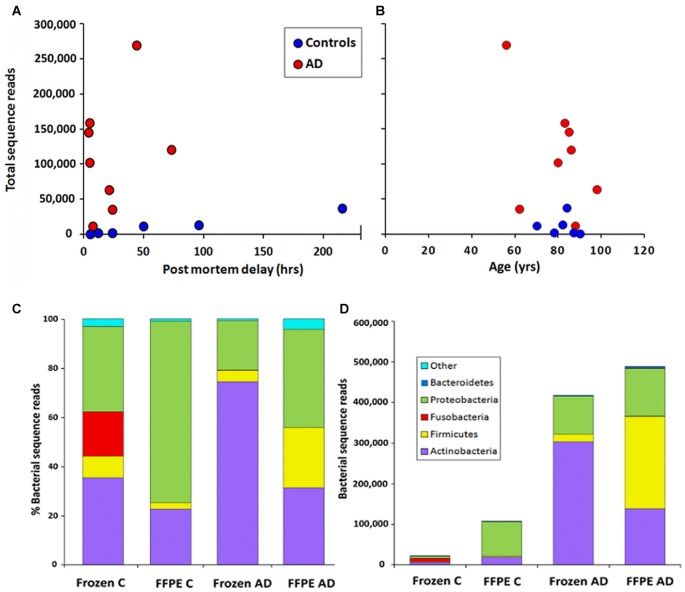
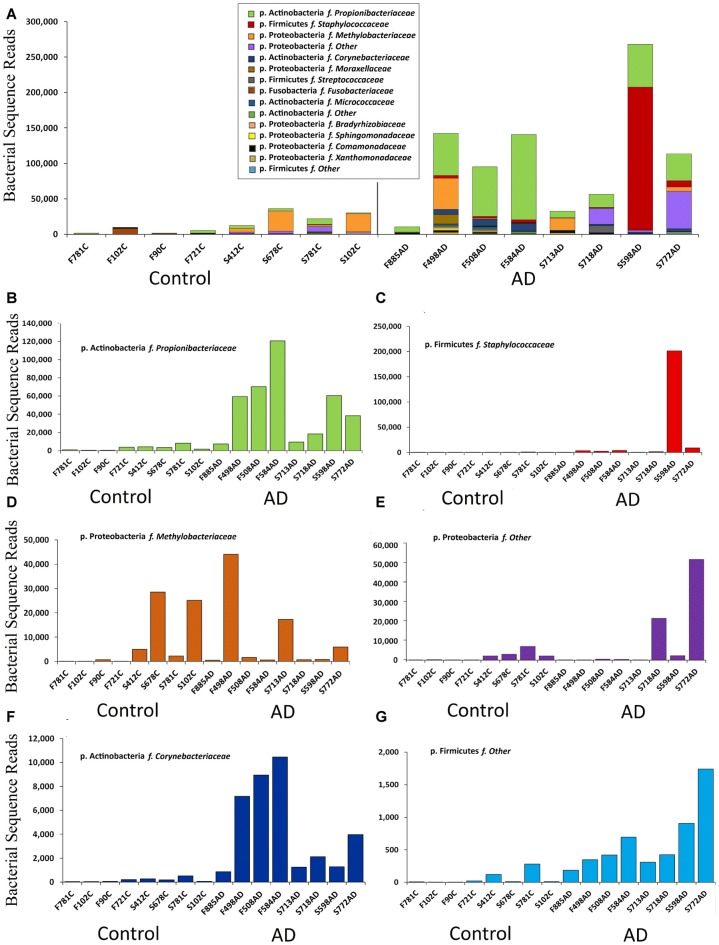
The neurological deterioration associated with Alzheimer's disease (AD), involving accumulation of amyloid-beta peptides and neurofibrillary tangles, is associated with evident neuroinflammation. This is now seen to be a significant contributor to pathology. Recently the tenet of the privileged status of the brain, regarding microbial compromise, has been questioned, particularly in terms of neurodegenerative diseases. It is now being considered that microbiological incursion into the central nervous system could be either an initiator or significant contributor to these. This is a novel study using 16S ribosomal gene-specific Next generation sequencing (NGS) of extracted brain tissue. A comparison was made of the bacterial species content of both frozen and formaldehyde fixed sections of a small cohort of Alzheimer-affected cases with those of cognitively unimpaired (normal). Our findings suggest an increase in bacterial populations in Alzheimer brain tissue compared with normal.
与阿尔茨海默病(AD)相关的神经功能衰退,涉及β-淀粉样肽的积累和神经原纤维缠结,与明显的神经炎症有关。现在认为这是病理学的一个重要因素。最近,大脑在微生物侵害方面享有特权地位的原则受到了质疑,特别是在神经退行性疾病方面。现在有人认为,微生物侵入中枢神经系统可能是这些疾病的引发因素或重要因素。这是一项利用提取的脑组织进行16S核糖体基因特异性下一代测序(NGS)的新研究。对一小群受阿尔茨海默病影响的病例的冷冻和甲醛固定切片与认知未受损(正常)病例的细菌种类含量进行了比较。我们的研究结果表明,与正常脑组织相比,阿尔茨海默病脑组织中的细菌数量有所增加。