Matthews Evan L, Greaney Jody L, Wenner Megan M
Department of Kinesiology and Applied Physiology, University of Delaware, Newark, DE, USA.
Department of Exercise Science and Physical Education, Montclair State University, Montclair, NJ, USA.
Exp Physiol. 2017 Sep 1;102(9):1092-1099. doi: 10.1113/EP086466. Epub 2017 Jul 23.
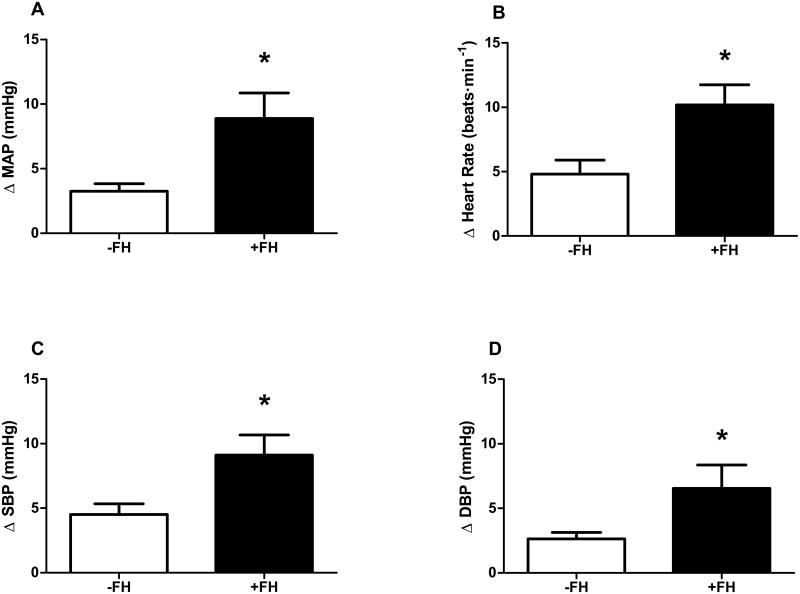
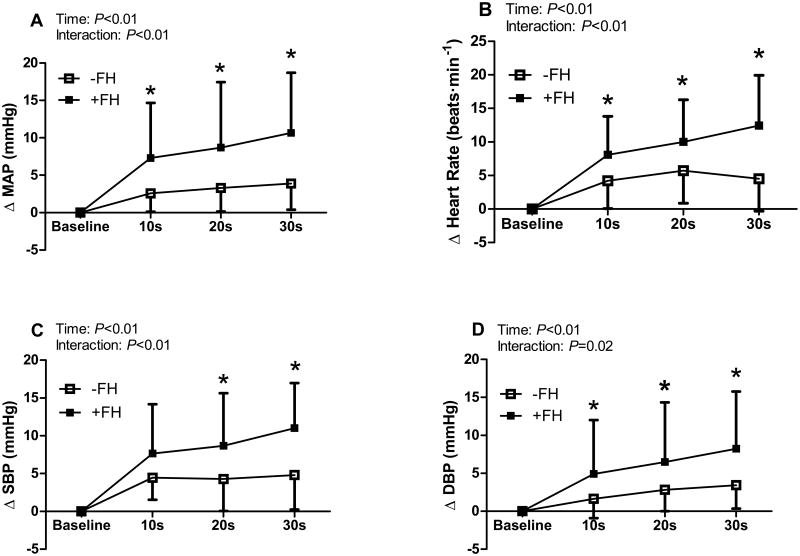
What is the central question of this study? Alterations in blood pressure control at exercise onset are apparent in older adults with established cardiovascular disease. It is currently not known whether these alterations are evident in young adults with a family history of hypertension. What is the main finding and its importance? We demonstrate that young women with a family history of hypertension display a larger change in blood pressure within the first 10 s of isometric exercise. These data suggest altered blood pressure control in young women with a family history of hypertension. Hypertensive adults demonstrate atypical increases in blood pressure (BP) and muscle sympathetic nerve activity (MSNA) at the immediate onset of static muscle contraction. However, it is unknown whether these abnormal responses occur in young, otherwise healthy adults at risk for developing future disease, such as those with a family history of hypertension (+FH). We tested the hypothesis that +FH young women have exaggerated increases in BP and MSNA at the onset of static muscle contraction compared with those without a family history of hypertension (-FH). We retrospectively examined beat-by-beat BP and MSNA during the initial 30 s of isometric handgrip exercise (30% of maximal voluntary contraction) in 16 +FH (22 ± 2 years old, 22 ± 3 kg m ) and 16 -FH (22 ± 3 years old, 22 ± 3 kg m ) women. Resting mean arterial pressure (+FH 80 ± 11 mmHg versus -FH 84 ± 13 mmHg), MSNA burst frequency (+FH 7 ± 3 bursts min versus -FH 9 ± 5 bursts min ) and burst incidence [+FH 12 ± 4 bursts (100 heart beats) versus -FH 12 ± 8 bursts (100 heart beats) ] were similar between groups (all P > 0.05). Within the first 10 s of exercise, changes in mean arterial pressure (+FH Δ8 ± 6 mmHg versus -FH Δ3 ± 2 mmHg, P < 0.05) and heart rate (+FH Δ8 ± 5 beats min versus -FH Δ4 ± 4 beats min , P < 0.05) were greater in +FH women. Absolute MSNA burst frequency during the first 30 s of exercise was not different between groups (-FH 7 ± 5 bursts min versus +FH 9 ± 3 bursts min ). Cardiovascular and sympathetic responses during the cold pressor test were not different between groups. These data demonstrate that young women at risk for developing cardiovascular disease exhibit greater changes in BP at the onset of static muscle contraction.
本研究的核心问题是什么?患有心血管疾病的老年人在运动开始时血压控制的变化很明显。目前尚不清楚这些变化在有高血压家族史的年轻人中是否明显。主要发现及其重要性是什么?我们证明,有高血压家族史的年轻女性在等长运动的前10秒内血压变化更大。这些数据表明有高血压家族史的年轻女性血压控制发生了改变。高血压成年人在静态肌肉收缩开始时血压(BP)和肌肉交感神经活动(MSNA)会出现非典型增加。然而,尚不清楚这些异常反应是否发生在有未来患病风险的年轻、健康成年人中,例如有高血压家族史(+FH)的人群。我们检验了这样一个假设:与没有高血压家族史(-FH)的女性相比,+FH年轻女性在静态肌肉收缩开始时BP和MSNA的增加更为显著。我们回顾性地检查了16名+FH(22±2岁,22±3kg·m)和16名 -FH(22±3岁,22±3kg·m)女性在等长握力运动(最大自主收缩的30%)最初30秒内的逐搏BP和MSNA。两组间静息平均动脉压(+FH 80±11mmHg对 -FH 84±13mmHg)、MSNA爆发频率(+FH 7±3次爆发/分钟对 -FH 9±5次爆发/分钟)和爆发发生率[+FH 12±4次爆发(100次心跳)对 -FH 12±8次爆发(100次心跳)]相似(所有P>0.05)。在运动的前10秒内,+FH女性的平均动脉压变化(+FH Δ8±6mmHg对 -FH Δ3±2mmHg,P<0.05)和心率变化(+FH Δ8±5次心跳/分钟对 -FH Δ4±4次心跳/分钟,P<0.05)更大。运动最初30秒内的绝对MSNA爆发频率在两组间无差异(-FH 7±5次爆发/分钟对 +FH 9±3次爆发/分钟)。冷加压试验期间的心血管和交感神经反应在两组间无差异。这些数据表明,有患心血管疾病风险的年轻女性在静态肌肉收缩开始时BP变化更大。