Wu Ying, He Junqin, Guo Chunyu, Zhang Ying, Yang Wei, Xin Mingwei, Liang Xinyun, Yin Xiaodan, Wang Jingshang, Liu Yanfeng
Department of Traditional Chinese Medicine, Beijing Obstetrics and Gynecology Hospital, Capital Medical University, Beijing 100026, P.R. China.
Department of Gynecology, Dongzhimen Hospital, Beijing University of Chinese Medicine, Beijing 100700, P.R. China.
Mol Med Rep. 2017 Sep;16(3):2367-2378. doi: 10.3892/mmr.2017.6890. Epub 2017 Jun 30.
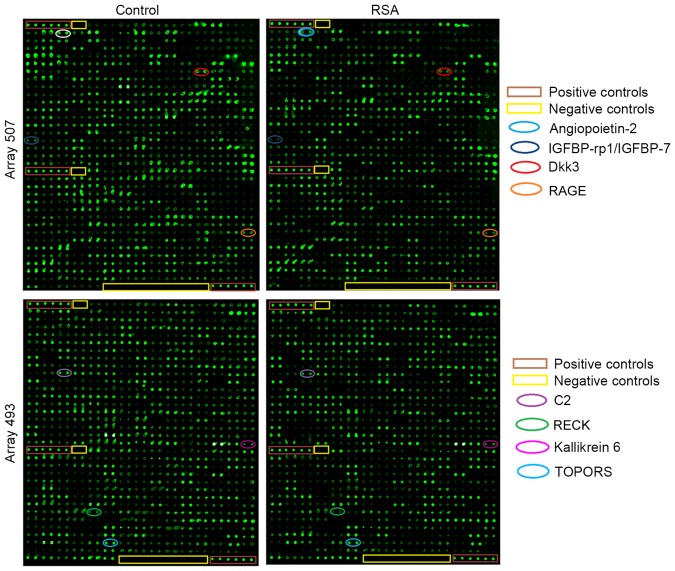
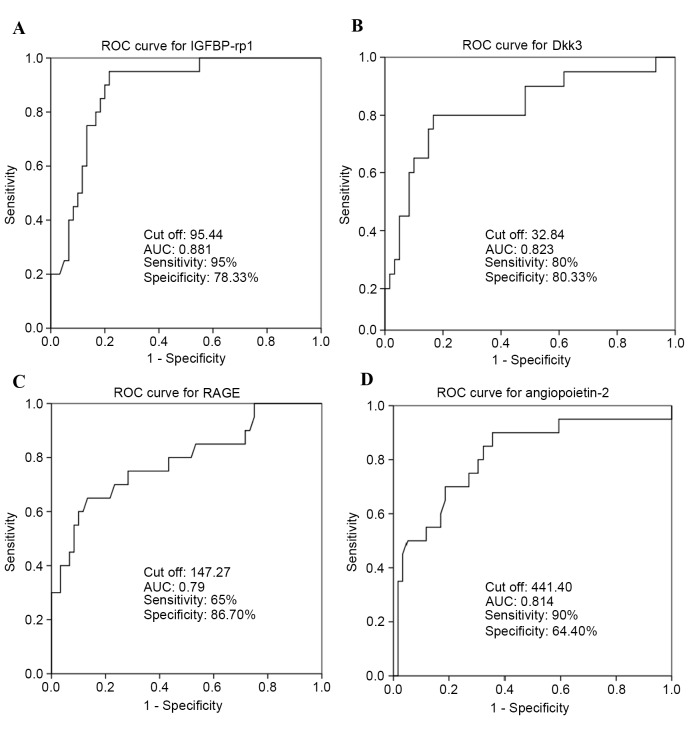
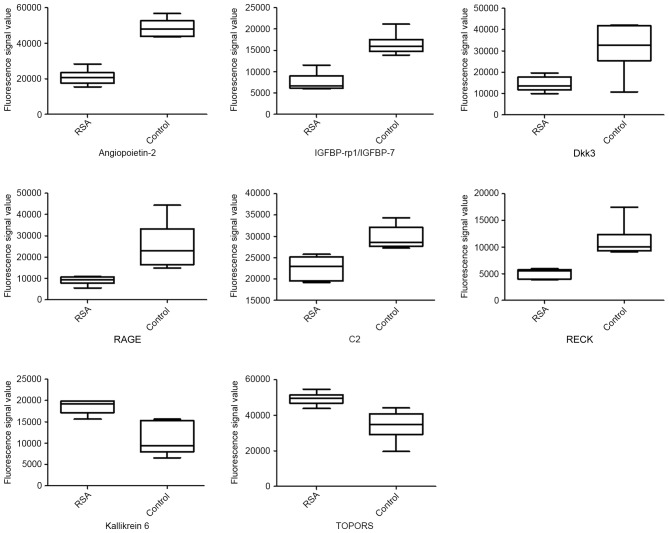
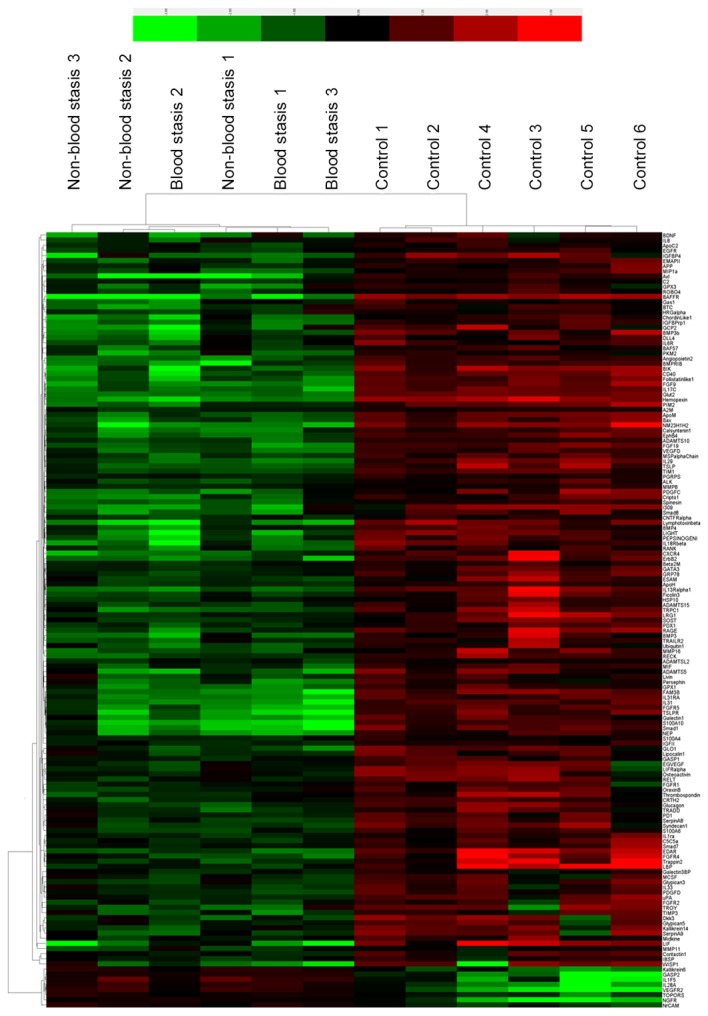
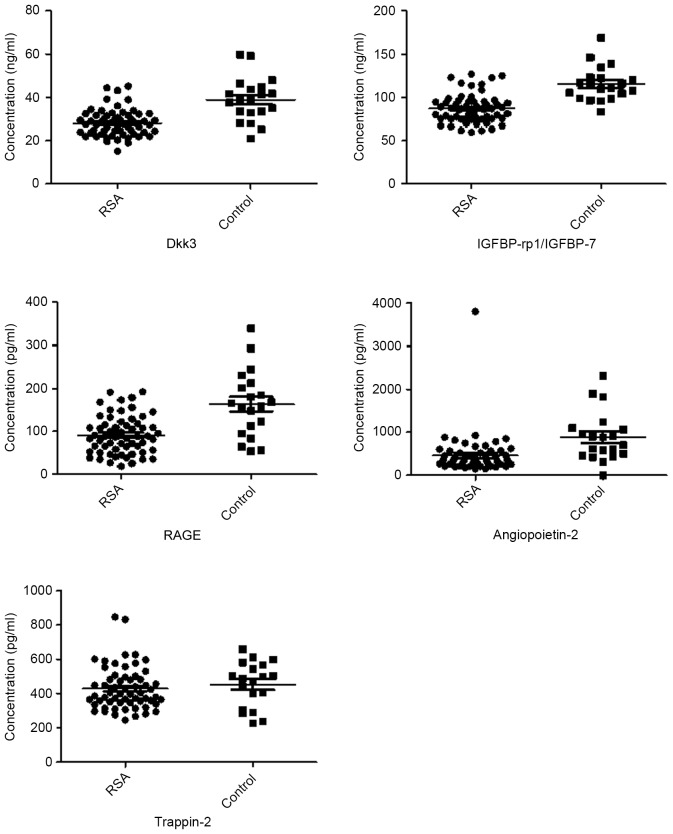
Recurrent spontaneous abortion (RSA) occurs in 1‑5% of parturients. The sustained therapy and research for RSA is expensive, which is a serious issue faced by both patients and doctors. The aim of the present study was to detect protein expression profiles in the serum of RSA patients and healthy controls, and to identify potential biomarkers for this disease. A 1,000‑protein microarray consisting of a combination of Human L‑507 and L‑493 was used. The microarray data revealed that eight serum protein expression levels were significantly upregulated and 143 proteins were downregulated in RSA patients compared with the healthy controls. ELISA individually validated 5 of these 151 proteins in a larger cohort of patients and control samples, demonstrating a significant decrease in insulin‑like growth factor‑binding protein‑related protein 1 (IFGBP‑rp1)/IGFBP‑7, Dickkopf‑related protein 3 (Dkk3), receptor for advanced glycation end products (RAGE) and angiopoietin‑2 levels in patients with RSA. Sensitivity and specificity analyses were calculated by a receiver operating characteristics curve, and were revealed to be 0.881, 0.823, 0.79 and 0.814, with diagnostic cut‑off points of 95.44 ng/ml for IFGBP‑rp1, 32.84 ng/ml for Dkk3, 147.27 ng/ml for RAGE and 441.40 ng/ml for angiopoietin‑2. The present study indicated that these four proteins were downregulated in RSA samples and may be useful as biomarkers for the prediction and diagnosis of RSA. Subsequent studies in larger‑scale cohorts are required to further validate the diagnostic value of these markers.
复发性自然流产(RSA)在1%至5%的产妇中发生。对RSA的持续治疗和研究成本高昂,这是患者和医生都面临的一个严重问题。本研究的目的是检测RSA患者和健康对照者血清中的蛋白质表达谱,并确定该疾病的潜在生物标志物。使用了由人类L-507和L-493组合而成的1000蛋白微阵列。微阵列数据显示,与健康对照相比,RSA患者中有8种血清蛋白表达水平显著上调,143种蛋白表达下调。酶联免疫吸附测定(ELISA)在更大的患者和对照样本队列中单独验证了这151种蛋白中的5种,结果表明RSA患者中胰岛素样生长因子结合蛋白相关蛋白1(IFGBP-rp1)/胰岛素样生长因子结合蛋白7(IGFBP-7)、Dickkopf相关蛋白3(Dkk3)、晚期糖基化终产物受体(RAGE)和血管生成素2水平显著降低。通过受试者工作特征曲线计算敏感性和特异性分析,结果显示IFGBP-rp1的敏感性和特异性分别为0.881、0.823,Dkk3为0.79,RAGE为0.814,血管生成素2为0.814,IFGBP-rp1的诊断临界值为95.44 ng/ml,Dkk3为32.84 ng/ml,RAGE为147.27 ng/ml,血管生成素2为441.40 ng/ml。本研究表明,这四种蛋白在RSA样本中表达下调,可能作为RSA预测和诊断的生物标志物。需要在更大规模队列中进行后续研究,以进一步验证这些标志物的诊断价值。