Kessel Kerstin A, Hesse Josefine, Straube Christoph, Zimmer Claus, Schmidt-Graf Friederike, Schlegel Jürgen, Meyer Bernhard, Combs Stephanie E
Department of Radiation Oncology, Technische Universität München (TUM), Munich, Germany.
Institute of Innovative Radiotherapy (iRT), Helmholtz Zentrum München, Neuherberg, Germany.
PLoS One. 2017 Jul 5;12(7):e0180457. doi: 10.1371/journal.pone.0180457. eCollection 2017.
For about 30 years, researchers developed prognostic scores and searched for prognostic factors to predict outcomes for cancer patients. The "Combs Prognostic Score" for re-irradiation in recurrent glioma was recently validated and results showed that the score is a significant (p < .001) and reliable predictor for patients undergoing re-irradiation (re-RT). We sought to enhance the score and generated a novel scoring approach, taking into account the information on resection of recurrent tumors, KPS, and tumor volume.
The prognostic score was generated based on 209 patients treated between 2002 and 2016 for recurrent glioma at the department of radiation oncology at the Klinikum rechts der Isar, Munich. To further enhance the previously validated Combs Prognostic Score, which uses the prognostic factors primary histology, time between primary RT and re-RT, and age, we added KPS, tumor volume (PTV) and re-resection into the scoring scheme.
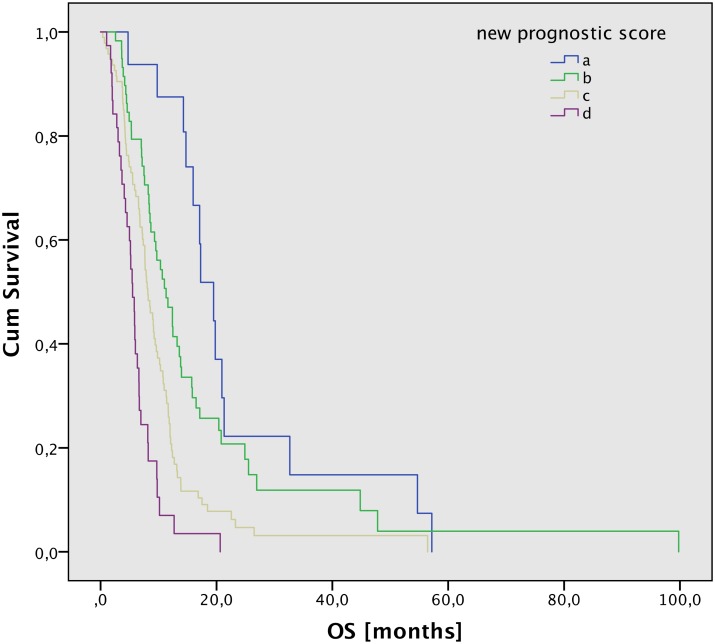
The median follow-up time was 3.5 months. 67.5% were WHO IV gliomas with a median OS after re-RT of 7.9 months, 17.7% were WHO III gliomas with an OS of 11.3 months and 14.8% were WHO I/II gliomas with an OS of 14.7 months. Multivariate analyses confirmed the prognostic factors KPS (p < .001) and showed a tendency to significance for tumor volume (p = .067) and re-resection (p = .064). The new prognostic score demonstrated a high significance (p < .001).
The "New Combs Prognostics Score" is a significant and useful tool to predict the overall effect of re-RT in patients with recurrence gliomas. This modified score offers an even better way to classify patients in clinical routine and prospective clinical trials investigating re-irradiation.
大约30年来,研究人员一直在开发预后评分系统并寻找预后因素,以预测癌症患者的预后情况。复发性胶质瘤再程放疗的“康姆斯预后评分”最近得到了验证,结果表明该评分对于接受再程放疗(re-RT)的患者是一个显著(p <.001)且可靠的预测指标。我们试图改进该评分,并考虑复发性肿瘤切除情况、KPS评分和肿瘤体积等信息,生成了一种新的评分方法。
预后评分基于2002年至2016年间在慕尼黑伊萨尔河右岸医院放射肿瘤科接受复发性胶质瘤治疗的209例患者生成。为了进一步改进先前验证的康姆斯预后评分(该评分使用主要组织学类型、初次放疗与再程放疗之间的时间以及年龄作为预后因素),我们将KPS评分、肿瘤体积(计划靶体积)和再次切除情况纳入评分方案。
中位随访时间为3.5个月。67.5%为世界卫生组织(WHO)IV级胶质瘤,再程放疗后的中位总生存期为7.9个月;17.7%为WHO III级胶质瘤,总生存期为11.3个月;14.8%为WHO I/II级胶质瘤,总生存期为14.7个月。多因素分析证实了KPS评分作为预后因素具有显著性(p <.001),肿瘤体积(p =.067)和再次切除情况(p =.064)有显著趋势。新的预后评分具有高度显著性(p <.001)。
“新康姆斯预后评分”是预测复发性胶质瘤患者再程放疗总体疗效的一个重要且有用的工具。这种改进后的评分在临床常规和研究再程放疗的前瞻性临床试验中为患者分类提供了更好的方法。