Lenze Ulrich, Kasal Stefanie, Hefti Fritz, Krieg Andreas Heinrich
Department of Orthopaedics, University Children's Hospital of both Basel (UKBB), Spitalstrasse 33, CH-4056, Basel, Switzerland.
BMC Musculoskelet Disord. 2017 Jul 5;18(1):289. doi: 10.1186/s12891-017-1640-z.
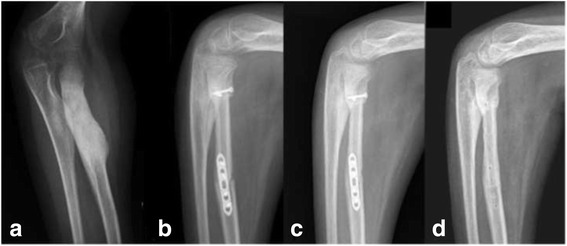
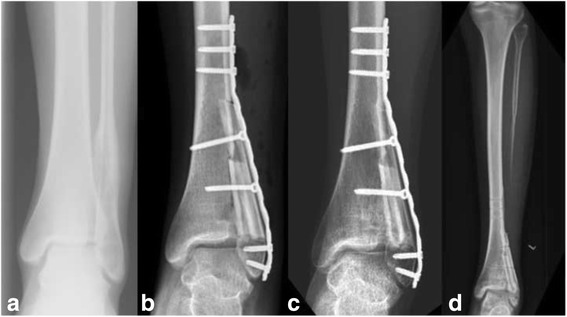
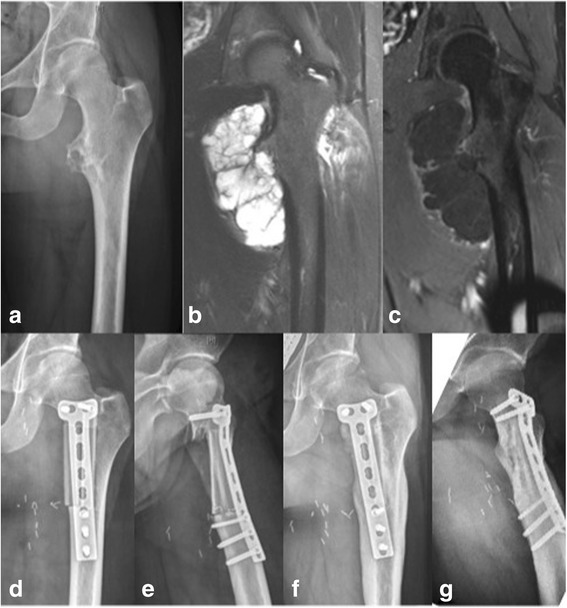
The reconstruction of meta-/diaphyseal bone defects following bone tumour resection is challenging, and biological treatment options should be applied whenever possible, especially in benign lesions and early stage sarcomas. We aimed to evaluate the results of segmental (SR) and hemicortical reconstructions (HR) at the extremities using non-vascularised fibula grafts.
We retrospectively enrolled 36 patients who were treated with non-vascularised fibula reconstructions (15 SR, 21 HR) after bone tumour resection (15 malignant, 21 benign). All cases were evaluated regarding consolidation, hypertrophy at the graft-host junctions, and complications; moreover, the functional and oncological results were assessed. The mean follow-up was 8.3 years (2.1-26.6 years).
Primary union was achieved in 94% (SR 87%, HR 100%) of patients, and 85% (SR 81%, HR 88%) showed hypertrophy at the graft-host junction. The overall complication rate was 36% with 4 patients (11%) developing local recurrence. There was a significant correlation between the development of mechanical complications (fracture, delayed-/non-union) and a defect size of ≥12 cm (p = 0.013), segmental defects (p = 0.013) and additional required treatment (p = 0.008). The functional outcome was highly satisfactory (mean MSTS score 86%).
Due to encouraging results and advantages (such as their remodelling capacity at the donor site), non-vascularised fibula reconstructions should be considered a valuable alternative treatment option for patients with hemicortical defects or segmental reconstructions of less than 12 cm in which no additional neo-/adjuvant treatment is necessary.
骨肿瘤切除术后干骺端/骨干骨缺损的重建具有挑战性,应尽可能采用生物治疗方案,尤其是在良性病变和早期肉瘤中。我们旨在评估使用非带血管腓骨移植进行肢体节段性(SR)和半皮质重建(HR)的结果。
我们回顾性纳入了36例在骨肿瘤切除术后接受非带血管腓骨重建的患者(15例SR,21例HR)(15例恶性,21例良性)。对所有病例进行了骨愈合、移植骨与宿主骨连接处肥大及并发症的评估;此外,还评估了功能和肿瘤学结果。平均随访时间为8.3年(2.1 - 26.6年)。
94%(SR为87%,HR为100%)的患者实现了一期愈合,85%(SR为81%,HR为88%)的患者在移植骨与宿主骨连接处出现肥大。总体并发症发生率为36%,4例患者(11%)出现局部复发。机械性并发症(骨折、延迟愈合/不愈合)的发生与≥12 cm的缺损大小(p = 0.013)、节段性缺损(p = 0.013)及额外所需治疗(p = 0.008)之间存在显著相关性。功能结果非常令人满意(平均MSTS评分为86%)。
由于结果令人鼓舞且具有优势(如供区的重塑能力),对于半皮质缺损或长度小于12 cm且无需额外新辅助治疗的节段性重建患者,非带血管腓骨重建应被视为一种有价值的替代治疗选择。