Liu Tang, Zhang Qing, Guo Xiaoning, Zhang Xiangsheng, Li Zhihong, Li Xiaoyang
Department of Orthopaedics, the Second Xiangya Hospital, Central South University, Changsha, Hunan 410011, P,R, China.
BMC Musculoskelet Disord. 2014 Mar 7;15:69. doi: 10.1186/1471-2474-15-69.
The purpose of this study was to compare the outcome, complications and survival of the commonly used surgical reconstructions of the proximal humerus after intrarticular tumour resection in our hospital.
Between 1998 and 2010, 41 consecutive proximal humeral reconstructions using prosthesis (group P, n = 25) or recycled pasteurized autograft combined with non-vascularised fibula autograft (group B, n = 16) were performed.
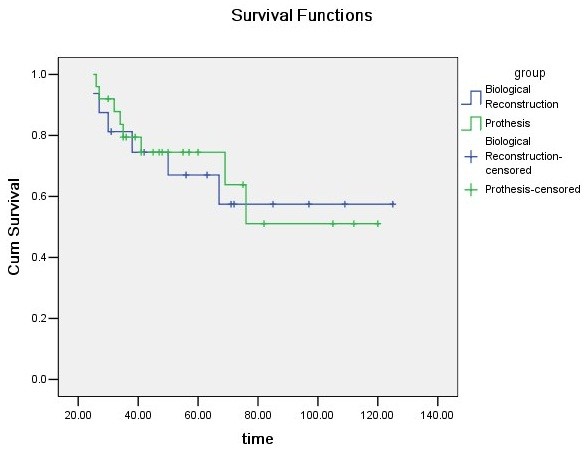
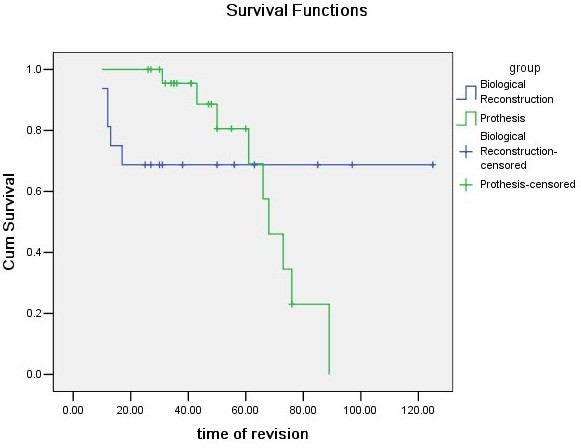
The mean follow-up was 57.7 months. Fourteen patients (8 patients in group P and 6 in group B) died during the follow-up period, the disease-specific survival of patients in group P was 74.5% at 5 years and in group B was 67.0%. Local recurrences were occurred in 3 cases (12.0%) in group P and 2 (12.5%) in group B. Pulmonary metastases were observed in 4 patients (16.0%) in group P and 4 (25.0%) in group B. There was no significant difference in the incidence of local recurrence, pulmonary metastasis or death of disease. Revisions were indicated in 9 patients (36.0%) in group P and 5 (31.25%) in group B. Thought the incidence of revisions was higher in group P, there was no significant difference in these two groups. The Kaplan-Meier 5-year implant survival estimates, with revision for any reason as the end point, were 80.6% and 68.8% for group P and group B, respectively. The mean MSTS Score was 63.6% in group P and 63.0% in group B. These differences were not statistically significant.
The study could show that prosthetic reconstruction and reconstruction with recycled pasteurized autograft are similar in terms of their local recurrence and metastasis, while the incidence of revisions was higher for patients with prosthetic reconstruction.
本研究旨在比较我院关节内肿瘤切除术后常用的肱骨近端手术重建的结果、并发症及生存率。
1998年至2010年期间,连续对41例肱骨近端进行重建,其中使用假体的有25例(P组),使用回收巴氏消毒自体骨联合非血管化腓骨自体骨的有16例(B组)。
平均随访57.7个月。随访期间有14例患者死亡(P组8例,B组6例),P组患者5年疾病特异性生存率为74.5%,B组为67.0%。P组有3例(12.0%)发生局部复发,B组有2例(12.5%)。P组有4例患者(16.0%)出现肺转移,B组有4例(25.0%)。局部复发、肺转移或疾病死亡的发生率无显著差异。P组有9例患者(36.0%)需要翻修,B组有5例(31.25%)。虽然P组翻修率较高,但两组无显著差异。以任何原因翻修为终点的Kaplan-Meier 5年植入物生存率估计,P组和B组分别为80.6%和68.8%。P组平均肌肉骨骼肿瘤协会(MSTS)评分为63.6%,B组为63.0%。这些差异无统计学意义。
该研究表明,假体重建和回收巴氏消毒自体骨重建在局部复发和转移方面相似,而假体重建患者的翻修率较高。