Stefansson Olafur Andri, Hermanowicz Stefan, van der Horst Jasper, Hilmarsdottir Holmfridur, Staszczak Zuzanna, Jonasson Jon Gunnlaugur, Tryggvadottir Laufey, Gudjonsson Thorkell, Sigurdsson Stefan
Cancer Research Laboratory, Biomedical Center, Vatnsmyrarvegur 16 (4th floor), 101, Reykjavik, Iceland.
Faculty of Medicine, University of Iceland, Vatnsmyrarvegur 16 (4th floor), 101, Reykjavik, Iceland.
BMC Cancer. 2017 Jul 5;17(1):469. doi: 10.1186/s12885-017-3453-8.
DNA repair of alkylation damage is defective in various cancers. This occurs through somatically acquired inactivation of the MGMT gene in various cancer types, including breast cancers. In addition to MGMT, the two E. coli AlkB homologs ALKBH2 and ALKBH3 have also been linked to direct reversal of alkylation damage. However, it is currently unknown whether ALKBH2 or ALKBH3 are found inactivated in cancer.
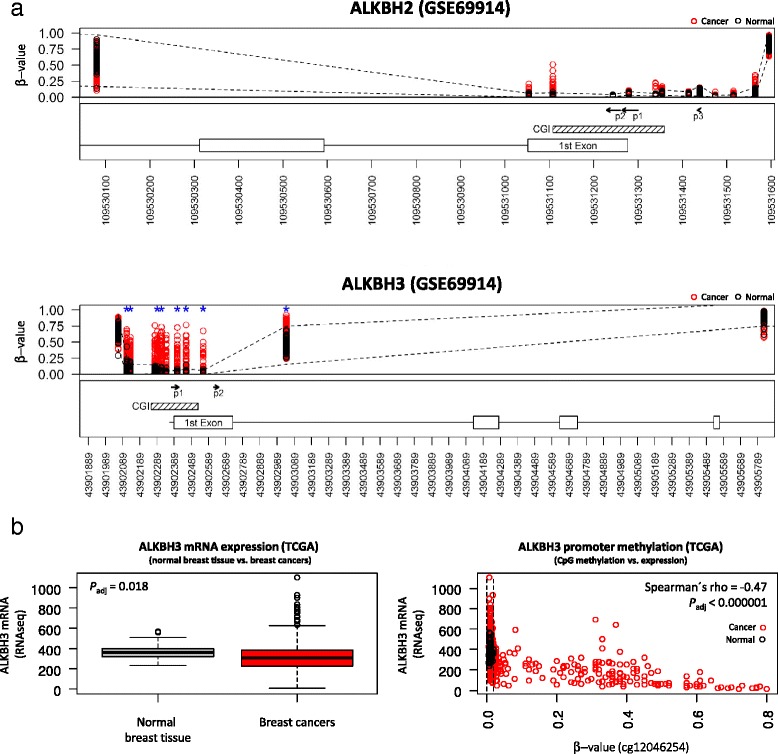
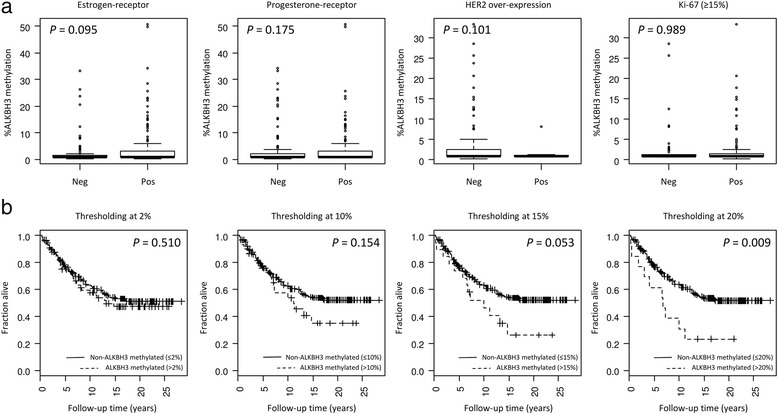
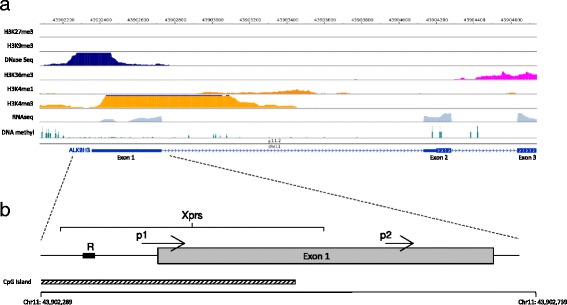
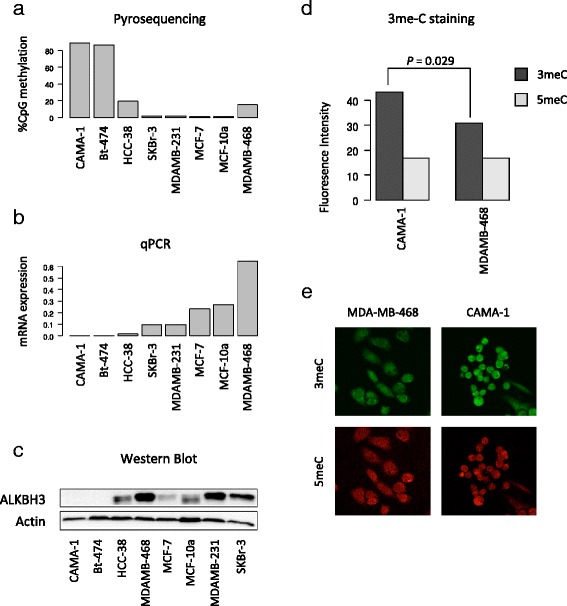
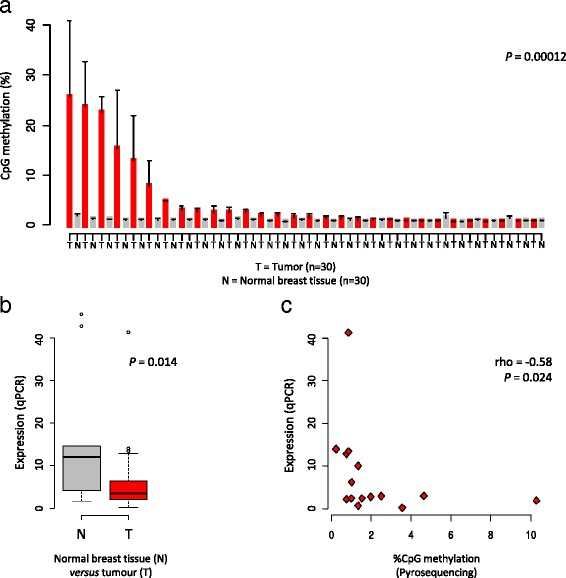
Methylome datasets (GSE52865, GSE20713, GSE69914), available through Omnibus, were used to determine whether ALKBH2 or ALKBH3 are found inactivated by CpG promoter methylation. TCGA dataset enabled us to then assess the impact of CpG promoter methylation on mRNA expression for both ALKBH2 and ALKBH3. DNA methylation analysis for the ALKBH3 promoter region was carried out by pyrosequencing (PyroMark Q24) in 265 primary breast tumours and 30 proximal normal breast tissue samples along with 8 breast-derived cell lines. ALKBH3 mRNA and protein expression were analysed in cell lines using RT-PCR and Western blotting, respectively. DNA alkylation damage assay was carried out in cell lines based on immunofluorescence and confocal imaging. Data on clinical parameters and survival outcomes in patients were obtained and assessed in relation to ALKBH3 promoter methylation.
The ALKBH3 gene, but not ALKBH2, undergoes CpG promoter methylation and transcriptional silencing in breast cancer. We developed a quantitative alkylation DNA damage assay based on immunofluorescence and confocal imaging revealing higher levels of alkylation damage in association with epigenetic inactivation of the ALKBH3 gene (P = 0.029). In our cohort of 265 primary breast cancer, we found 72 cases showing aberrantly high CpG promoter methylation over the ALKBH3 promoter (27%; 72 out of 265). We further show that increasingly higher degree of ALKBH3 promoter methylation is associated with reduced breast-cancer specific survival times in patients. In this analysis, ALKBH3 promoter methylation at >20% CpG methylation was found to be statistically significantly associated with reduced survival (HR = 2.3; P = 0.012). By thresholding at the clinically relevant CpG methylation level (>20%), we find the incidence of ALKBH3 promoter methylation to be 5% (13 out of 265).
ALKBH3 is a novel addition to the catalogue of DNA repair genes found inactivated in breast cancer. Our results underscore a link between defective alkylation repair and breast cancer which, additionally, is found in association with poor disease outcome.
在多种癌症中,烷基化损伤的DNA修复存在缺陷。这是通过包括乳腺癌在内的多种癌症类型中MGMT基因的体细胞获得性失活而发生的。除了MGMT,两种大肠杆菌AlkB同源物ALKBH2和ALKBH3也与烷基化损伤的直接修复有关。然而,目前尚不清楚ALKBH2或ALKBH3在癌症中是否失活。
通过综合库获得的甲基化组数据集(GSE52865、GSE20713、GSE69914)用于确定ALKBH2或ALKBH3是否因CpG启动子甲基化而失活。TCGA数据集使我们能够随后评估CpG启动子甲基化对ALKBH2和ALKBH3 mRNA表达的影响。通过焦磷酸测序(PyroMark Q24)对265例原发性乳腺肿瘤、30例近端正常乳腺组织样本以及8种乳腺来源的细胞系进行ALKBH3启动子区域的DNA甲基化分析。分别使用RT-PCR和蛋白质印迹法在细胞系中分析ALKBH3 mRNA和蛋白质表达。基于免疫荧光和共聚焦成像在细胞系中进行DNA烷基化损伤测定。获取并评估患者的临床参数和生存结果数据与ALKBH3启动子甲基化的关系。
在乳腺癌中,ALKBH3基因而非ALKBH2基因发生CpG启动子甲基化和转录沉默。我们基于免疫荧光和共聚焦成像开发了一种定量烷基化DNA损伤测定方法,发现与ALKBH3基因的表观遗传失活相关的烷基化损伤水平更高(P = 0.029)。在我们的265例原发性乳腺癌队列中,我们发现72例在ALKBH3启动子上显示异常高的CpG启动子甲基化(27%;265例中的72例)。我们进一步表明,ALKBH3启动子甲基化程度越高,患者的乳腺癌特异性生存时间越短。在该分析中,发现CpG甲基化>20%时的ALKBH3启动子甲基化与生存率降低在统计学上显著相关(HR = 2.3;P = 0.012)。通过在临床相关的CpG甲基化水平(>20%)进行阈值设定,我们发现ALKBH3启动子甲基化的发生率为(265例中的13例)5%。
ALKBH3是在乳腺癌中发现失活的DNA修复基因目录中的一个新成员。我们的结果强调了烷基化修复缺陷与乳腺癌之间的联系,此外,还发现与不良疾病预后相关。