Department of Cancer Biology, Irell & Manella Graduate School of Biological Sciences, Beckman Research Institute at the City of Hope, Duarte, California, USA.
Department of Diabetes and Cancer Metabolism, Beckman Research Institute at the City of Hope, Duarte, California, USA.
J Biol Chem. 2024 Aug;300(8):107492. doi: 10.1016/j.jbc.2024.107492. Epub 2024 Jun 24.
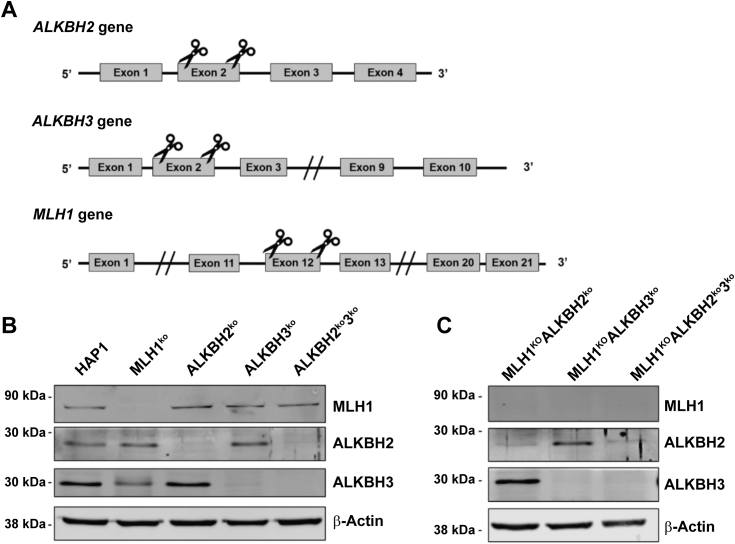
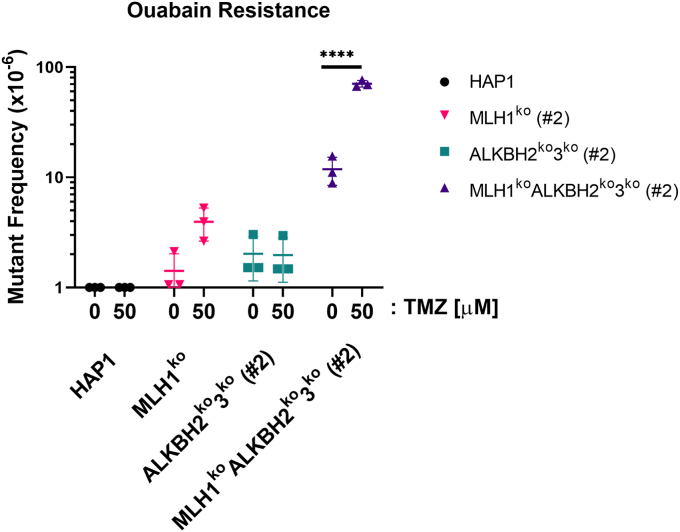
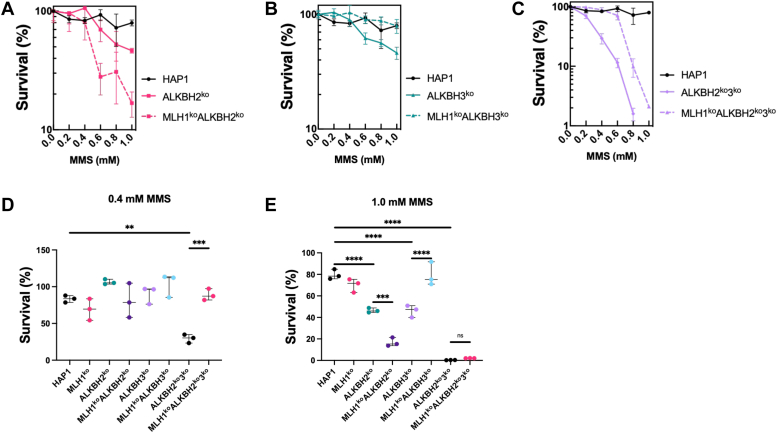
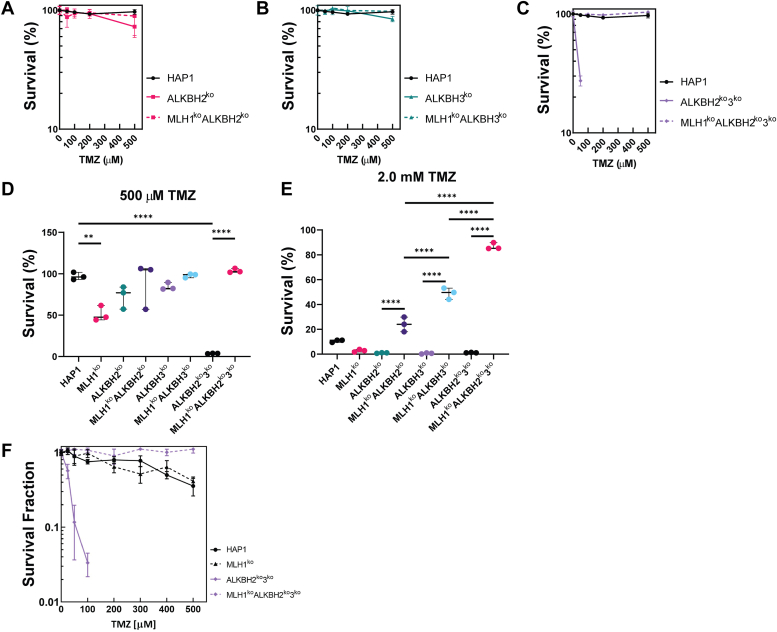
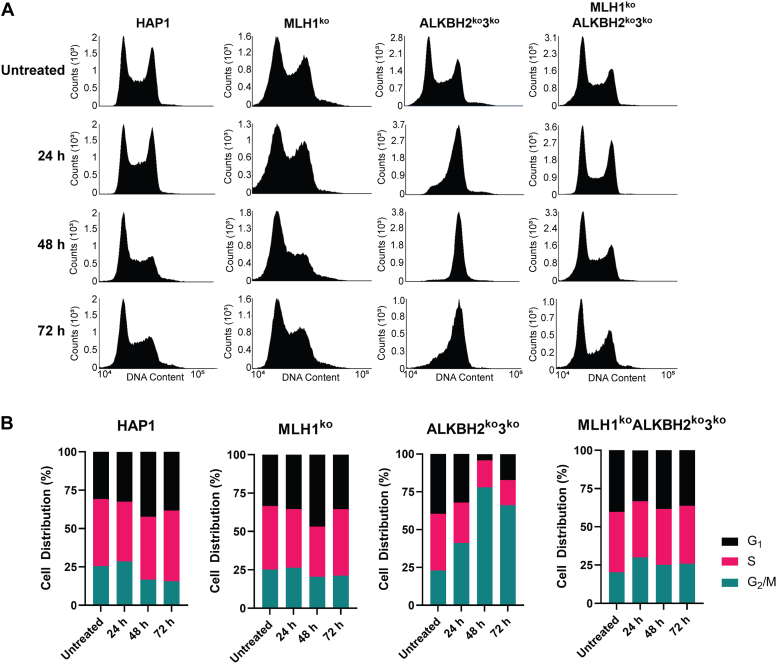
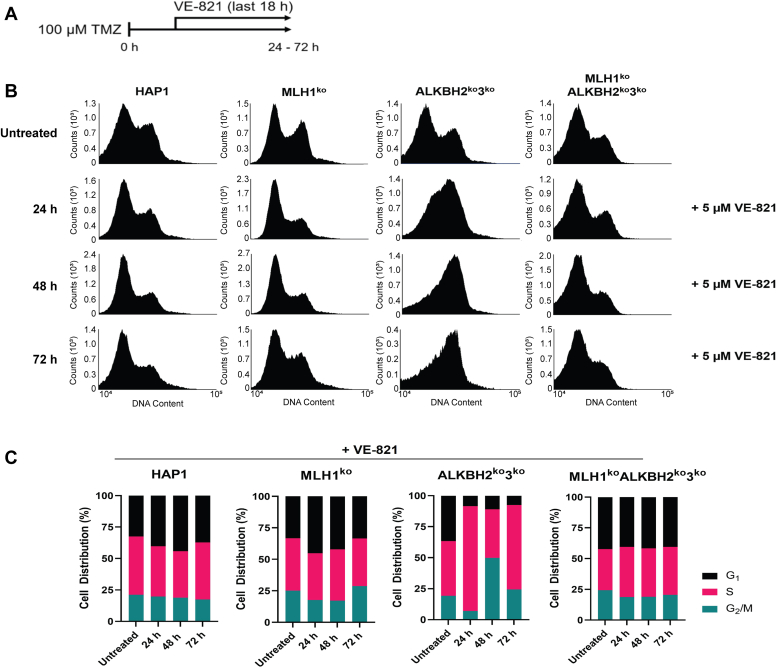
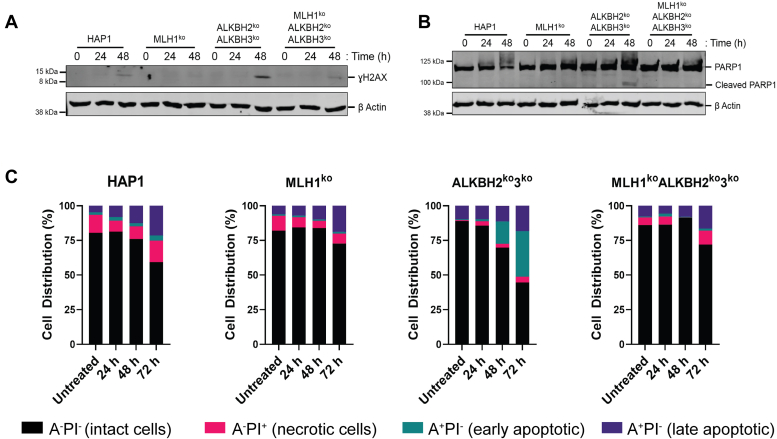
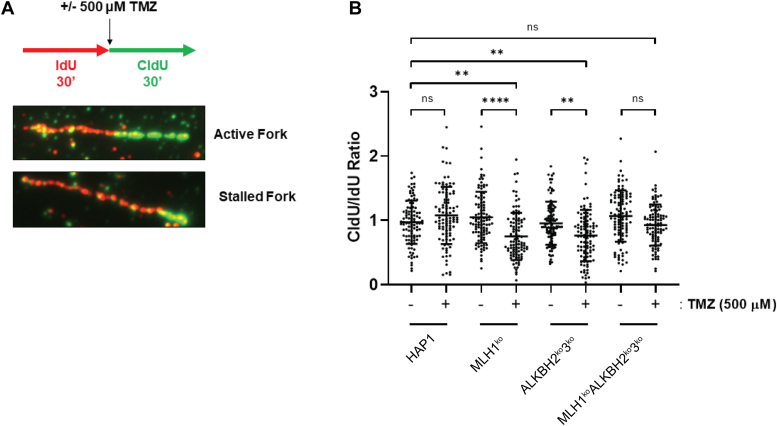
The human alkylation B (AlkB) homologs, ALKBH2 and ALKBH3, respond to methylation damage to maintain genomic integrity and cellular viability. Both ALKBH2 and ALKBH3 are direct reversal repair enzymes that remove 1-methyladenine (1meA) and 3-methylcytosine (3meC) lesions commonly generated by alkylating chemotherapeutic agents. Thus, the existence of deficiencies in ALKBH proteins can be exploited in synergy with chemotherapy. In this study, we investigated possible interactions between ALKBH2 and ALKBH3 with other proteins that could alter damage response and discovered an interaction with the mismatch repair (MMR) system. To test whether the lack of active MMR impacts ALKBH2 and/or ALKBH3 response to methylating agents, we generated cells deficient in ALKBH2, ALKBH3, or both in addition to Mlh homolog 1 (MLH1), another MMR protein. We found that MLH1ALKBH3 cells showed enhanced resistance toward S1- and S2-type methylating agents, whereas MLH1ALKBH2 cells were only resistant to S1-type methylating agents. Concomitant loss of ALKBH2 and ALKBH3 (ALKBH23) rendered cells sensitive to S1- and S2-agents, but the additional loss of MLH1 enhanced resistance to both types of damage. We also showed that ALKBH23 cells have an ATR-dependent arrest at the G/M checkpoint, increased apoptotic signaling, and replication fork stress in response to methylation. However, these responses were not observed with the loss of functional MLH1 in MLH1ALKBH23 cells. Finally, in MLH1ALKBH23 cells, we observed elevated mutant frequency in untreated and temozolomide treated cells. These results suggest that obtaining a more accurate prognosis of chemotherapeutic outcome requires information on the functionality of ALKBH2, ALKBH3, and MLH1.
人类烷基化 B(AlkB)同源物 ALKBH2 和 ALKBH3 响应甲基化损伤以维持基因组完整性和细胞活力。ALKBH2 和 ALKBH3 都是直接逆转修复酶,可去除烷基化化疗药物常见产生的 1-甲基腺嘌呤(1meA)和 3-甲基胞嘧啶(3meC)损伤。因此,ALKBH 蛋白的缺陷可以与化疗协同利用。在这项研究中,我们研究了 ALKBH2 和 ALKBH3 与其他可能改变损伤反应的蛋白质之间的可能相互作用,并发现与错配修复(MMR)系统的相互作用。为了测试缺乏活跃的 MMR 是否会影响 ALKBH2 和/或 ALKBH3 对甲基化剂的反应,我们除了 MLH 同源物 1(MLH1),即另一种 MMR 蛋白外,还生成了 ALKBH2、ALKBH3 或两者均缺失的细胞。我们发现 MLH1ALKBH3 细胞对 S1 和 S2 型甲基化剂表现出增强的抗性,而 MLH1ALKBH2 细胞仅对 S1 型甲基化剂有抗性。ALKBH2 和 ALKBH3 的同时缺失(ALKBH23)使细胞对 S1 和 S2 型药物敏感,但 MLH1 的额外缺失增强了对两种类型损伤的抗性。我们还表明,ALKBH23 细胞在 G/M 检查点有 ATR 依赖性停滞,在响应甲基化时有增加的凋亡信号和复制叉应激。然而,在用 MLH1 功能丧失的 MLH1ALKBH23 细胞中未观察到这些反应。最后,在 MLH1ALKBH23 细胞中,我们观察到未经处理和替莫唑胺处理的细胞中突变频率升高。这些结果表明,获得更准确的化疗结果预后需要有关 ALKBH2、ALKBH3 和 MLH1 功能的信息。