Ni Ling, Dong Chen
Institute for Immunology and School of Medicine, Tsinghua University, Beijing, China.
Mol Cancer Ther. 2017 Jul;16(7):1203-1211. doi: 10.1158/1535-7163.MCT-16-0761.
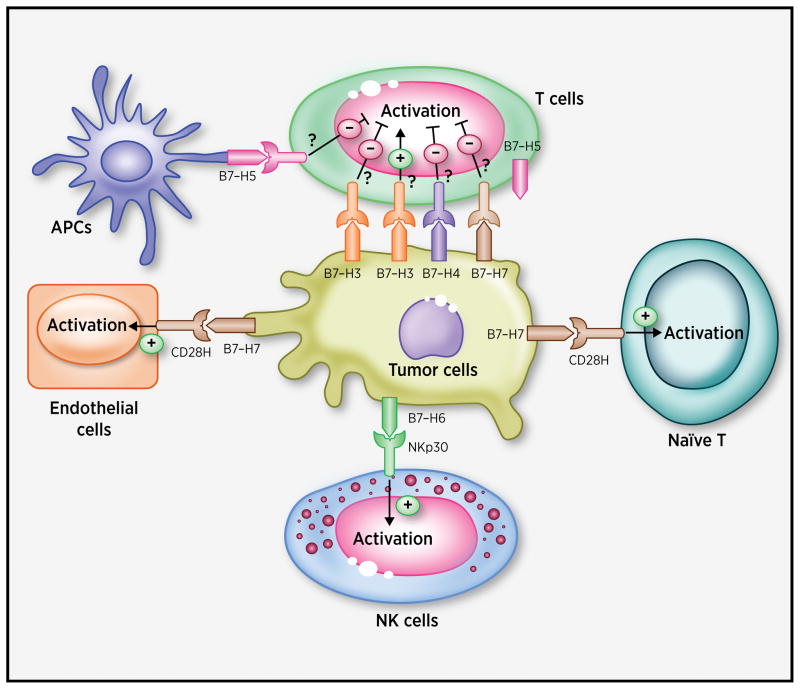
T cells are the main effector cells in immune response against tumors. The activation of T cells is regulated by the innate immune system through positive and negative costimulatory molecules. Targeting immune checkpoint regulators such as programmed cell death 1 (PD-1)/PD-1 ligand 1 (PD-L1) and CTL antigen 4 (CTLA-4) has achieved notable benefit in a variety of cancers, which leads to multiple clinical trials with antibodies targeting the other related B7/CD28 family members. Recently, five new B7 family ligands, B7-H3, B7-H4, B7-H5, B7-H6, and B7-H7, were identified. Here we review recent understanding of new B7 family checkpoint molecules as they have come to the front of cancer research with the concept that tumor cells exploit them to escape immune surveillance. The aim of this article is to address the structure and expression of the new B7 family molecules as well as their roles in controlling and suppressing immune responses of T cells as well as NK cells. We also discuss clinical significance and contribution of these checkpoint expressions in human cancers. .
T细胞是抗肿瘤免疫反应中的主要效应细胞。T细胞的激活由先天免疫系统通过正负共刺激分子进行调节。靶向免疫检查点调节因子,如程序性细胞死亡蛋白1(PD-1)/PD-1配体1(PD-L1)和细胞毒性T淋巴细胞相关抗原4(CTLA-4),已在多种癌症中取得显著疗效,这引发了多项针对其他相关B7/CD28家族成员的抗体的临床试验。最近,又鉴定出了五个新的B7家族配体,即B7-H3、B7-H4、B7-H5、B7-H6和B7-H7。在此,我们综述了对新的B7家族检查点分子的最新认识,因为它们已成为癌症研究的前沿领域,其概念是肿瘤细胞利用它们来逃避免疫监视。本文旨在探讨新的B7家族分子的结构和表达,以及它们在控制和抑制T细胞及自然杀伤细胞(NK细胞)免疫反应中的作用。我们还将讨论这些检查点表达在人类癌症中的临床意义和作用。