
柑橘全基因组关联研究和基因组预测:基因组辅助育种在果实品质性状上的潜力。
Genome-wide association study and genomic prediction in citrus: Potential of genomics-assisted breeding for fruit quality traits.
机构信息
Laboratory of Biometry and Bioinformatics, Department of Agricultural and Environmental Biology, Graduate School of Agricultural and Life Sciences, The University of Tokyo, 1-1-1 Yayoi, Bunkyo, Tokyo, 113-8657, Japan.
Institute of Fruit Tree and Tea Science, National Agriculture and Food Research Organization (NARO), 485-6 Okitsu Nakacho, Shimizu, Shizuoka, 424-0292, Japan.
出版信息
Sci Rep. 2017 Jul 5;7(1):4721. doi: 10.1038/s41598-017-05100-x.
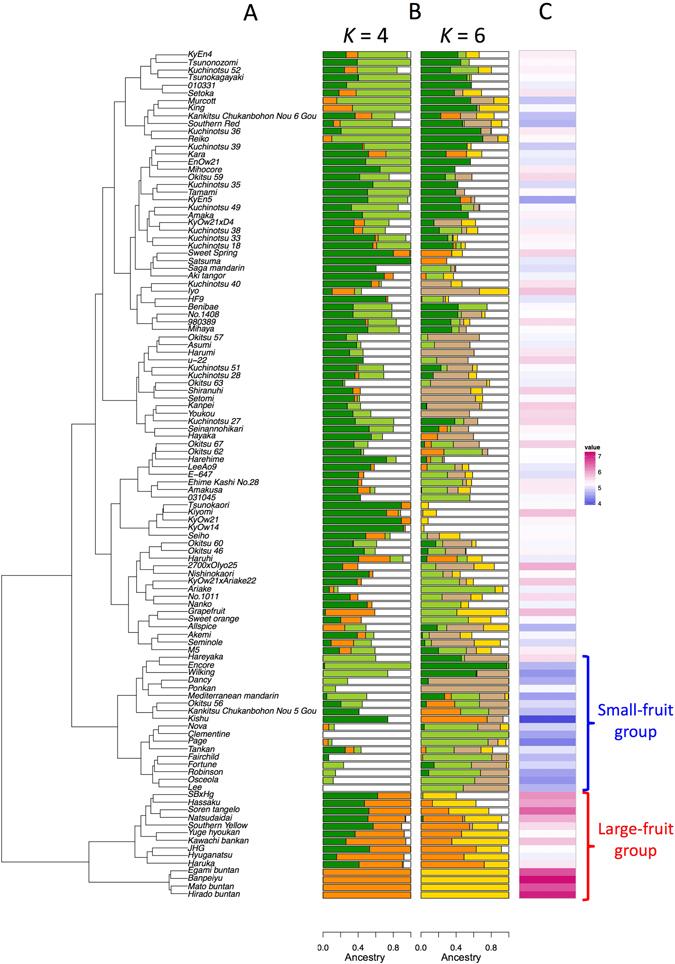
Novel genomics-based approaches such as genome-wide association studies (GWAS) and genomic selection (GS) are expected to be useful in fruit tree breeding, which requires much time from the cross to the release of a cultivar because of the long generation time. In this study, a citrus parental population (111 varieties) and a breeding population (676 individuals from 35 full-sib families) were genotyped for 1,841 single nucleotide polymorphisms (SNPs) and phenotyped for 17 fruit quality traits. GWAS power and prediction accuracy were increased by combining the parental and breeding populations. A multi-kernel model considering both additive and dominance effects improved prediction accuracy for acidity and juiciness, implying that the effects of both types are important for these traits. Genomic best linear unbiased prediction (GBLUP) with linear ridge kernel regression (RR) was more robust and accurate than GBLUP with non-linear Gaussian kernel regression (GAUSS) in the tails of the phenotypic distribution. The results of this study suggest that both GWAS and GS are effective for genetic improvement of citrus fruit traits. Furthermore, the data collected from breeding populations are beneficial for increasing the detection power of GWAS and the prediction accuracy of GS.
基于基因组学的新方法,如全基因组关联研究 (GWAS) 和基因组选择 (GS),有望应用于果树育种。由于世代时间长,果树从杂交到品种推出需要很长时间。在这项研究中,对柑橘亲本群体(111 个品种)和育种群体(35 个全同胞家系的 676 个个体)进行了 1841 个单核苷酸多态性 (SNP) 的基因分型和 17 个果实品质性状的表型分析。通过组合亲本群体和育种群体,提高了 GWAS 的功效和预测准确性。考虑加性和显性效应的多核模型提高了对酸度和多汁性的预测准确性,这意味着这两种效应对这些性状都很重要。在表型分布的尾部,与非线性高斯核回归 (GAUSS) 相比,具有线性岭核回归 (RR) 的基因组最佳线性无偏预测 (GBLUP) 更稳健、更准确。本研究结果表明,GWAS 和 GS 均能有效改良柑橘果实性状。此外,从育种群体中收集的数据有利于提高 GWAS 的检测能力和 GS 的预测准确性。




 Zotero 插件