Shin Seung-Shick, Song Jun-Hui, Hwang Byungdoo, Park Sung Lyea, Kim Won Tae, Park Sung-Soo, Kim Wun-Jae, Moon Sung-Kwon
Department of Food Science and Nutrition, Jeju National University, Jeju, South Korea.
Department of Food and Nutrition, Chung-Ang University, Anseong, South Korea.
Food Nutr Res. 2017 Jun 20;61(1):1338918. doi: 10.1080/16546628.2017.1338918. eCollection 2017.
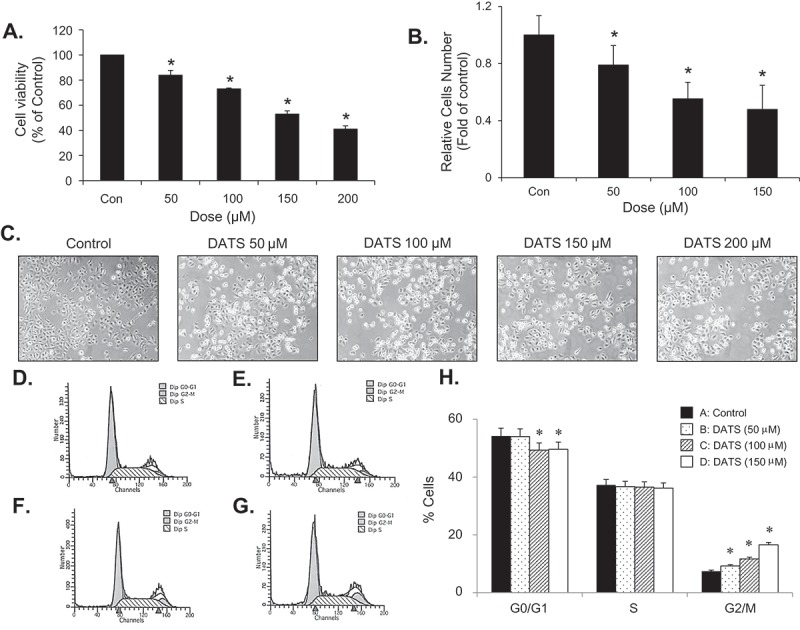
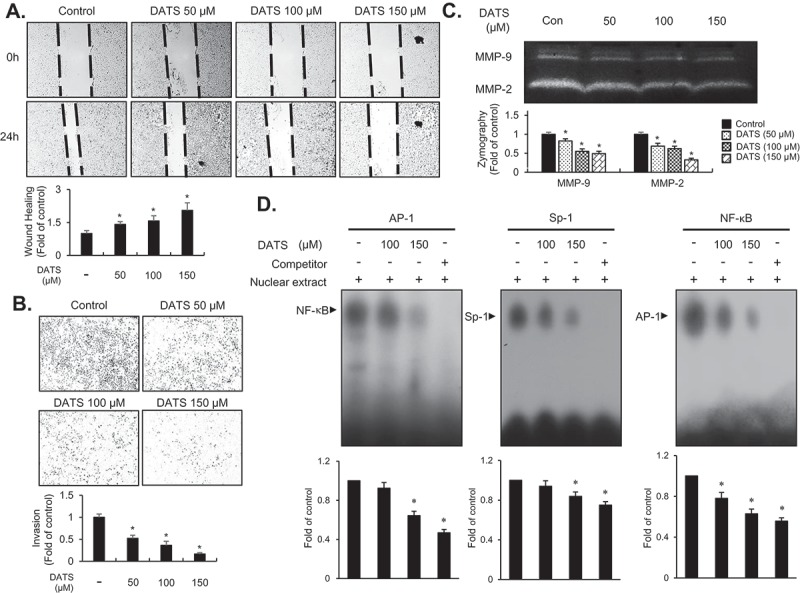
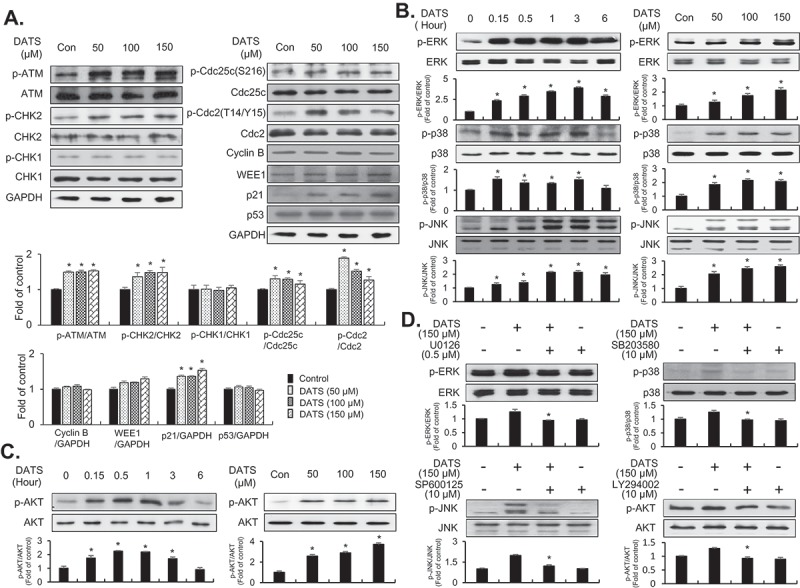
: Diallyl trisulfide (DATS), a bioactive sulfur compound in garlic, has been highlighted due to its strong anti-carcinogenic activity. : The current study investigated the molecular mechanism of garlic-derived DATS in cancer cells. Additionally, we explored possible molecular markers to monitoring clinical responses to DATS-based chemotherapy. : EJ bladder carcinoma cells were treated with different concentration of DATS. Molecular changes including differentially expressed genes in EJ cells were examined using immunoblot, FACS cell cycle analysis, migration and invasion assays, electrophoresis mobility shift assay , microarray, and bioinformatics analysis. : DATS inhibited EJ cell growth via G/M-phase cell cycle arrest. ATM-CHK2-Cdc25c-p21WAF1-Cdc2 signaling cascade, MAPKs, and AKT were associated with the DATS-mediated growth inhibition of EJ cells. DATS-induced inhibition of migration and invasion was correlated with down-regulated MMP-9 via reduced activation of AP-1, Sp-1, and NF-κB. Through microarray gene expression analysis, ANGPTL4, PLCXD1, and MMP3 were identified as candidates of molecular targets of DATS. Introduction of each gene to EJ cells revealed that ANGPTL4 was associated with the DATS-induced inhibition of cell growth, migration, and invasion. : ANGPTL4 regulates DATS-mediated inhibition of proliferation, migration, and invasion of EJ cells, and thus, has potential as a prognostic marker for bladder cancer patients.
二烯丙基三硫化物(DATS)是大蒜中的一种生物活性硫化合物,因其强大的抗癌活性而备受关注。本研究调查了大蒜衍生的DATS在癌细胞中的分子机制。此外,我们探索了可能的分子标志物,以监测基于DATS的化疗的临床反应。用不同浓度的DATS处理EJ膀胱癌细胞。使用免疫印迹、FACS细胞周期分析、迁移和侵袭试验、电泳迁移率变动分析、微阵列和生物信息学分析来检测EJ细胞中包括差异表达基因在内的分子变化。DATS通过G/M期细胞周期阻滞抑制EJ细胞生长。ATM-CHK2-Cdc25c-p21WAF1-Cdc2信号级联、丝裂原活化蛋白激酶(MAPKs)和蛋白激酶B(AKT)与DATS介导的EJ细胞生长抑制有关。DATS诱导的迁移和侵袭抑制与通过降低激活蛋白-1(AP-1)、特异性蛋白1(Sp-1)和核因子κB(NF-κB)而导致的基质金属蛋白酶-9(MMP-9)下调相关。通过微阵列基因表达分析,血管生成素样蛋白4(ANGPTL4)、磷脂酶C-X结构域包含蛋白1(PLCXD1)和基质金属蛋白酶3(MMP3)被确定为DATS的分子靶点候选物。将每个基因导入EJ细胞显示,ANGPTL4与DATS诱导的细胞生长、迁移和侵袭抑制有关。ANGPTL4调节DATS介导的EJ细胞增殖、迁移和侵袭抑制,因此,有潜力作为膀胱癌患者的预后标志物。