Hata Tomokazu, Asano Yasunari, Yoshihara Kazufumi, Kimura-Todani Tae, Miyata Noriyuki, Zhang Xue-Ting, Takakura Shu, Aiba Yuji, Koga Yasuhiro, Sudo Nobuyuki
Department of Psychosomatic Medicine, Graduate School of Medical Sciences, Kyushu University, Fukuoka, Japan.
Department of Infectious Diseases, Tokai University of Medicine, Isehara, Japan.
PLoS One. 2017 Jul 6;12(7):e0180745. doi: 10.1371/journal.pone.0180745. eCollection 2017.
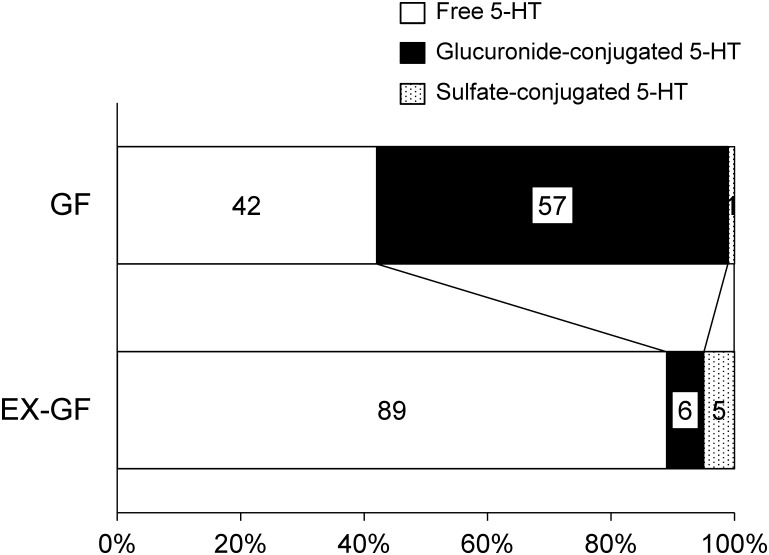
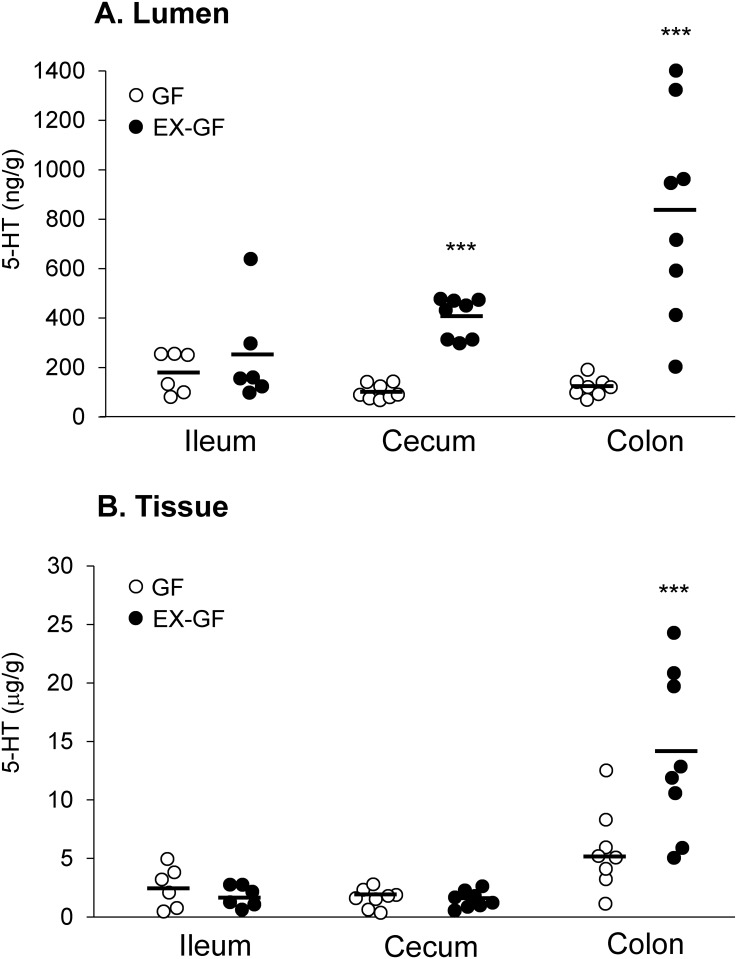
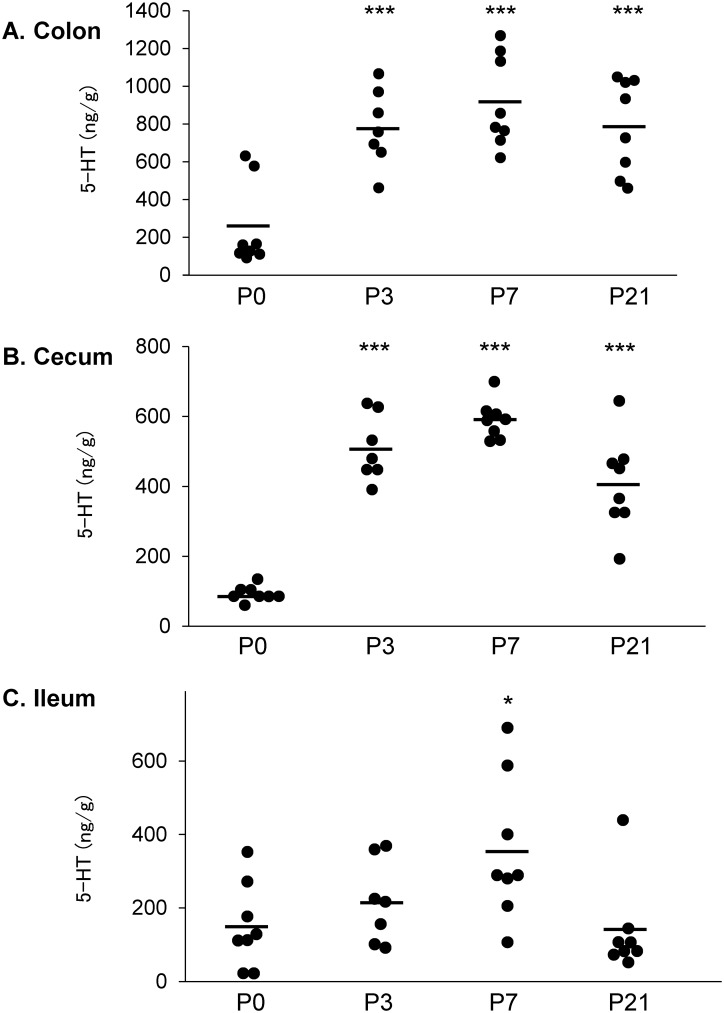
Gut lumen serotonin (5-hydroxytryptamine: 5-HT) contributes to several gastrointestinal functions such as peristaltic reflexes. 5-HT is released from enterochromaffin (EC) cells in response to a number of stimuli, including signals from the gut microbiota. However, the specific mechanism by which the gut microbiota regulates 5-HT levels in the gut lumen has not yet been clarified. Our previous work with gnotobiotic mice showed that free catecholamines can be produced by the deconjugation of conjugated catecholamines; hence, we speculated that deconjugation by bacterial enzymes may be one of the mechanisms whereby gut microbes can produce free 5-HT in the gut lumen. In this study, we tested this hypothesis using germ-free (GF) mice and gnotobiotic mice recolonized with specific pathogen-free (SPF) fecal flora (EX-GF). The 5-HT levels in the lumens of the cecum and colon were significantly lower in the GF mice than in the EX-GF mice. Moreover, these levels were rapidly increased, within only 3 days after exposure to SPF microbiota. The majority of 5-HT was in an unconjugated, free form in the EX-GF mice, whereas approximately 50% of the 5-HT was found in the conjugated form in the GF mice. These results further support the current view that the gut microbiota plays a crucial role in promoting the production of biologically active, free 5-HT. The deconjugation of glucuronide-conjugated 5-HT by bacterial enzymes is likely one of the mechanisms contributing to free 5-HT production in the gut lumen.
肠道腔内的血清素(5-羟色胺:5-HT)有助于多种胃肠功能,如蠕动反射。5-HT是由肠嗜铬(EC)细胞在多种刺激下释放的,这些刺激包括来自肠道微生物群的信号。然而,肠道微生物群调节肠道腔内5-HT水平的具体机制尚未阐明。我们之前用无菌小鼠做的研究表明,结合型儿茶酚胺的去结合作用可产生游离儿茶酚胺;因此,我们推测细菌酶的去结合作用可能是肠道微生物在肠道腔内产生游离5-HT的机制之一。在本研究中,我们使用无菌(GF)小鼠和重新定殖了无特定病原体(SPF)粪便菌群的悉生小鼠(EX-GF)来验证这一假设。GF小鼠盲肠和结肠腔内的5-HT水平显著低于EX-GF小鼠。此外,在暴露于SPF微生物群后仅3天内,这些水平就迅速升高。在EX-GF小鼠中,大部分5-HT呈未结合的游离形式,而在GF小鼠中,约50%的5-HT以结合形式存在。这些结果进一步支持了当前的观点,即肠道微生物群在促进生物活性游离5-HT的产生中起关键作用。细菌酶对葡萄糖醛酸结合型5-HT的去结合作用可能是导致肠道腔内游离5-HT产生的机制之一。