Gulyaeva Marina, Sharshov Kirill, Suzuki Mizuho, Sobolev Ivan, Sakoda Yoshihiro, Alekseev Alexander, Sivay Mariya, Shestopalova Lidia, Shchelkanov Michael, Shestopalov Alexander
Novosibirsk State University, Novosibirsk, 630090, Russia.
Research Institute of Experimental and Clinical Medicine, Novosibirsk, 630117, Russia.
J Vet Med Sci. 2017 Aug 18;79(8):1461-1465. doi: 10.1292/jvms.17-0048. Epub 2017 Jul 10.
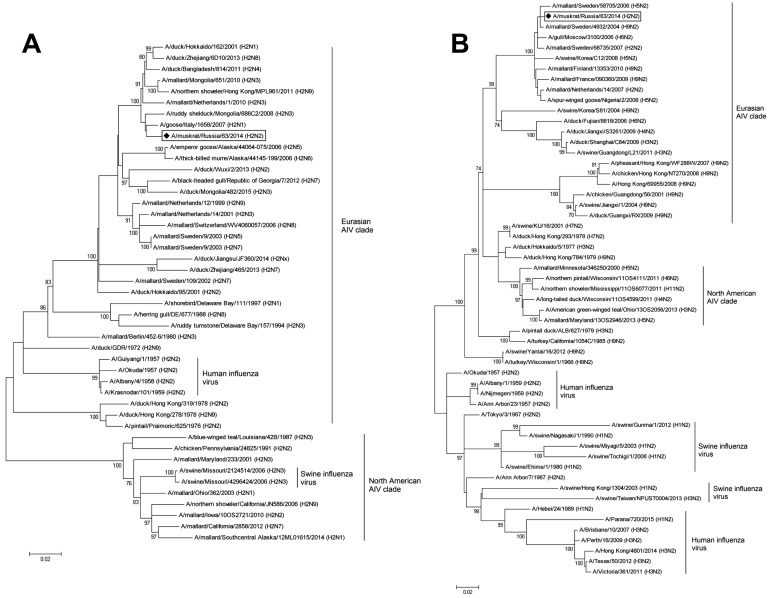
Thirty-two muskrats (Ondatra zibethicus) were captured for surveillance of avian influenza virus in wild waterfowl and mammals near Lake Chany, Western Siberia, Russia. A/muskrat/Russia/63/2014 (H2N2) was isolated from an apparently healthy muskrat using chicken embryos. Based on phylogenetic analysis, the hemagglutinin and neuraminidase genes of this isolate were classified into the Eurasian avian-like influenza virus clade and closely related to low pathogenic avian influenza viruses (LPAIVs) isolated from wild water birds in Italy and Sweden, respectively. Other internal genes were also closely related to LPAIVs isolated from Eurasian wild water birds. Results suggest that interspecies transmission of LPAIVs from wild water birds to semiaquatic mammals occurs, facilitating the spread and evolution of LPAIVs in wetland areas of Western Siberia.
在俄罗斯西西伯利亚的恰尼湖附近,为监测野生水禽和哺乳动物中的禽流感病毒,捕获了32只麝鼠(麝鼠属)。使用鸡胚从一只看似健康的麝鼠中分离出A/麝鼠/俄罗斯/63/2014(H2N2)。基于系统发育分析,该分离株的血凝素和神经氨酸酶基因被归类为欧亚禽源样流感病毒分支,分别与从意大利和瑞典的野生水鸟中分离出的低致病性禽流感病毒(LPAIV)密切相关。其他内部基因也与从欧亚野生水鸟中分离出的LPAIV密切相关。结果表明,LPAIV从野生水鸟到半水生哺乳动物的种间传播发生,促进了LPAIV在西西伯利亚湿地地区的传播和进化。