Perrone-Bertolotti Marcela, Kauffmann Louise, Pichat Cédric, Vidal Juan R, Baciu Monica
Department of Psychology, Université Grenoble Alpes, CNRS, LPNC UMR 51055105Grenoble, France.
Neural Mechanisms of Human Communication Research group, Max Planck Institute for Human Cognitive and Brain SciencesLeipzig, Germany.
Front Hum Neurosci. 2017 Jun 22;11:325. doi: 10.3389/fnhum.2017.00325. eCollection 2017.
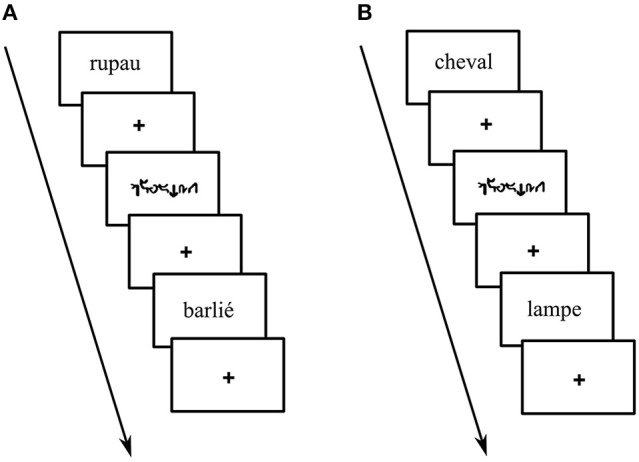
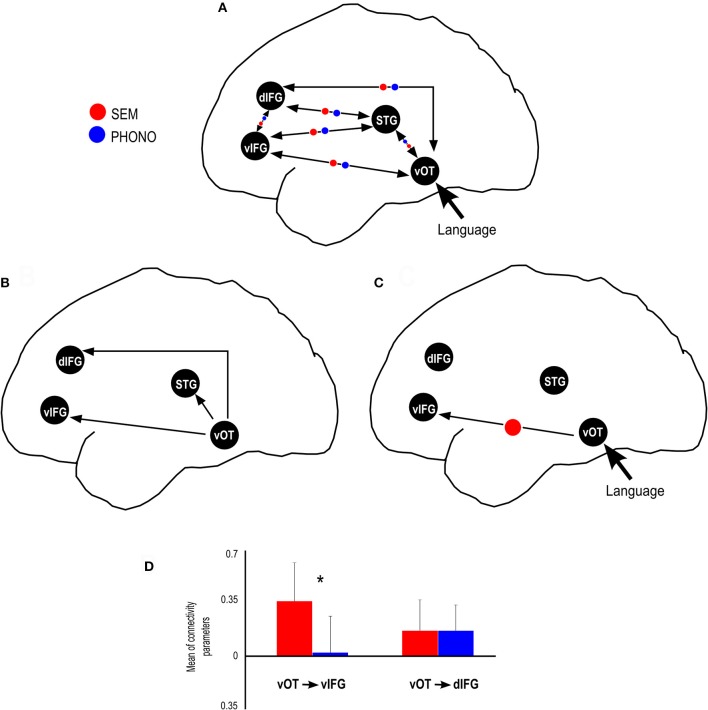
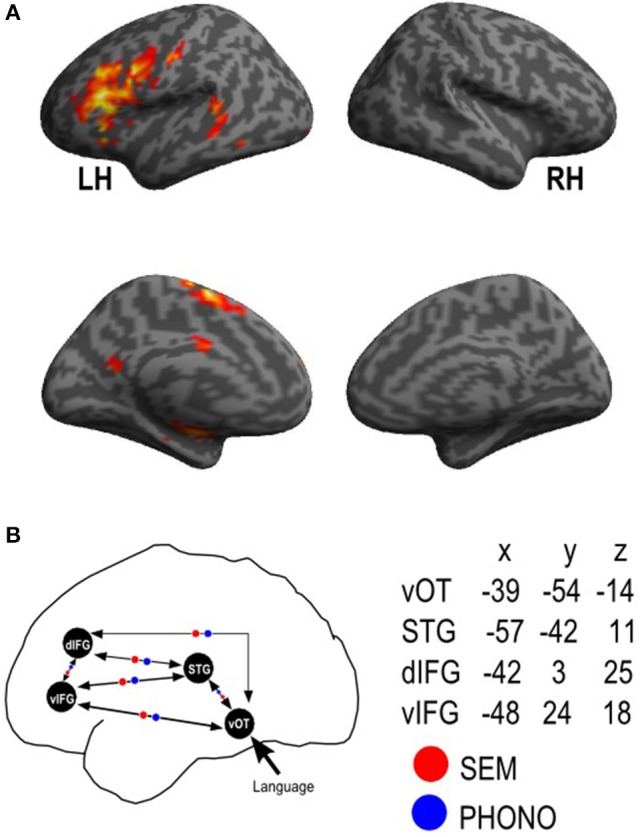
It has been suggested that dorsal and ventral pathways support distinct aspects of language processing. Yet, the full extent of their involvement and their inter-regional connectivity in visual word recognition is still unknown. Studies suggest that they might reflect the dual-route model of reading, with the dorsal pathway more involved in grapho-phonological conversion during phonological tasks, and the ventral pathway performing lexico-semantic access during semantic tasks. Furthermore, this subdivision is also suggested at the level of the inferior frontal cortex, involving ventral and dorsal parts for lexico-semantic and phonological processing, respectively. In the present study, we assessed inter-regional brain connectivity and task-induced modulations of brain activity during a phoneme detection and semantic categorization tasks, using fMRI in healthy subject. We used a dynamic causal modeling approach to assess inter-regional connectivity and task demand modulation within the dorsal and ventral pathways, including the following network components: the ventral occipito-temporal cortex (vOTC; dorsal and ventral), the superior temporal gyrus (STG; dorsal), the dorsal inferior frontal gyrus (dIFG; dorsal), and the ventral IFG (vIFG; ventral). We report three distinct inter-regional interactions supporting orthographic information transfer from vOTC to other language regions (vOTC -> STG, vOTC -> vIFG and vOTC -> dIFG) regardless of task demands. Moreover, we found that (a) during semantic processing (direct ventral pathway) the vOTC -> vIFG connection strength specifically increased and (b) a lack of modulation of the vOTC -> dIFG connection strength by the task that could suggest a more general involvement of the dorsal pathway during visual word recognition. Results are discussed in terms of anatomo-functional connectivity of visual word recognition network.
有人提出,背侧和腹侧通路支持语言处理的不同方面。然而,它们在视觉单词识别中的参与程度及其区域间的连通性仍不清楚。研究表明,它们可能反映了阅读的双通路模型,背侧通路在语音任务中更多地参与字形-语音转换,而腹侧通路在语义任务中进行词汇-语义通达。此外,在额下回水平也有这种细分,分别涉及腹侧和背侧部分进行词汇-语义和语音处理。在本研究中,我们使用功能磁共振成像(fMRI)对健康受试者进行了音素检测和语义分类任务,评估了区域间脑连通性以及任务诱导的脑活动调制。我们使用动态因果模型方法评估背侧和腹侧通路内的区域间连通性和任务需求调制,包括以下网络组件:腹侧枕颞叶皮层(vOTC;背侧和腹侧)、颞上回(STG;背侧)、背侧额下回(dIFG;背侧)和腹侧额下回(vIFG;腹侧)。我们报告了三种不同的区域间相互作用,支持从vOTC到其他语言区域的正字法信息传递(vOTC -> STG、vOTC -> vIFG和vOTC -> dIFG),与任务需求无关。此外,我们发现:(a)在语义处理(直接腹侧通路)过程中,vOTC -> vIFG连接强度特别增加;(b)任务对vOTC -> dIFG连接强度缺乏调制,这可能表明背侧通路在视觉单词识别过程中参与更广泛。我们从视觉单词识别网络的解剖-功能连通性方面对结果进行了讨论。