Li Mingxia, Guo Rui, Jiao Yang, Jin Xiaofei, Zhang Haiyan, Shi Lianxuan
School of Life Sciences, Northeast Normal UniversityChangchun, China.
Key Laboratory of Dryland Agriculture, Institute of Environment and Sustainable Development in Agriculture, Chinese Academy of Agricultural SciencesBeijing, China.
Front Plant Sci. 2017 Jun 23;8:1101. doi: 10.3389/fpls.2017.01101. eCollection 2017.
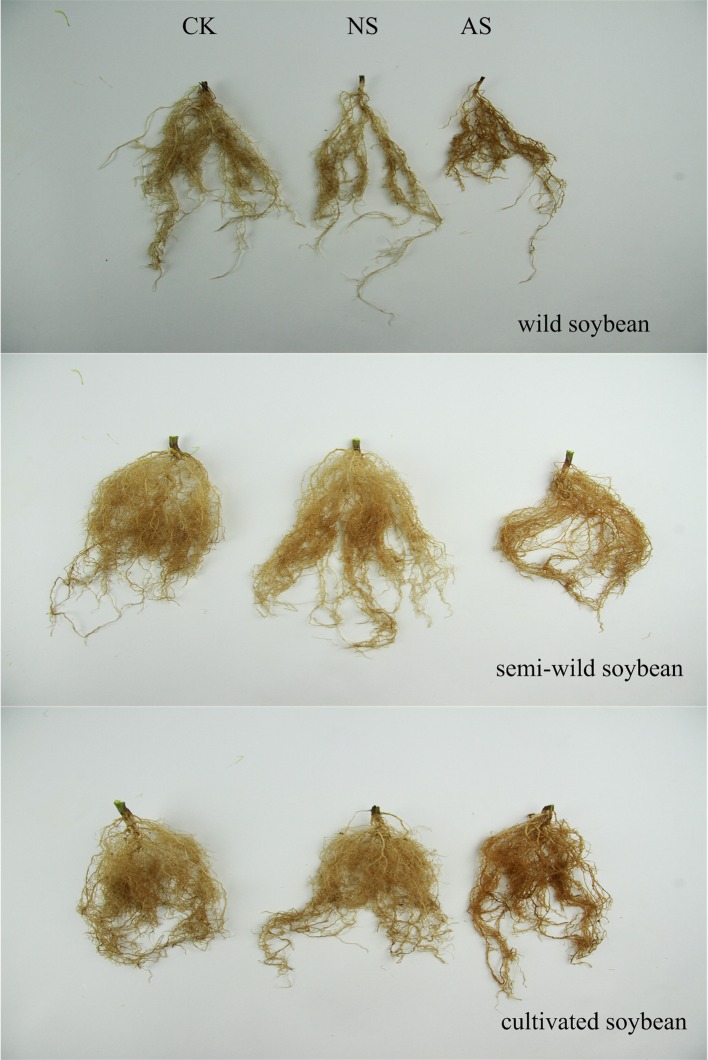
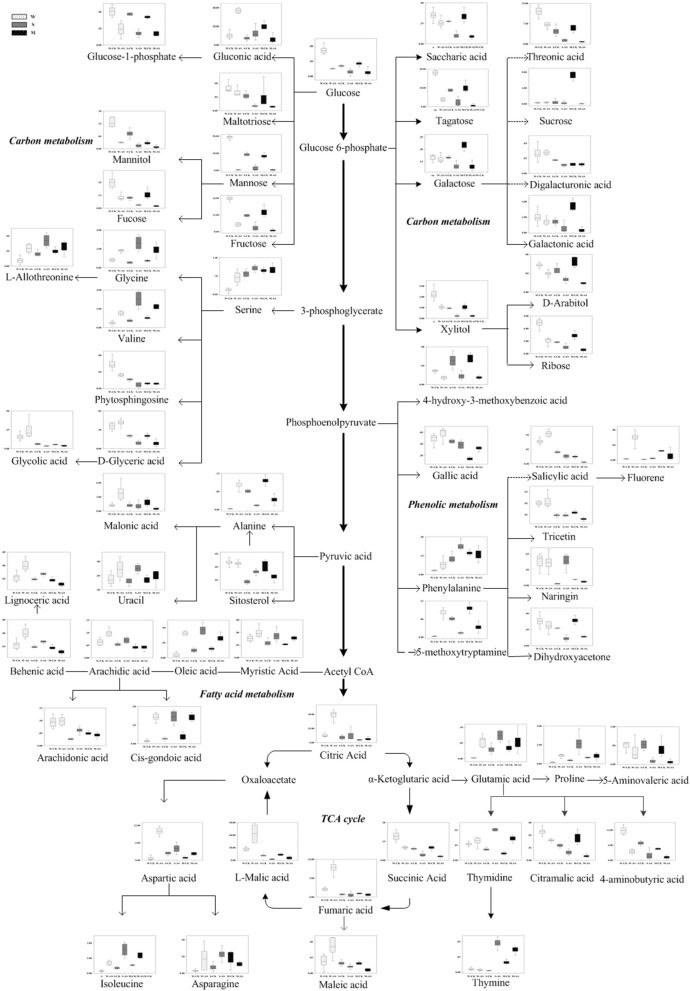
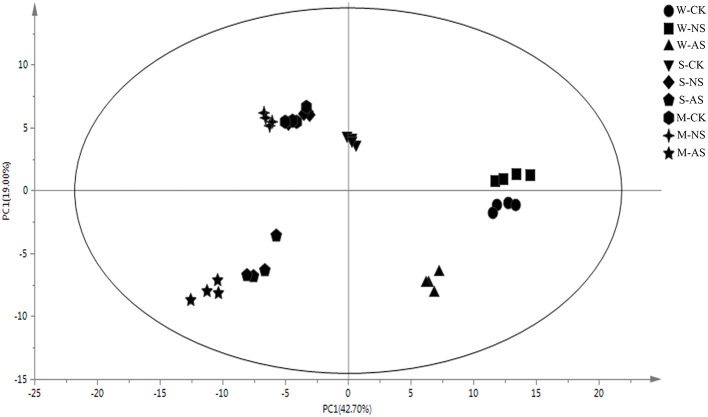
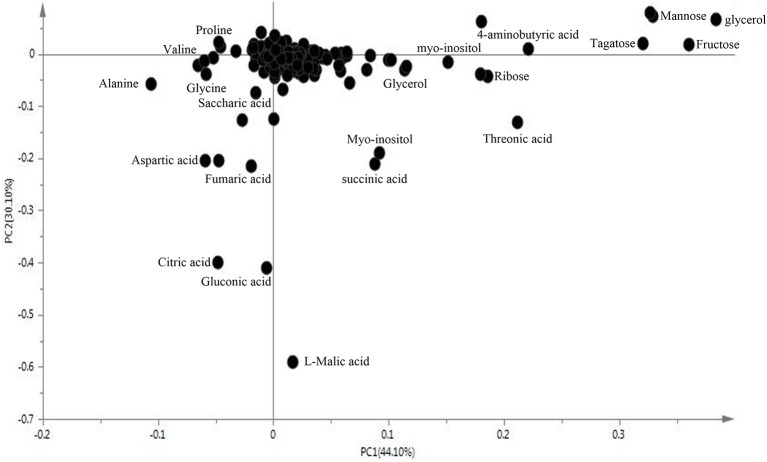
Soybean is an important economic crop that is continually threatened by abiotic stresses, especially salt stress. Wild soybean is an important germplasm resource for the breeding of cultivated soybean. The root system plays a very important role in plant salt tolerance. To explore the salt tolerance-related mechanisms among , we have demonstrated the seedling roots' growth and metabolomics in wild soybean, semi-wild soybean, and cultivated soybean under two types of salt stress by using gas chromatography-mass spectrometry. We characterized 47 kinds of differential metabolites under neutral salt stress, and isoleucine, serine, l-allothreonine, glutamic acid, phenylalanine, asparagines, aspartic acid, pentadecanoic acid, lignoceric acid, oleic acid, galactose, tagatose, d-arabitol, dihydroxyacetone, 3-hydroxybutyric acid, and glucuronic acid increased significantly in the roots of wild soybean seedlings. However, these metabolites were suppressed in semi-wild and cultivated soybeans. Amino acid, fatty acid, sugars, and organic acid synthesis and the secondary metabolism of antioxidants increased significantly in the roots of wild soybean seedling. Under alkaline salt stress, wild soybean contained significantly higher amounts of proline, glutamic acid, aspartic acid, l-allothreonine, isoleucine, serine, alanine, arachidic acid, oleic acid, cis-gondoic acid, fumaric acid, l-malic acid, citric acid, malonic acid, gluconic acid, 5-methoxytryptamine, salicylic acid, and fluorene than semi-wild and cultivated soybeans. Our study demonstrated that carbon and nitrogen metabolism, and the tricarboxylic acid (TCA) cycle and receiver operating characteristics (especially the metabolism of phenolic substances) of the seedling roots were important to resisting salt stress and showed a regular decreasing trend from wild soybean to cultivated soybean. The metabolomics's changes were critical factors in the evolution of salt tolerance among . This study provides new insights into salt tolerance in soybean, and presents quantitative parameters for a salt tolerant soybean breeding system, which is conducive to the rational use and protection of wild soybean resources.
大豆是一种重要的经济作物,不断受到非生物胁迫的威胁,尤其是盐胁迫。野生大豆是栽培大豆育种的重要种质资源。根系在植物耐盐性中起着非常重要的作用。为了探究[此处原文可能有缺失内容]之间与耐盐性相关的机制,我们利用气相色谱 - 质谱联用技术,展示了野生大豆、半野生大豆和栽培大豆在两种盐胁迫下幼苗根系的生长和代谢组学情况。我们鉴定出在中性盐胁迫下有47种差异代谢物,异亮氨酸、丝氨酸、L - 别苏氨酸、谷氨酸、苯丙氨酸、天冬酰胺、天冬氨酸、十五烷酸、木蜡酸、油酸、半乳糖、塔格糖、D - 阿拉伯糖醇、二羟基丙酮、3 - 羟基丁酸和葡萄糖醛酸在野生大豆幼苗根系中显著增加。然而,这些代谢物在半野生和栽培大豆中受到抑制。野生大豆幼苗根系中氨基酸、脂肪酸、糖类和有机酸的合成以及抗氧化剂的次生代谢显著增加。在碱性盐胁迫下,野生大豆中脯氨酸、谷氨酸、天冬氨酸、L - 别苏氨酸、异亮氨酸、丝氨酸、丙氨酸、花生酸、油酸、顺 - 桐酸、富马酸、L - 苹果酸、柠檬酸、丙二酸、葡萄糖酸、5 - 甲氧基色胺、水杨酸和芴的含量显著高于半野生和栽培大豆。我们的研究表明,幼苗根系的碳氮代谢、三羧酸(TCA)循环和接收操作特征(尤其是酚类物质的代谢)对抵抗盐胁迫很重要,并且从野生大豆到栽培大豆呈现出有规律的下降趋势。代谢组学的变化是[此处原文可能有缺失内容]耐盐性进化的关键因素。本研究为大豆耐盐性提供了新的见解,并为耐盐大豆育种系统提供了定量参数,有利于野生大豆资源的合理利用和保护。