van Donk Susanne, Camphuysen Kees C J, Shamoun-Baranes Judy, van der Meer Jaap
Department Coastal Systems NIOZ Royal Institute for Sea Research and Utrecht University Den Burg Texel The Netherlands.
Computational Geo-EcologyI BED University of Amsterdam Amsterdam The Netherlands.
Ecol Evol. 2017 May 20;7(13):4620-4629. doi: 10.1002/ece3.3018. eCollection 2017 Jul.
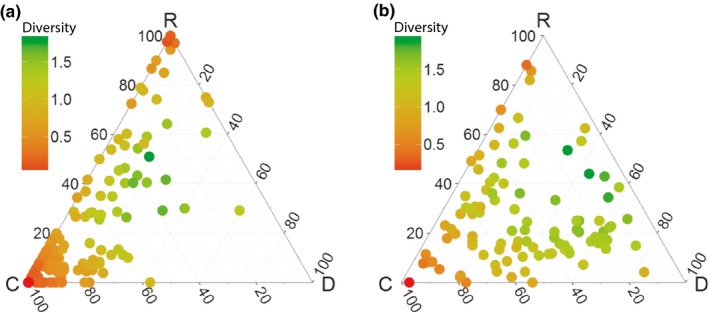
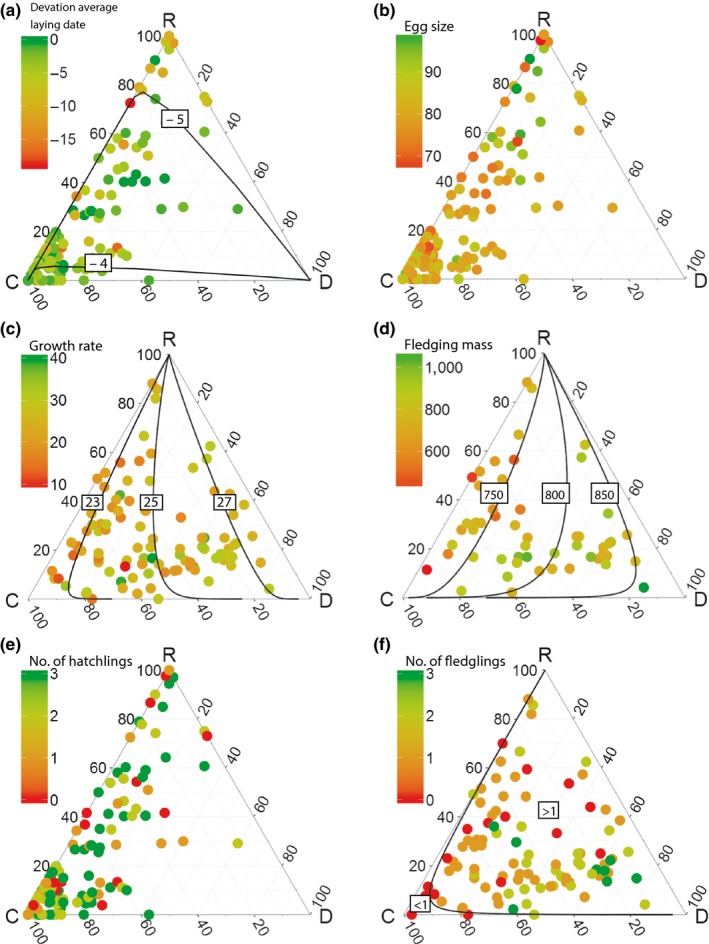
Dietary specialization has been described across a wide range of taxa in the animal kingdom. Fitness consequences are, however, not well documented. We examined the reproductive consequences of different dietary specializations in the herring gull , an omnivorous seabird, using an extensive dataset which includes breeding and dietary data of 10 successive years. We hypothesized that pairs that focused on prey of higher energetic value would yield higher fledging rates. An alternative hypothesis is that pairs that relied on more resources simultaneously would reproduce better. The novelty of this study is that we used continuous measurements representing dietary composition and degree of specialization rather than restricting our analysis to predefined categories. By relating these two continuous measurements for diet to several proxies for reproductive success, we show clear consequences of dietary choice. Most pairs concentrated on bivalves, a prey type not particularly rich in energy. Pairs feeding on energy-rich prey (e.g., "domestic refuse and fishery discards") during chick rearing were found to have a higher reproductive success, supporting the first hypothesis. Pairs that used more resources did not clearly have a higher reproductive success. The majority of the pairs did not switch to energy-rich prey during chick rearing, despite low breeding outcome. We discuss how trade-offs between factors such as resource availability, predictability, and the time and energy needed to obtain certain prey species may influence resource selection.
在动物王国中,广泛的分类群都存在饮食特化现象。然而,其对适应性的影响却鲜有充分记录。我们利用一个涵盖连续10年繁殖和饮食数据的广泛数据集,研究了杂食性海鸟银鸥不同饮食特化的繁殖后果。我们假设专注于高能量值猎物的配对会有更高的雏鸟离巢率。另一种假设是同时依赖更多资源的配对繁殖情况会更好。本研究的新颖之处在于我们使用了代表饮食组成和特化程度的连续测量值,而不是将分析局限于预定义的类别。通过将这两个饮食连续测量值与几个繁殖成功的指标相关联,我们展示了饮食选择的明确后果。大多数配对集中在双壳类动物上,这是一种能量并不特别丰富的猎物类型。发现在育雏期间以富含能量的猎物(如“生活垃圾和渔业丢弃物”)为食的配对具有更高的繁殖成功率,这支持了第一个假设。使用更多资源的配对并没有明显更高的繁殖成功率。尽管繁殖结果不佳,但大多数配对在育雏期间并没有转向富含能量的猎物。我们讨论了资源可用性、可预测性以及获取某些猎物物种所需的时间和能量等因素之间的权衡如何可能影响资源选择。