Enners Leonie, Schwemmer Philipp, Corman Anna-Marie, Voigt Christian C, Garthe Stefan
Research and Technology Centre (FTZ) University of Kiel Büsum Germany.
Leibniz Institute for Zoo and Wildlife Research (IZW) Berlin Germany.
Ecol Evol. 2018 Jul 6;8(15):7529-7542. doi: 10.1002/ece3.4167. eCollection 2018 Aug.
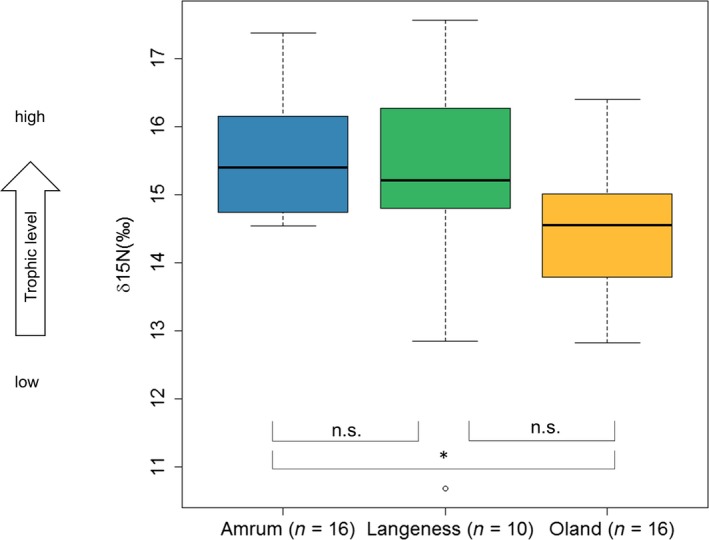
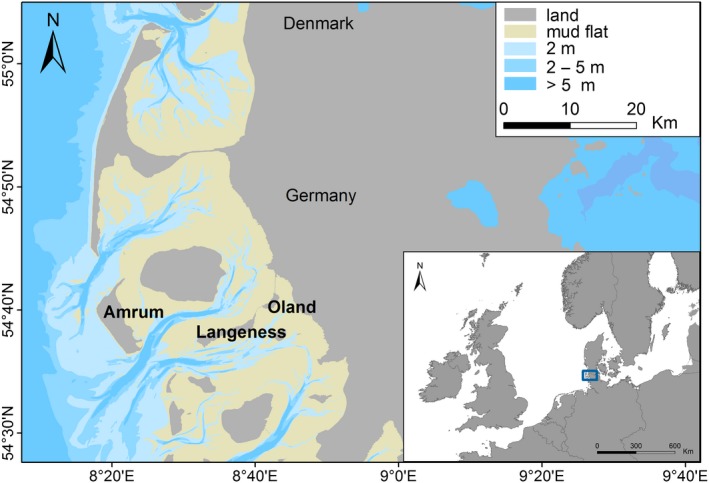
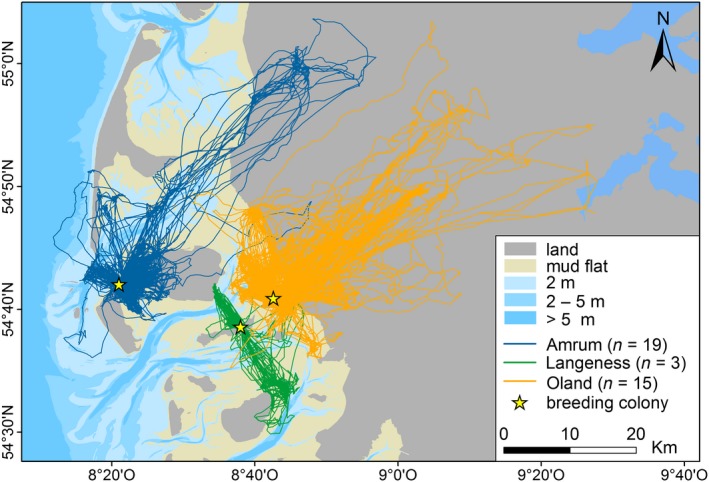
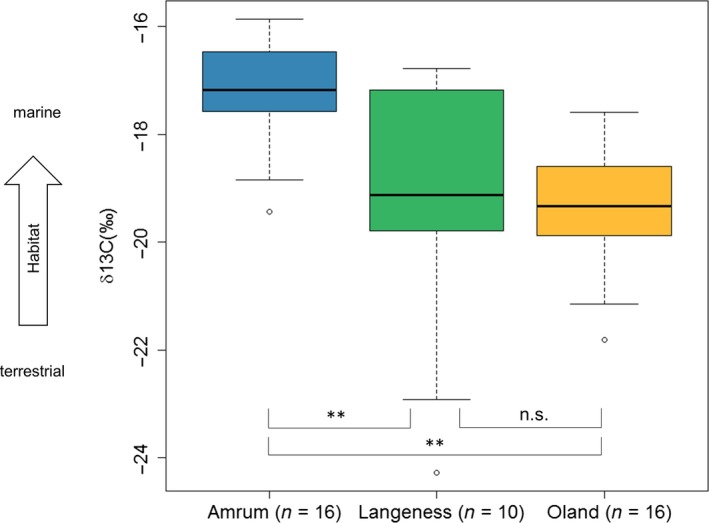
Herring gulls () are opportunistic predators that prefer to forage in the intertidal zone, but an increasing degree of terrestrial foraging has recently been observed. We therefore aimed to analyze the factors influencing foraging behavior and diet composition in the German Wadden Sea. Gulls from three breeding colonies on islands at different distances from the mainland were equipped with GPS data loggers during the incubation seasons in 2012-2015. Logger data were analyzed for 37 individuals, including 1,115 foraging trips. Herring gulls breeding on the island furthest from the mainland had shorter trips (mean total distance = 12.3 km; mean maximum distance = 4.2 km) and preferred to feed on the tidal flats close to the colony, mainly feeding on common cockles () and shore crabs (). In contrast, herring gulls breeding close to the mainland carried out trips with a mean total distance of 26.7 km (mean maximum distance = 9.2 km). These gulls fed on the neobiotic razor clams () in the intertidal zone, and a larger proportion of time was spent in distant terrestrial habitats on the mainland, feeding on earthworms. C and N values were higher at the colony furthest from the mainland and confirmed a geographical gradient in foraging strategy. Analyses of logger data, pellets, and stable isotopes revealed that herring gulls preferred to forage in intertidal habitats close to the breeding colony, but shifted to terrestrial habitats on the mainland as the tide rose and during the daytime. Reduced prey availability in the vicinity of the breeding colony might force herring gulls to switch to feed on razor clams in the intertidal zone or to use distant terrestrial habitats. Herring gulls may thus act as an indicator for the state of the intertidal system close to their breeding colony.
银鸥是机会主义捕食者,更喜欢在潮间带觅食,但最近观察到其在陆地觅食的程度有所增加。因此,我们旨在分析影响德国瓦登海银鸥觅食行为和饮食组成的因素。在2012年至2015年的孵化季节,为来自距离大陆不同距离岛屿上的三个繁殖群体的银鸥配备了GPS数据记录器。对37只个体的记录器数据进行了分析,包括1115次觅食行程。在距离大陆最远的岛屿上繁殖的银鸥行程较短(平均总距离 = 12.3千米;平均最大距离 = 4.2千米),并且更喜欢在靠近繁殖群体的潮间带滩涂觅食,主要以鸟蛤和岸蟹为食。相比之下,在靠近大陆繁殖的银鸥行程平均总距离为26.7千米(平均最大距离 = 9.2千米)。这些银鸥在潮间带以新出现的蛏子为食,并且在大陆上较远的陆地栖息地花费了更大比例的时间,以蚯蚓为食。在距离大陆最远的繁殖群体中,碳和氮的值更高,这证实了觅食策略存在地理梯度。对记录器数据、食丸和稳定同位素的分析表明,银鸥更喜欢在靠近繁殖群体的潮间带栖息地觅食,但随着潮水上涨和白天时段会转移到大陆上的陆地栖息地。繁殖群体附近猎物可获得性的降低可能迫使银鸥转而以潮间带的蛏子为食或利用较远的陆地栖息地。因此,银鸥可能作为其繁殖群体附近潮间带系统状态的一个指标。