Merchant Roland C, Romanoff Justin, Clark Melissa A, Liu Tao, Rosenberger Joshua G, Bauermeister Jose, Mayer Kenneth H
1 Department of Emergency Medicine and Department of Epidemiology, Alpert Medical School and the School of Public Health, Brown University, Providence, RI, USA.
2 Department of Biostatistics, Center for Statistical Sciences, Brown University School of Public Health, Providence, RI, USA.
Am J Mens Health. 2017 Sep;11(5):1342-1357. doi: 10.1177/1557988317717383. Epub 2017 Jul 10.
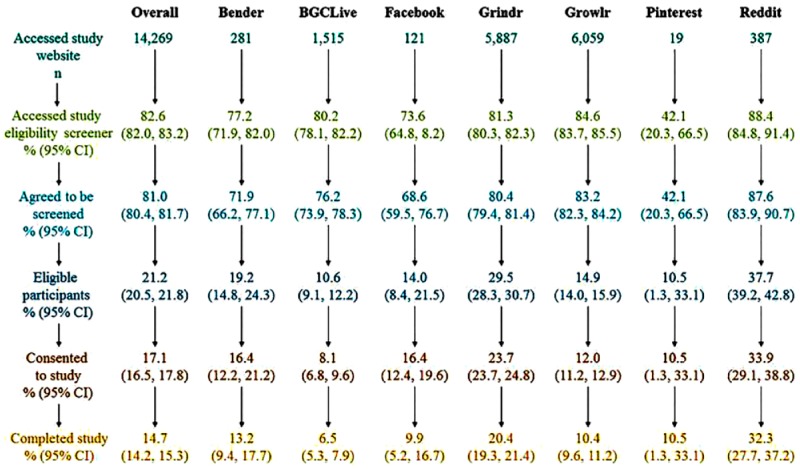
The Internet is a commonly used medium for recruiting geographically dispersed, smaller populations quickly, such as young adult men-who-have-sex-with-men (YMSM). One approach to improve reach and representativeness is to employ multiple Internet platforms to recruit this hard-to-reach population. The utility of this approach has not been studied adequately, and its impact on the study sample recruited is not yet known. Using data from a study of 18- to 24-year-old HIV-uninfected, Black, Hispanic, and White United States (US) YMSM, this investigation compared advertising and enrollment metrics and participant characteristics of those recruited across Internet platforms. Of the 2,444 participants, their median age was 22 years old; 21% were Black, 37% Hispanic, and 42% White; 90% had been tested for HIV at least once in their life; and 87% reported prior condomless anal intercourse (CAI) with another man. There were noticeable differences across platforms in the number of people accessing the study website, meeting study eligibility requirements, consenting to participate, consenting to participate per day of advertising and per click, as well as costs of advertising per consented participant. Participants recruited also varied across platform by race/ethnicity, geographic area of residence in the US, health-care insurance status, years of formal education, history of HIV testing, and CAI by partner type and sexual positioning. The investigation results indicate that the Internet platforms used for recruitment significantly impact not only enrollment but also diversity and characteristics of the sample obtained and consequently, the observations and conclusions rendered.
互联网是一种常用的媒介,可迅速招募地理位置分散的较小规模人群,比如男男性行为的年轻成年男性(YMSM)。一种提高覆盖面和代表性的方法是利用多个互联网平台来招募这类难以接触到的人群。这种方法的效用尚未得到充分研究,其对所招募研究样本的影响也尚不清楚。本调查使用了一项针对18至24岁未感染艾滋病毒的美国黑人、西班牙裔和白人YMSM的研究数据,比较了在不同互联网平台上招募的人员的广告和招募指标以及参与者特征。在2444名参与者中,他们的年龄中位数为22岁;21%为黑人,37%为西班牙裔,42%为白人;90%的人一生中至少接受过一次艾滋病毒检测;87%的人报告曾与另一名男性进行过无保护肛交(CAI)。不同平台在访问研究网站的人数、符合研究资格要求的人数、同意参与的人数、每天广告和每次点击的同意参与人数以及每个同意参与参与者的广告成本方面存在显著差异。按种族/族裔、在美国的居住地理区域、医疗保险状况、正规教育年限、艾滋病毒检测史以及按性伴侣类型和性取向的无保护肛交情况来看,不同平台招募的参与者也存在差异。调查结果表明,用于招募的互联网平台不仅对招募人数有重大影响,而且对所获得样本的多样性和特征也有重大影响,进而影响所做出的观察和结论。