
多发性硬化症患者报告的结局与生存率:一项使用多发性硬化症影响量表-29的10年回顾性队列研究。
Patient-reported outcomes and survival in multiple sclerosis: A 10-year retrospective cohort study using the Multiple Sclerosis Impact Scale-29.
作者信息
Raffel Joel, Wallace Alison, Gveric Djordje, Reynolds Richard, Friede Tim, Nicholas Richard
机构信息
Division of Brain Sciences, Faculty of Medicine, Imperial College London, London, United Kingdom.
Imperial College Healthcare NHS Trust, London, United Kingdom.
出版信息
PLoS Med. 2017 Jul 10;14(7):e1002346. doi: 10.1371/journal.pmed.1002346. eCollection 2017 Jul.
BACKGROUND
There is increasing emphasis on using patient-reported outcomes (PROs) to complement traditional clinical outcomes in medical research, including in multiple sclerosis (MS). Research, particularly in oncology and heart failure, has shown that PROs can be prognostic of hard clinical endpoints such as survival time (time from study entry until death). However, unlike in oncology or cardiology, it is unknown whether PROs are associated with survival time in neurological diseases. The Multiple Sclerosis Impact Scale-29 (MSIS-29) is a PRO sensitive to short-term change in MS, with questions covering both physical and psychological quality of life. This study aimed to investigate whether MSIS-29 scores can be prognostic for survival time in MS, using a large observational cohort of people with MS.
METHODS AND FINDINGS
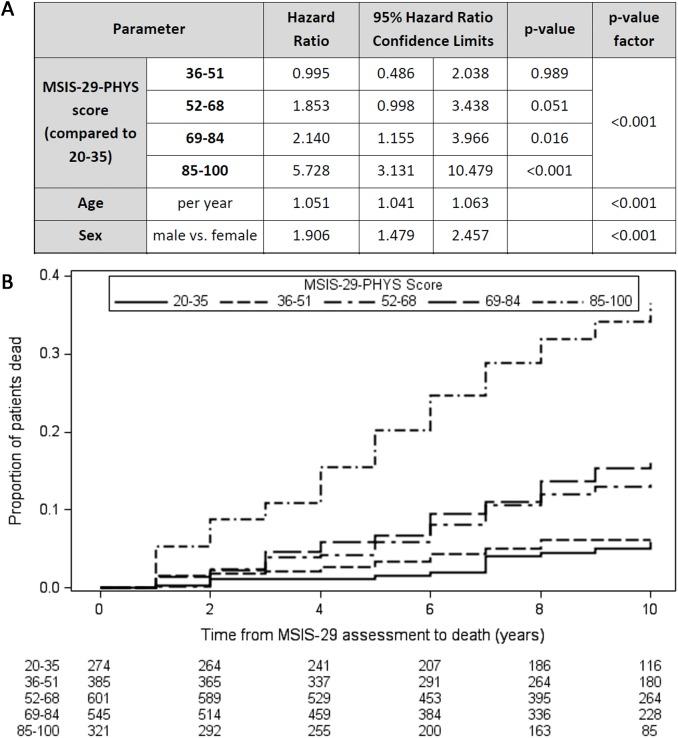
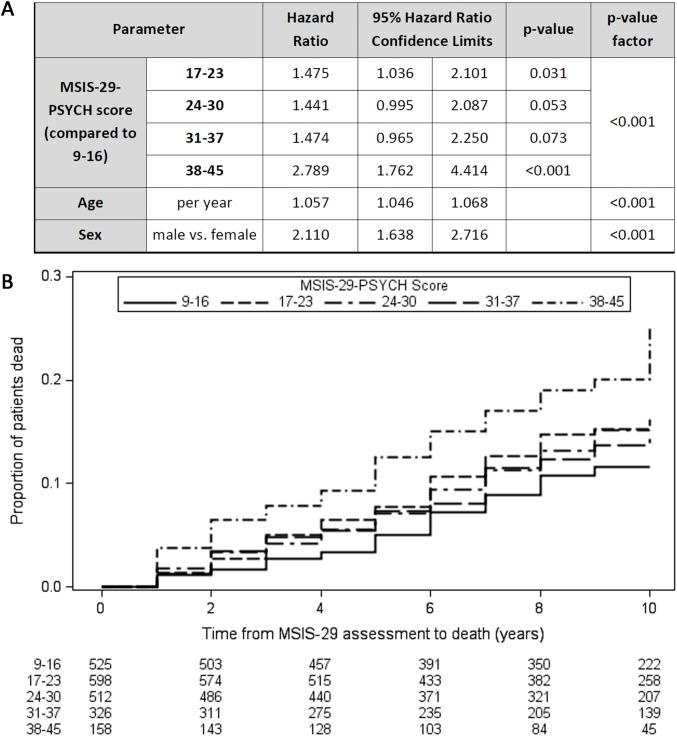
From 15 July 2004 onwards, MSIS-29 questionnaires were completed by people with MS registered with the MS Society Tissue Bank (n = 2,126, repeated 1 year later with n = 872 of the original respondents). By 2014, 264 participants (12.4%) had died. Higher baseline MSIS-29 physical (MSIS-29-PHYS) score was associated with reduced survival time (subgroup with highest scores versus subgroup with lowest scores: hazard ratio [HR] 5.7, 95% CI 3.1-10.5, p < 0.001). Higher baseline MSIS-29 psychological score was also associated with reduced survival time (subgroup with highest scores versus subgroup with lowest scores: HR 2.8, 95% CI 1.8-4.4, p < 0.001). In those with high baseline MSIS-29 scores, mortality risk was even greater if the MSIS-29 score worsened over 1 year (HR 2.3, 95% CI 1.2-4.4, p = 0.02). MSIS-29-PHYS scores were associated with survival time independent of age, sex, and patient-reported Expanded Disability Status Scale score in a Cox regression analysis (per 1-SD increase in MSIS-29-PHYS score: HR 1.8, 95% CI 1.1-2.9, p = 0.03). A limitation of the study is that this cohort had high baseline age and disability levels; the prognostic value of MSIS-29 for survival time at earlier disease stages requires further investigation.
CONCLUSIONS
This study reports that PROs can be prognostic for hard clinical outcomes in neurological disease, and supports PROs as a meaningful clinical outcome for use in research and clinical settings.
背景
在医学研究中,包括在多发性硬化症(MS)研究中,越来越强调使用患者报告结局(PRO)来补充传统临床结局。尤其是在肿瘤学和心力衰竭领域的研究表明,PRO可以预测诸如生存时间(从研究入组到死亡的时间)等硬性临床终点。然而,与肿瘤学或心脏病学不同的是,在神经疾病中PRO是否与生存时间相关尚不清楚。多发性硬化症影响量表29(MSIS - 29)是一种对MS短期变化敏感的PRO,其问题涵盖身体和心理生活质量。本研究旨在使用一个大型MS患者观察队列,调查MSIS - 29评分是否可以预测MS患者的生存时间。
方法与结果
从2004年7月15日起,MSIS - 29问卷由在MS协会组织库登记的MS患者填写(n = 2126,1年后对872名原始受访者进行重复调查)。到2014年,264名参与者(12.4%)已经死亡。较高的基线MSIS - 29身体(MSIS - 29 - PHYS)评分与较短的生存时间相关(得分最高的亚组与得分最低的亚组相比:风险比[HR] 5.7,95%置信区间3.1 - 10.5,p < 0.001)。较高的基线MSIS - 29心理评分也与较短的生存时间相关(得分最高的亚组与得分最低的亚组相比:HR 2.8,95%置信区间1.8 - 4.4,p < 0.001)。在基线MSIS - 29评分较高的患者中,如果MSIS - 29评分在1年内恶化,死亡风险甚至更高(HR 2.3,95%置信区间1.2 - 4.4,p = 0.02)。在Cox回归分析中,MSIS - 29 - PHYS评分与生存时间相关,独立于年龄、性别和患者报告的扩展残疾状态量表评分(MSIS - 29 - PHYS评分每增加1个标准差:HR 1.8,95%置信区间1.1 - 2.9,p = 0.03)。本研究的一个局限性是该队列的基线年龄和残疾水平较高;MSIS - 29在疾病早期阶段对生存时间的预后价值需要进一步研究。
结论
本研究报告称,PRO可以预测神经疾病的硬性临床结局,并支持将PRO作为研究和临床环境中有意义的临床结局。

 Zotero 插件