Yacoub Sophie, Trung Trieu Huynh, Lam Phung Khanh, Thien Vuong Huynh Ngoc, Hai Duong Ha Thi, Phan Tu Qui, Nguyet Oanh Pham Kieu, Quyen Nguyen Than Ha, Simmons Cameron Paul, Broyd Christopher, Screaton Gavin Robert, Wills Bridget
Oxford University Clinical Research Unit, Wellcome Trust Major Overseas Programme, Ho Chi Minh City, Vietnam.
Department of Medicine, Imperial College London, London, United Kingdom.
PLoS Negl Trop Dis. 2017 Jul 10;11(7):e0005740. doi: 10.1371/journal.pntd.0005740. eCollection 2017 Jul.
Dengue can cause plasma leakage that may lead to dengue shock syndrome (DSS). In approximately 30% of DSS cases, recurrent episodes of shock occur. These patients have a higher risk of fluid overload, respiratory distress and poor outcomes. We investigated the association of echocardiographically-derived cardiac function and intravascular volume parameters plus lactate levels, with the outcomes of recurrent shock and respiratory distress in severe dengue.
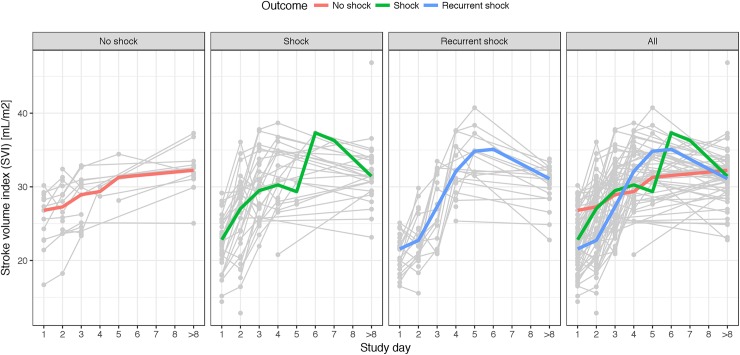
METHODS/PRINCIPLE FINDINGS: We performed a prospective observational study in Paediatric and adult ICU, at the Hospital for Tropical Diseases (HTD), Ho Chi Minh City, Vietnam. Patients with dengue were enrolled within 12 hours of admission to paediatric or adult ICU. A haemodynamic assessment and portable echocardiograms were carried out daily for 5 days from enrolment and all interventions recorded. 102 patients were enrolled; 22 patients did not develop DSS, 48 had a single episode of shock and 32 had recurrent shock. Patients with recurrent shock had a higher enrolment pulse than those with 1 episode or no shock (median: 114 vs. 100 vs. 100 b/min, P = 0.002), significantly lower Stroke Volume Index (SVI), (median: 21.6 vs. 22.8 vs. 26.8mls/m2, P<0.001) and higher lactate levels (4.2 vs. 2.9 vs. 2.2 mmol/l, P = 0.001). Higher SVI and worse left ventricular function (higher Left Myocardial Performance Index) on study days 3-5 was associated with the secondary endpoint of respiratory distress. There was an association between the total IV fluid administered during the ICU admission and respiratory distress (OR: 1.03, 95% CI 1.01-1.06, P = 0.001). Admission lactate levels predicted patients who subsequently developed recurrent shock (P = 0.004), and correlated positively with the total IV fluid volume received (rho: 0.323, P = 0.001) and also with admission ALT (rho: 0.764, P<0.001) and AST (rho: 0.773, P<0.001).
CONCLUSIONS/SIGNIFICANCE: Echo-derived intravascular volume assessment and venous lactate levels can help identify dengue patients at high risk of recurrent shock and respiratory distress in ICU. These findings may serve to, not only assist in the management of DSS patients, but also these haemodynamic endpoints could be used in future dengue fluid intervention trials.
登革热可导致血浆渗漏,进而可能引发登革热休克综合征(DSS)。在约30%的DSS病例中,会出现休克反复发作的情况。这些患者发生液体过载、呼吸窘迫及预后不良的风险更高。我们研究了超声心动图测定的心脏功能、血管内容量参数以及乳酸水平与重症登革热患者休克复发及呼吸窘迫结局之间的关联。
方法/主要发现:我们在越南胡志明市热带病医院的儿科和成人重症监护病房进行了一项前瞻性观察研究。登革热患者在入住儿科或成人重症监护病房的12小时内入组。从入组起连续5天每天进行血流动力学评估和便携式超声心动图检查,并记录所有干预措施。共入组102例患者;22例未发生DSS,48例发生单次休克,32例发生休克复发。休克复发患者的入组脉搏高于发生单次休克或未发生休克的患者(中位数:114次/分钟 vs. 100次/分钟 vs. 100次/分钟,P = 0.002),每搏量指数(SVI)显著更低(中位数:21.6 vs. 22.8 vs. 26.8 ml/m²,P<0.001),乳酸水平更高(4.2 vs. 2.9 vs. 2.2 mmol/L,P = 0.001)。在研究第3 - 5天,较高的SVI和较差的左心室功能(较高的左心室心肌做功指数)与呼吸窘迫这一次要终点相关。重症监护病房住院期间静脉输注的总液体量与呼吸窘迫之间存在关联(比值比:1.03,95%置信区间1.01 - 1.06,P = 0.001)。入院时的乳酸水平可预测随后发生休克复发的患者(P = 0.004),且与接受的静脉输注总液体量呈正相关(相关系数:0.323,P = 0.001),也与入院时的谷丙转氨酶(ALT)(相关系数:0.764,P<0.001)和谷草转氨酶(AST)(相关系数:0.773,P<0.001)呈正相关。
结论/意义:超声心动图测定的血管内容量评估及静脉血乳酸水平有助于识别重症监护病房中休克复发和呼吸窘迫风险较高的登革热患者。这些发现不仅可能有助于DSS患者的管理,而且这些血流动力学终点指标未来可用于登革热液体干预试验。