Lam Phung Khanh, Tam Dong Thi Hoai, Dung Nguyen Minh, Tien Nguyen Thi Hanh, Kieu Nguyen Tan Thanh, Simmons Cameron, Farrar Jeremy, Wills Bridget, Wolbers Marcel
Oxford University Clinical Research Unit, Hospital for Tropical Diseases, Ho Chi Minh City, Viet Nam.
University of Medicine and Pharmacy of Ho Chi Minh City, Ho Chi Minh City, Viet Nam.
PLoS One. 2015 May 6;10(5):e0126134. doi: 10.1371/journal.pone.0126134. eCollection 2015.
To identify risk factors and develop a prediction model for the development of profound and recurrent shock amongst children presenting with dengue shock syndrome (DSS).
We analyzed data from a prospective cohort of children with DSS recruited at the Paediatric Intensive Care Unit of the Hospital for Tropical Disease in Ho Chi Minh City, Vietnam. The primary endpoint was "profound DSS", defined as ≥2 recurrent shock episodes (for subjects presenting in compensated shock), or ≥1 recurrent shock episodes (for subjects presenting initially with decompensated/hypotensive shock), and/or requirement for inotropic support. Recurrent shock was evaluated as a secondary endpoint. Risk factors were pre-defined clinical and laboratory variables collected at the time of presentation with shock. Prognostic model development was based on logistic regression and compared to several alternative approaches.
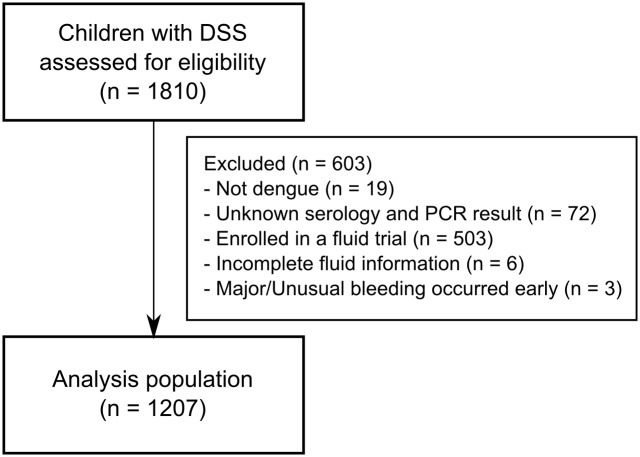
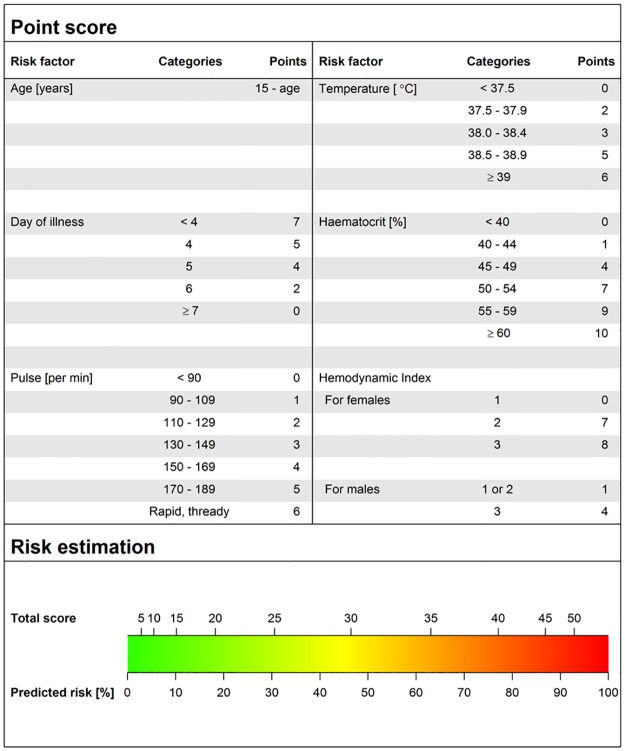
The analysis population included 1207 children of whom 222 (18%) progressed to "profound DSS" and 433 (36%) had recurrent shock. Independent risk factors for both endpoints included younger age, earlier presentation, higher pulse rate, higher temperature, higher haematocrit and, for females, worse hemodynamic status at presentation. The final prognostic model for "profound DSS" showed acceptable discrimination (AUC=0.69 for internal validation) and calibration and is presented as a simple score-chart.
Several risk factors for development of profound or recurrent shock among children presenting with DSS were identified. The score-chart derived from the prognostic models should improve triage and management of children presenting with DSS in dengue-endemic areas.
确定登革热休克综合征(DSS)患儿发生严重和反复休克的危险因素,并建立预测模型。
我们分析了在越南胡志明市热带病医院儿科重症监护病房招募的DSS患儿前瞻性队列的数据。主要终点是“严重DSS”,定义为≥2次反复休克发作(对于最初表现为代偿性休克的受试者),或≥1次反复休克发作(对于最初表现为失代偿性/低血压性休克的受试者),和/或需要使用血管活性药物支持。反复休克作为次要终点进行评估。危险因素是在休克出现时收集的预先定义的临床和实验室变量。预后模型的开发基于逻辑回归,并与几种替代方法进行比较。
分析人群包括1207名儿童,其中222名(18%)进展为“严重DSS”,433名(36%)发生反复休克。两个终点的独立危险因素包括年龄较小、就诊较早、脉搏率较高、体温较高、血细胞比容较高,对于女性而言,就诊时血流动力学状态较差。“严重DSS”的最终预后模型显示出可接受的区分度(内部验证的AUC = 0.69)和校准度,并以简单的评分表形式呈现。
确定了DSS患儿发生严重或反复休克的几个危险因素。从预后模型得出的评分表应能改善登革热流行地区DSS患儿的分诊和管理。