Fattorini L, Veloccia A, Della Rovere F, D'Angeli S, Falasca G, Altamura M M
Dipartimento di Biologia Ambientale, Sapienza Università di Roma, Roma, Italy.
BMC Plant Biol. 2017 Jul 11;17(1):121. doi: 10.1186/s12870-017-1071-x.
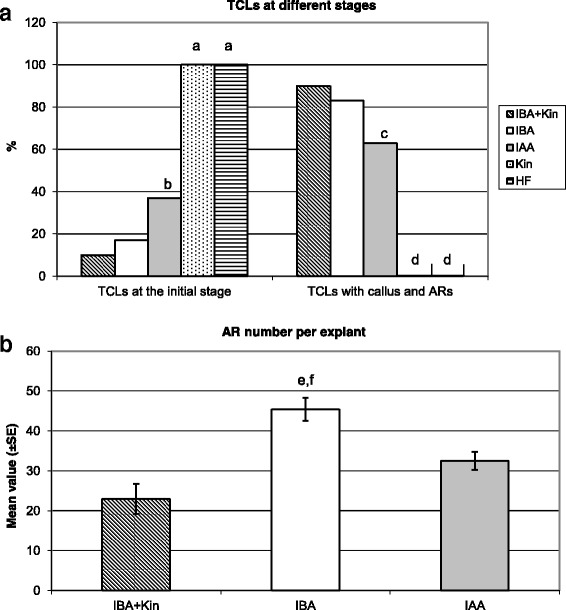
Indole-3-acetic acid (IAA), and its precursor indole-3-butyric acid (IBA), control adventitious root (AR) formation in planta. Adventitious roots are also crucial for propagation via cuttings. However, IBA role(s) is/are still far to be elucidated. In Arabidopsis thaliana stem cuttings, 10 μM IBA is more AR-inductive than 10 μM IAA, and, in thin cell layers (TCLs), IBA induces ARs when combined with 0.1 μM kinetin (Kin). It is unknown whether arabidopsis TCLs produce ARs under IBA alone (10 μM) or IAA alone (10 μM), and whether they contain endogenous IAA/IBA at culture onset, possibly interfering with the exogenous IBA/IAA input. Moreover, it is unknown whether an IBA-to-IAA conversion is active in TCLs, and positively affects AR formation, possibly through the activity of the nitric oxide (NO) deriving from the conversion process.
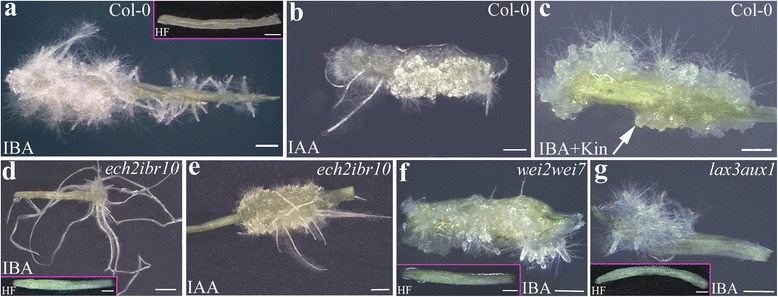
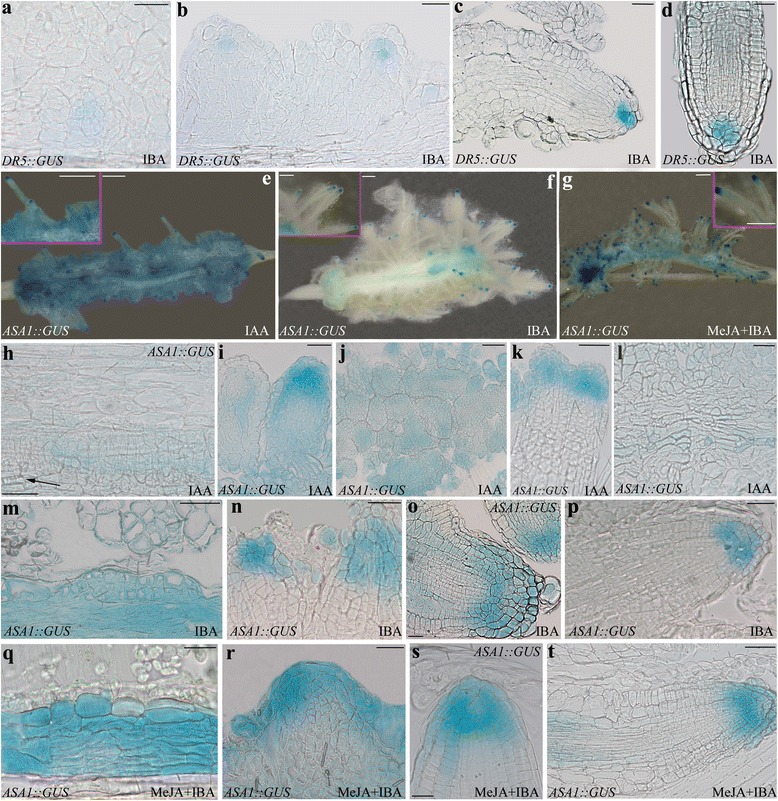
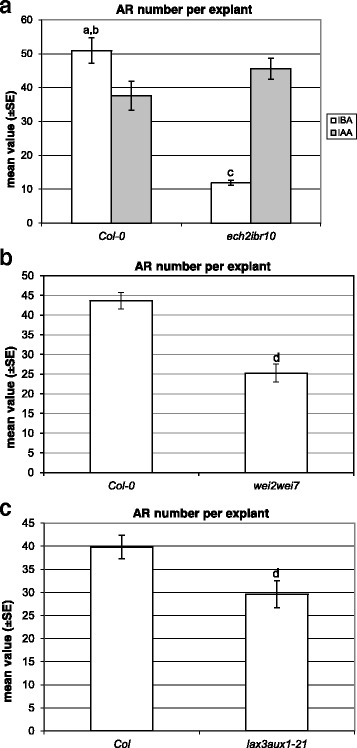
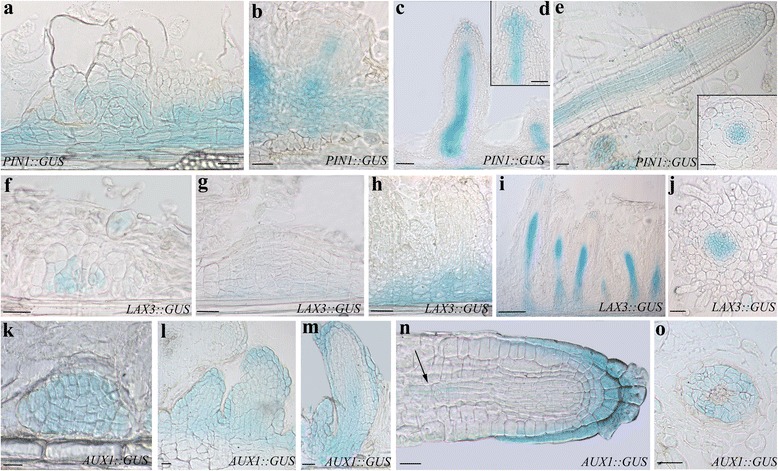
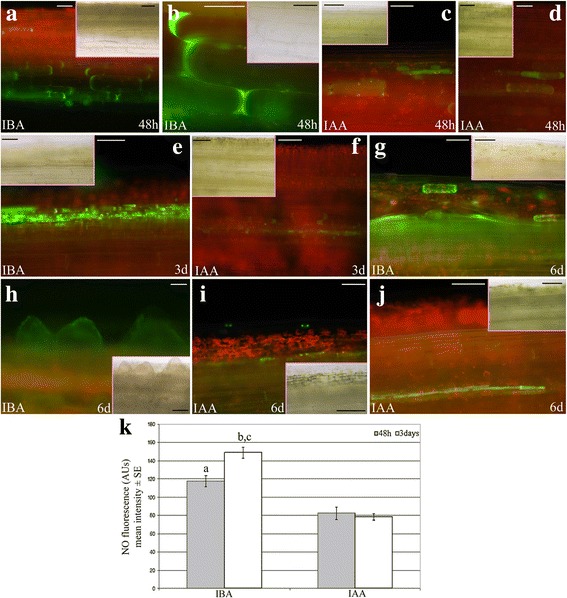
Revealed undetectable levels of both auxins at culture onset, showing that arabidopsis TCLs were optimal for investigating AR-formation under the total control of exogenous auxins. The AR-response of TCLs from various ecotypes, transgenic lines and knockout mutants was analyzed under different treatments. It was shown that ARs are better induced by IBA than IAA and IBA + Kin. IBA induced IAA-efflux (PIN1) and IAA-influx (AUX1/LAX3) genes, IAA-influx carriers activities, and expression of ANTHRANILATE SYNTHASE -alpha1 (ASA1), a gene involved in IAA-biosynthesis. ASA1 and ANTHRANILATE SYNTHASE -beta1 (ASB1), the other subunit of the same enzyme, positively affected AR-formation in the presence of exogenous IBA, because the AR-response in the TCLs of their mutant wei2wei7 was highly reduced. The AR-response of IBA-treated TCLs from ech2ibr10 mutant, blocked into IBA-to-IAA-conversion, was also strongly reduced. Nitric oxide, an IAA downstream signal and a by-product of IBA-to-IAA conversion, was early detected in IAA- and IBA-treated TCLs, but at higher levels in the latter explants.
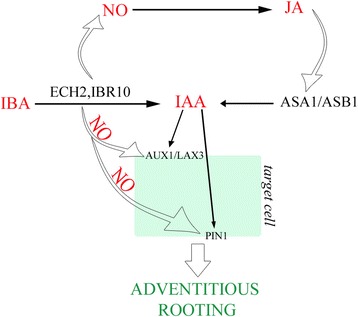
Altogether, results showed that IBA induced AR-formation by conversion into IAA involving NO activity, and by a positive action on IAA-transport and ASA1/ASB1-mediated IAA-biosynthesis. Results are important for applications aimed to overcome rooting recalcitrance in species of economic value, but mainly for helping to understand IBA involvement in the natural process of adventitious rooting.
吲哚 - 3 - 乙酸(IAA)及其前体吲哚 - 3 - 丁酸(IBA)在植物中控制不定根(AR)的形成。不定根对于通过扦插繁殖也至关重要。然而,IBA的作用仍有待深入阐明。在拟南芥茎插条中,10 μM IBA比10 μM IAA更能诱导不定根形成,并且在薄细胞层(TCL)中,IBA与0.1 μM激动素(Kin)结合时可诱导不定根形成。尚不清楚拟南芥TCL在单独使用10 μM IBA或10 μM IAA时是否能产生不定根,以及在培养开始时它们是否含有内源性IAA/IBA,这可能会干扰外源IBA/IAA的输入。此外,尚不清楚IBA向IAA的转化在TCL中是否活跃,以及是否通过转化过程中产生的一氧化氮(NO)的活性对不定根形成产生积极影响。
结果表明在培养开始时两种生长素的水平均检测不到,这表明拟南芥TCL对于在外源生长素的完全控制下研究不定根形成是最佳的。分析了来自不同生态型、转基因系和基因敲除突变体的TCL在不同处理下的不定根响应。结果表明,IBA比IAA和IBA + Kin更能诱导不定根形成。IBA诱导了IAA流出(PIN1)和IAA流入(AUX1/LAX3)基因、IAA流入载体活性以及参与IAA生物合成的邻氨基苯甲酸合酶 -α1(ASA1)的表达。ASA1和同一种酶的另一个亚基邻氨基苯甲酸合酶 -β1(ASB1)在存在外源IBA的情况下对不定根形成有积极影响,因为其突变体wei2wei7的TCL中的不定根响应显著降低。来自ech2ibr10突变体的IBA处理的TCL的不定根响应也显著降低,该突变体阻断了IBA向IAA的转化。一氧化氮是IAA的下游信号以及IBA向IAA转化的副产物,在IAA和IBA处理的TCL中早期即可检测到,但在后者外植体中的水平更高。
总之,结果表明IBA通过转化为IAA并涉及NO活性,以及对IAA转运和ASA1/ASB1介导的IAA生物合成的积极作用来诱导不定根形成。这些结果对于旨在克服具有经济价值物种生根难问题的应用具有重要意义,但主要有助于理解IBA在不定根形成自然过程中的作用。